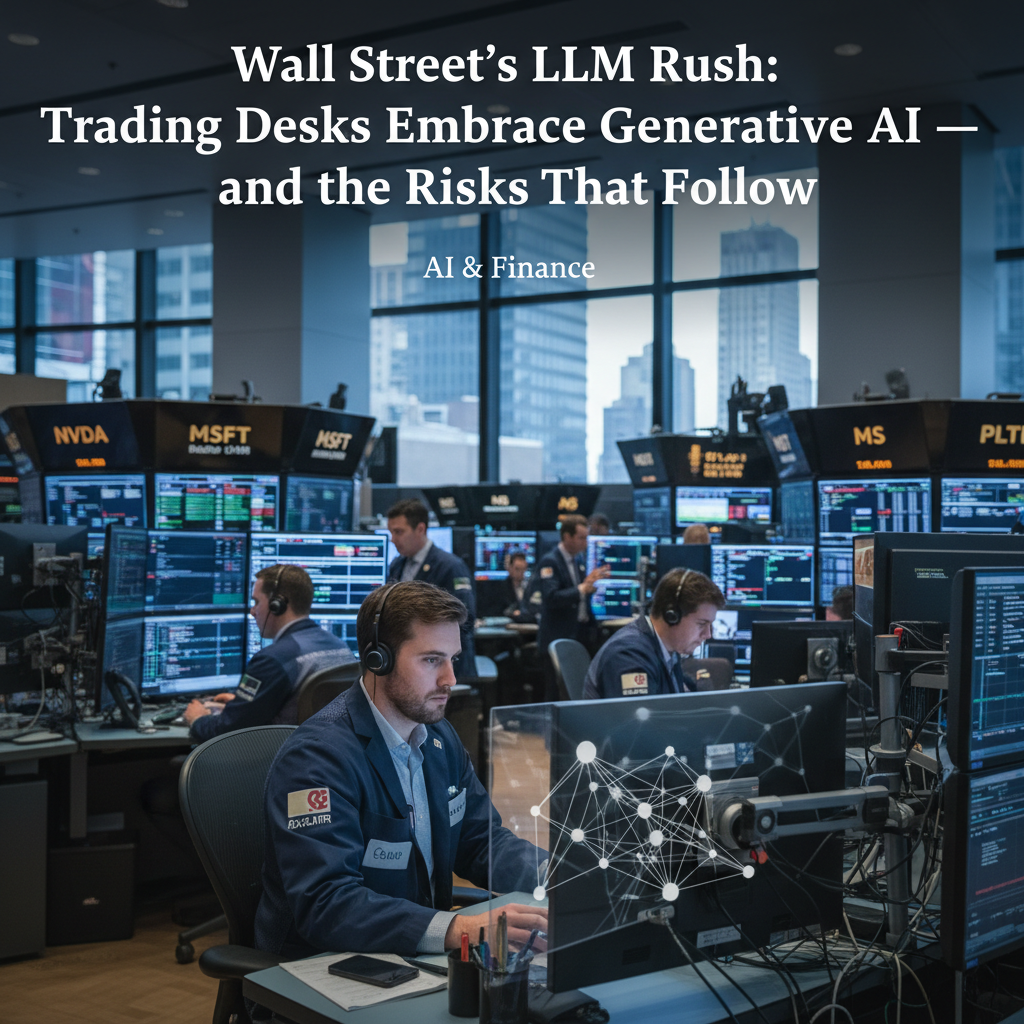
The pitch is simple: feed an LLM news, filings and market data, and get trade ideas, bite-sized risk explanations, or even execution scripts. Traders who remember the blunt toolkits of old quants see generative AI as the missing, human-like layer for pulling signal out of messy text.
A break with history — and a familiar pattern
Algorithmic trading has roots in the 1990s. Quants chased edge through faster execution and cleaner math ever since. What’s new now isn’t raw speed so much as texture. These models can read earnings calls, untangle legalese, and turn macro chatter into plain language. That promises a lot — and yet the memory of 2007–2009 drawdowns and the flash crashes that followed model blind spots is useful. Old mistakes can reappear in new clothes.
What firms are actually doing, in plain terms
- Using LLMs to synthesize research and spit out hypotheses that humans then vet. Think: idea generation, not autopilot.
- Translating strategy rules into algos and wiring them to execution venues through cloud stacks. Some of the heavy engineering work gets hidden, but it still exists.
- Watching newsflow with AI: conference transcripts, SEC filings, social posts — and flagging potential trades or risks in near real time.
This is not purely academic. Cloud vendors, GPU makers and a handful of fintech vendors are productizing toolkits so trading desks can experiment without building everything from scratch.
Real upside — and where it will probably show up
- Faster idea discovery. An analyst can cover many more names if an LLM triages and prioritizes signals.
- Better retail and wealth workflows. Robo-advisors augmented with text models can give more contextual, plain-language advice at scale.
- Less friction between a PM’s intent and a trading system. Natural-language interfaces can reduce the engineering back-and-forth that slows execution.
But the risks are not theoretical
- Model drift and data decay. These models are good storytellers; sometimes they invent causal narratives that sound plausible but are wrong.
- Explainability and audit gaps. Compliance and regulators want a traceable rationale for trades. Generative systems can blur the causal chain.
- Feedback loops. If many desks act on the same LLM signals, trades can reinforce themselves and move prices in unexpected ways.
A few concrete blind spots
- An LLM that overweighted earnings-sentiment signals could systematically misread industry jargon and trigger clustered trades that spike volatility in mid-cap stocks.
- A desk relying on synthesized sell-side notes might miss a sudden regime shift — say an unexpected Fed move — because the model’s training window didn’t include that new reality.
What this means for investors and policy
- Active investors should watch execution quality and concentration risk. If lots of desks buy the same AI-driven signal, dispersion narrows fast.
- Passive investors get more indirect exposure: the gains are likely to flow to the ecosystem — GPUs, cloud providers, data vendors — rather than to a neat, deployable alpha stream.
- Regulators will press for stronger model governance: version control, auditable decision logs and real-time monitoring are going to move from optional to required.
My take
Generative AI is not a magic box that will reliably print alpha. It is a potent amplifier: small informational edges can become tradable signals — and small misreads can become market shocks. The prudent approach is selective exposure. Favor infrastructure plays and firms that pair model outputs with human oversight, sound risk controls and rigorous backtests.
If you’re watching for opportunities, skip the flashy demos and ask two operational questions: who owns the data pipe, and who takes responsibility when a model-driven trade goes wrong? The answers will separate those who benefit sustainably from those riding the short-term hype.