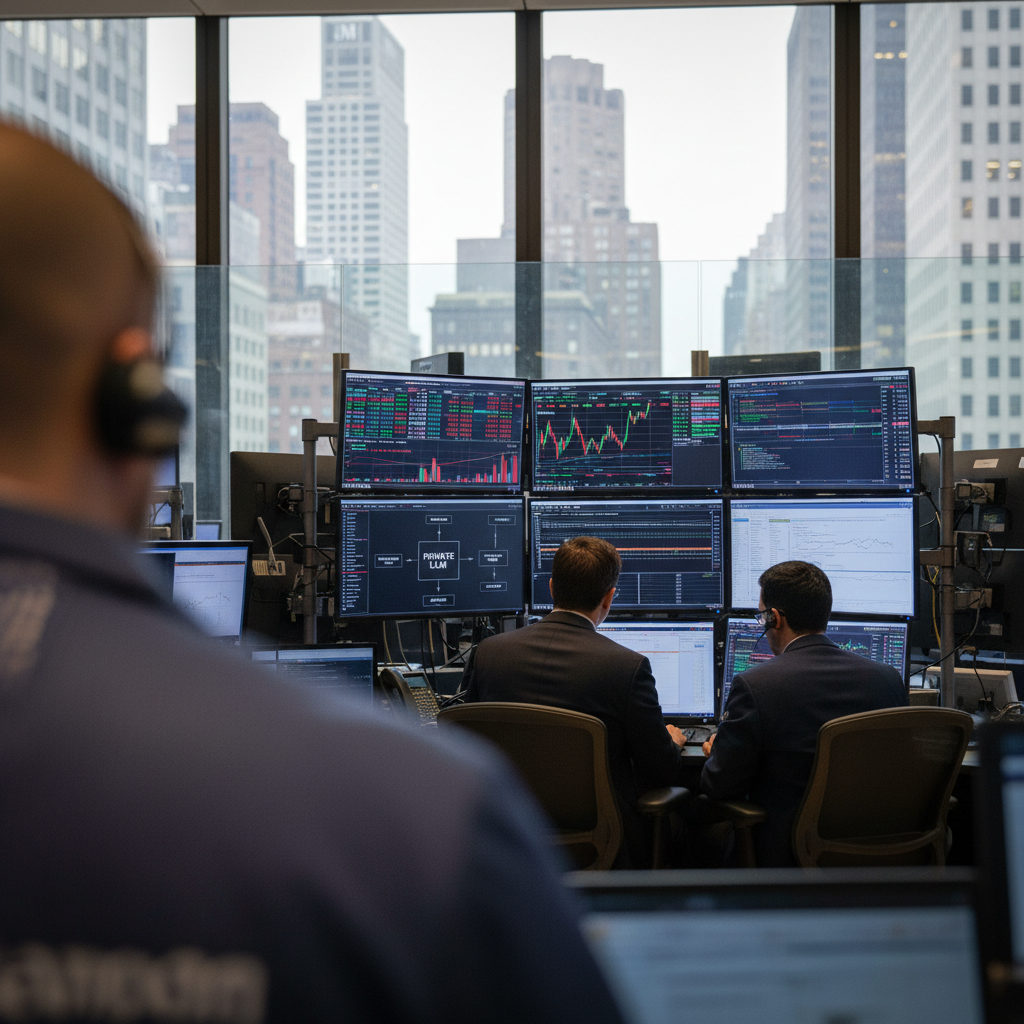
A quiet migration is underway on the trading floors.
For years, many financial firms handed the heavy lifting of generative AI to cloud vendors and boutique model shops. That era is ending. Increasingly, banks are building their own large language models to power trading research, client advice, risk oversight and compliance workflows.
This is not a fad. Three concrete incentives are driving the shift.
- Exclusive data advantage. Banks sit on decades of trade records, client exchanges and proprietary signals they are reluctant to share with outsiders. Owning the model keeps that edge internal.
- Regulatory clarity. Running models in-house simplifies questions about data lineage, explainability and audit trails — at least from the bank’s point of view.
- Latency and cost. For low-latency tasks, local inference and custom optimizations can outperform standard cloud endpoints in both speed and long-term expense.
Think of it as finance catching up to the quant revolution of the 1990s, but with neural nets instead of regression desks. The prize now is platform control as much as alpha. Institutions that once outsourced model work are increasingly aiming for full-stack ownership — model architecture, training pipelines, deployment and ongoing monitoring.
What this looks like in practice
Large banks are reportedly training variants of foundation models tuned for market use. Typical elements include:
- curated internal datasets and specialized pretraining,
- fine-tuning on research notes, filings and trade histories,
- aggressive guardrails to limit hallucination and leakage,
- dedicated inference clusters to shave milliseconds off responses.
The economics are real. Training a mid-size LLM at enterprise scale can run into the tens of millions in GPU time and engineering effort. That is expensive. But if a bank can monetize sharper trading signals, faster client responses and fewer compliance headaches, the return can justify the outlay. For some firms the math lines up; for others, not yet.
Who benefits — and who doesn’t
This shift ripples outward. GPU and infrastructure vendors stand to win from long-term contracts and steady inference spend. Cloud and model providers will still have customers, but the market may bifurcate: hosted services for smaller firms, and captive, bespoke platforms inside the biggest institutions.
Immediate implications for investors
- Chipmakers look like clear beneficiaries: demand for high-performance GPUs and accelerators should keep capex plans intact.
- Big cloud providers will still earn services revenue, though growth may split between standardized and custom offerings.
- Banks that hire ML engineering talent and embed models into revenue workflows will widen their moat; banks that fail to do so risk vendor lock-in and rising operating costs.
Counterpoints and risks
Building models in-house is far from a guaranteed win. Talent is scarce and costly. Maintenance, retraining and governance create ongoing expense. Regulators might treat proprietary models as material systems, which could invite heavier oversight and capital consequences. In short: it’s an arms race with real upkeep.
A human moment
Reporting this, what stood out was cultural change on the desks. Traders who once distrusted AI are now pushing for bespoke models — not to remove human judgment, but to keep it central. That tension between automation and oversight will shape which architectures actually work in practice.
Where this lands
Wall Street building its own LLMs feels like an inflection point. The predictable winners are in hardware and platform engineering; the harder choices fall to institutions deciding whether to build or buy. Watch two signals closely: capex commitments to AI infrastructure and hires that sit at the crossroads of software engineering and derivatives research.
Quick checklist for market watchers
- Track GPU vendor orders and cloud capex announcements.
- Watch hiring of ML engineers inside major banks.
- Monitor regulatory guidance on model governance and data residency.
If history is any guide, this won’t be a short sprint. Expect a multi-year contest where control of data and models matters as much as clever algorithms.