The quiet rearrangement
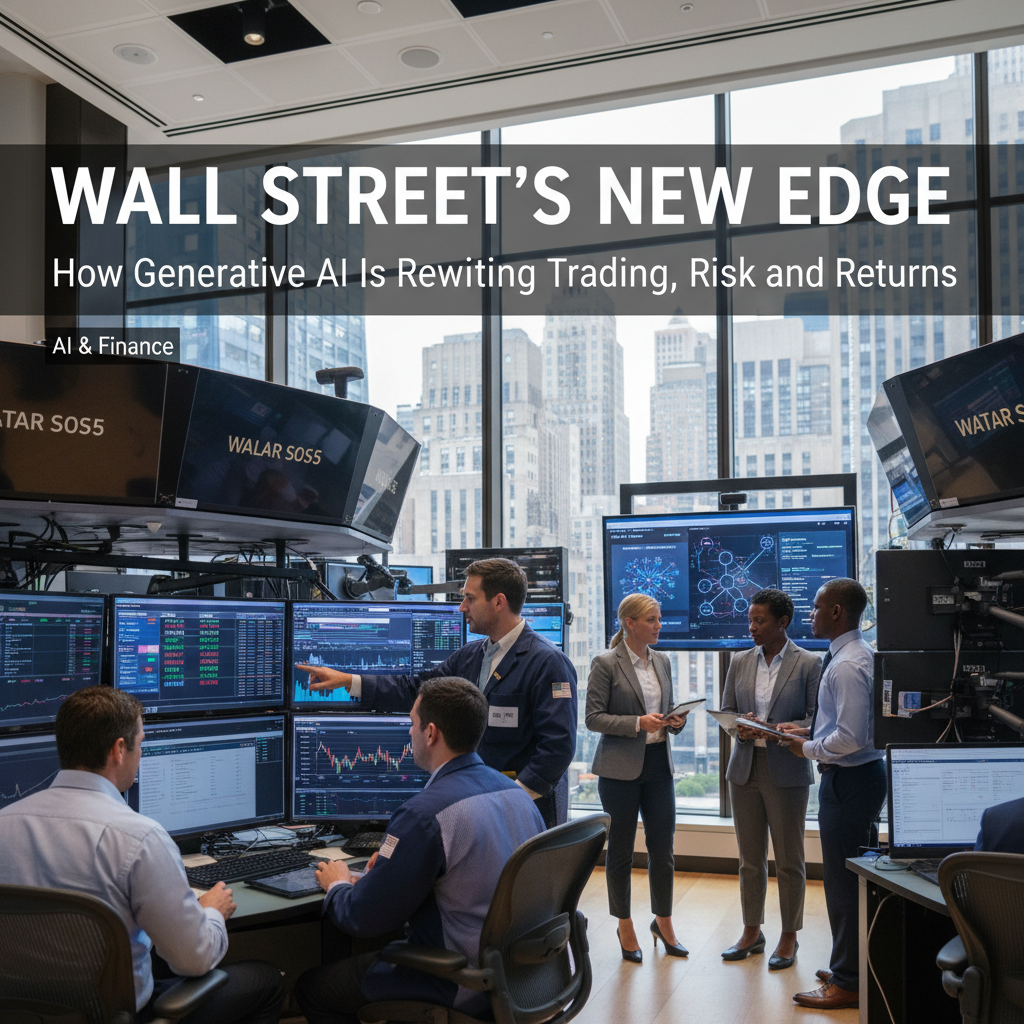
Generative AI has moved beyond product pilots and marketing decks. Over the last 18 months it has quietly crept onto trading floors, into credit desks and inside compliance operations. This is not one big inflection so much as a slow, systemic retooling — the kind that changes how profits get made and how risk is measured, often in ways that are obvious only after the fact.
Why it matters now
- Banks and asset managers are squeezed on margins and pressed to stand out. Large language models speed up research synthesis, surface trade ideas and automate parts of surveillance — sometimes producing useful results in seconds that used to take teams hours.
- The hardware and data plumbing that make these models work — GPUs, specialized chips, curated datasets and cloud stacks — are concentrated among a few suppliers. That concentration creates both capability and single points of failure.
Concrete examples (because this isn’t just hype)
- Front office assistants: Traders are experimenting with models that summarize earnings calls, flag odd market moves and spit out hypothesis-driven trade ideas. Faster, yes. Not always right.
- Credit and underwriting: Models can read dense contracts or fold in alternative data to speed decisions. They also reproduce the biases in their training data, which matters a lot in lending.
- Compliance and surveillance: Pattern recognition at scale helps surface suspicious activity sooner, but false positives and gaps in explainability create fresh operational headaches.
What’s interesting here is how messy the trade-offs are in practice. Speed and scale arrive with new failure modes.
A quick historical frame
Think of this as the next wave after algorithmic trading and the quant boom. The first wave automated execution and stripped latency. The next brought statistical learning and exotic data sources. Generative models layer probabilistic reasoning and natural-language understanding on top of those earlier advances, enabling workflows that previously required human synthesis.
Winners and dangers
- Likely winners are firms that combine proprietary data with disciplined model governance — some asset managers, plus cloud and chip providers that can scale securely.
- Real dangers: model overfitting, supplier concentration for chips and datasets, adversarial attacks on models, and regulatory pushback when AI-driven choices cannot be explained.
None of these risks is theoretical. Some are already material.
Regulation and governance will matter
Regulators are watching. Expect rules around model validation, data lineage and auditable decision trails. Firms that rush deployments without governance may face fines, reputational damage or worse: correlated failures if many institutions rely on similar models and make the same call at once.
Signals investors should follow
- Revenue cues: rising SaaS/cloud spend and clear AI projects mentioned on earnings calls.
- Concentration risk: chokepoints among suppliers of training chips, model infrastructure and curated datasets.
- Talent flows: where quants and ML engineers go is a good proxy for where real capability is consolidating.
The practical verdict
Generative AI will reshuffle advantages in finance, but it is not a magic profit engine on its own. The edge will go to organizations that treat AI as an operational capability — serious data stewardship, layered risk controls and a culture that balances skepticism with experimentation. Not glamorous, but effective.
This is a moment for cautious optimism. The tools are powerful, incentives are strong, and the mistakes will be instructive — provided the industry learns faster than it deploys.