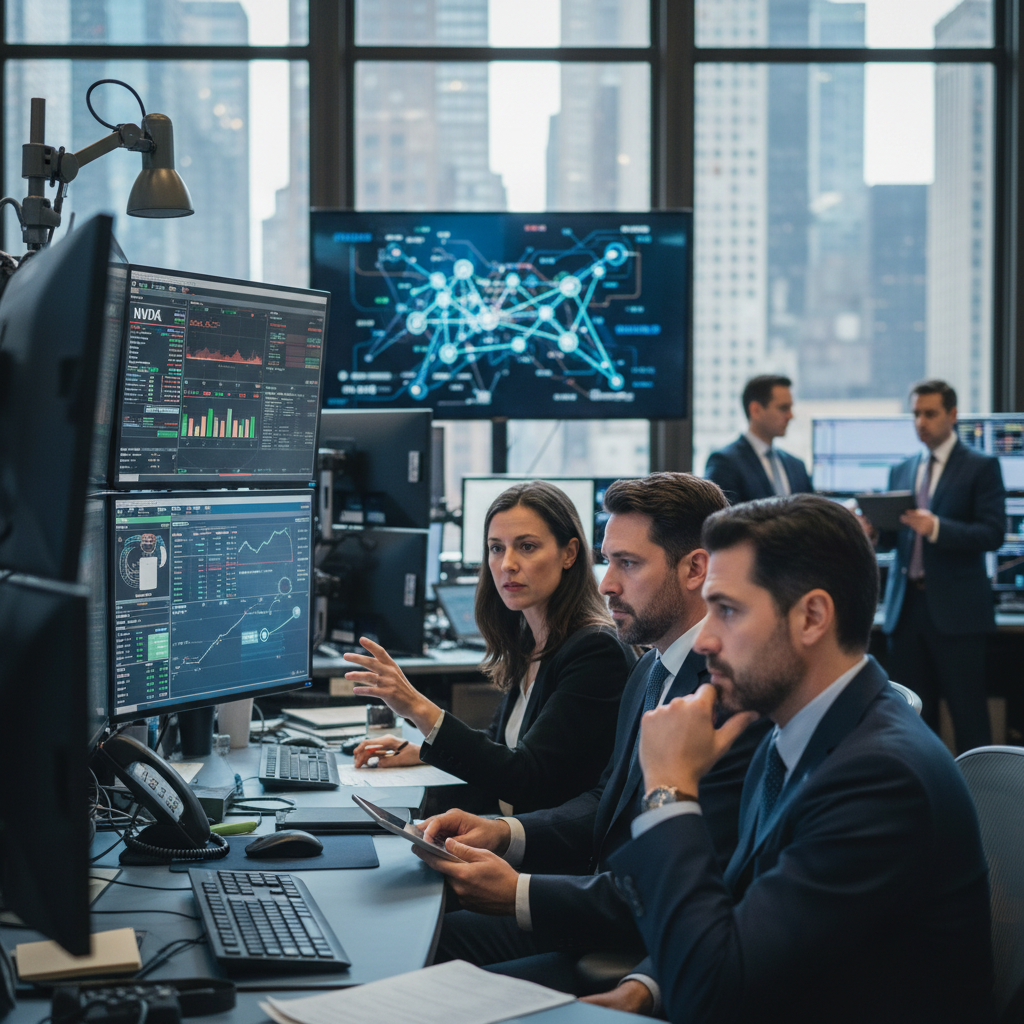
The new normal on trading floors is not a ticker-tape parade but a server rack and an engineer on call.
Asset managers and big banks have moved from pilots to full production use of large language models and other generative tools to do things humans used to do more slowly: price illiquid assets, tease out hidden correlations, and write the trading narratives that feed execution algorithms.
That looks like a straightforward efficiency story — and it is, up to a point. The risk isn’t a lone model making a silly mistake. It’s what happens when many desks rely on similarly trained, opaque models that all learn from the same market signals and then amplify each other.
Why this matters now
- Cheap, fast inference driven by GPUs and cloud AI services from vendors like Nvidia and Microsoft has put model outputs into the cadence of everyday trading decisions.
- Firms are building foundation models around proprietary datasets — transaction histories, alternative feeds, client behavior. That mix speeds repricing and surfaces new signals, but it also produces subtle model drift that’s easy to miss.
- Regulators are paying attention because opacity here isn’t hypothetical. When models start moving prices, feedback loops can be quick and self‑reinforcing.
A quick history lesson
Treat prior quant blowups as a rehearsal. The Flash Crash and various quant squeezes were caused by algorithmic strategies interacting in ways no one expected. Now picture models that summarize, predict and prescribe trades in near‑human prose. Machines not only reading the market but telling other machines what to do. Different tools, similar systemic hazards.
Concrete risks, with examples
- Concentration risk: If many firms fine‑tune on the same alternative data and run on the same cloud stacks, one bad signal can cascade.
- Explanation gap: Lenders and regulators need audit trails. An LLM that nudges a price but can’t provide a human‑meaningful justification leaves compliance teams exposed.
- Adversarial and data‑integrity attacks: Models trained on noisy or manipulated feeds can turn false narratives into real price moves.
Why firms keep pushing
- Real edge in illiquid markets: Models can uncover cross‑asset opportunities and price small pockets of risk that humans miss.
- Speed and cost: Automation narrows manual spreads, tightens bid‑ask, and scales expertise across products.
Regulators and risk teams — practical steps
- Require model inventories and provenance logs that record training data, inference versions and drift metrics. Not a box‑checking exercise; something you can actually audit.
- Mandate red‑team stress tests that include adversarial inputs and scenarios where many models behave in a correlated way.
- Enforce human‑in‑the‑loop gates for decisions above defined thresholds — and make the human role substantive, not just ceremonial.
What investors should watch
- Compute concentration: which cloud providers and GPU vendors dominate a fund’s stack.
- Filings and disclosures that call out AI, model governance, or third‑party model providers.
- Revenue lines explicitly tied to AI‑driven products — and whether those lines come with rigorous governance notes or just performance claims.
Portfolio implications — pragmatic moves
- If you want pure AI exposure, tilt to infrastructure winners, but be mindful that those same winners are a concentration risk.
- For balanced exposure, favor managers with documented model governance and visible human oversight over those with glossy performance stories and little disclosure.
Where this leads
Generative models will nudge market microstructure in small ways and occasionally in big ones. The efficiency gains are real. The smarter trade for investors is not simply backing AI winners but reading the governance signals. Firms that treat explainability and stress‑testing as afterthoughts raise systemic risk. Teams that bake governance into deployment are the ones likely to capture value without turning markets into a hall of mirrors.
Pedro Marini