Lede
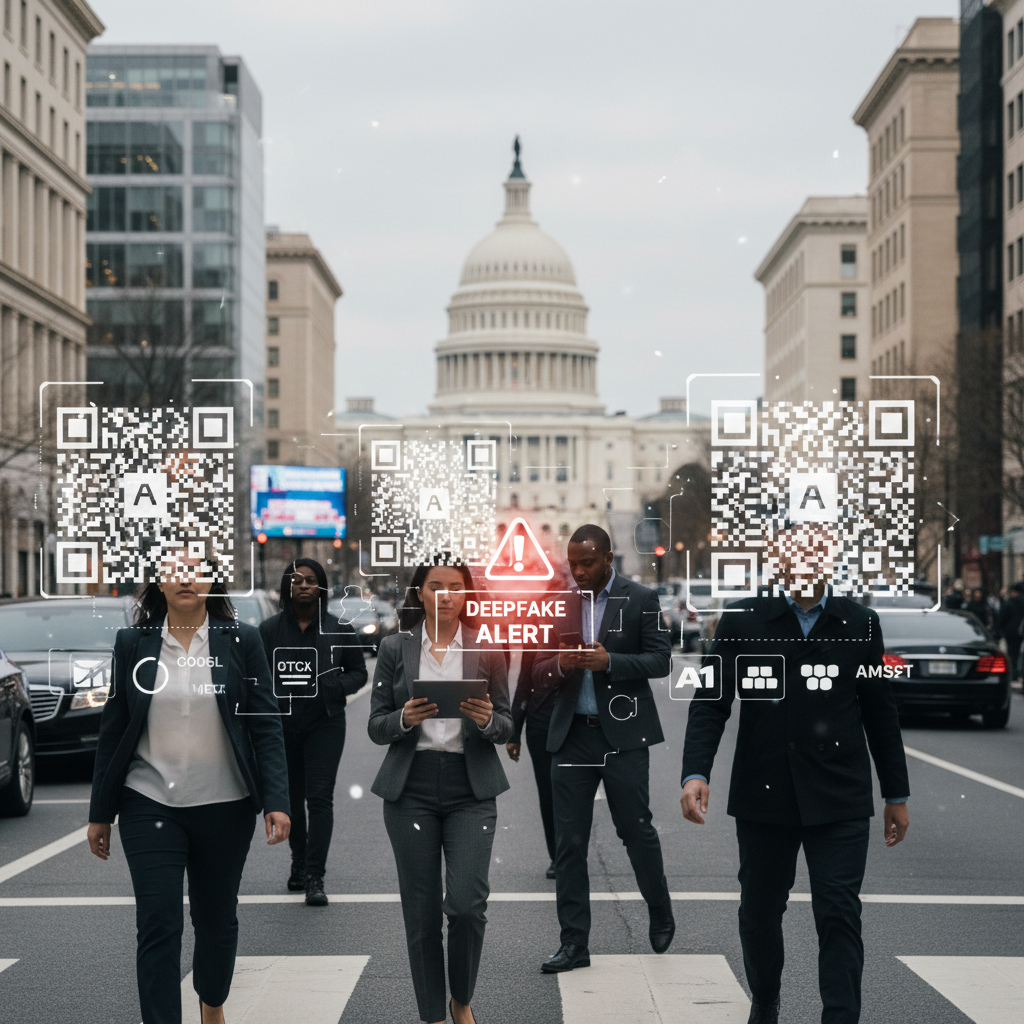
A rush of bills, agency memos, and regulatory signals coming out of Washington now share a single, blunt idea: force AI to disclose when it is speaking. Lawmakers are pushing mandatory watermarks and provenance records for text, images, audio and video produced by generative systems. The pitch is simple — make synthetic content identifiable to blunt deepfakes, election meddling and fraud. In practice, it will be messier than that.
Why this is happening now
This is not a thought experiment. Scams using cloned voices and fabricated videos have already produced real bank losses and ruined reputations. Regulators see an intuitively appealing fix: if machines tag their output, platforms and users can triage harm faster. For a worried public, it reads like putting nutrition labels on content that would otherwise be mysterious. But labels do not solve every problem.
What lawmakers are proposing
- Required visible or machine-readable watermarks on generative outputs.
- Centralized provenance registries logging which model, dataset and provider created each item.
- Civil penalties for deliberately hiding or misusing synthetic media.
These ideas are getting bipartisan attention because the harms cut across many domains — from election integrity to scams targeting the elderly.
Technical and practical frictions
The policy looks tidy on paper. Under the hood, it runs into several hard questions.
- It quickly becomes an arms race. Watermarks can be removed or scrambled through basic edits, and bad actors will adapt fast.
- Standards and interoperability are unresolved. Which watermark format do we mandate? Who decides a global protocol?
- Watermarks give a measure of control, but not certainty. Machine-readable provenance helps platforms with moderation, yet clever disinformation campaigns can still sidestep or fake traces.
Think of watermarking like a factory label: useful for inspectors, but worthless if the label is forged or the workshop moves out of sight.
Business and creator consequences
- Compliance will be costly. Platforms with deep pockets can build audit systems and absorb expenses; smaller rivals may struggle, which risks reinforcing incumbent advantages.
- Independent creators and open-source researchers could be caught in rules aimed at commercial providers, creating friction for legitimate projects.
- Newsrooms get a tool for vetting submissions, but the line between verification and suppression of remix culture will be fuzzy in practice.
There are trade-offs here that policy drafters often underplay.
Law, politics and international spillover
The EU’s AI Act has already framed risk-based regulation and is a reference point in D.C. But any U.S. approach must wrestle more directly with First Amendment concerns. Expect litigation over compelled speech, and if Congress stalls, a patchwork of state laws will follow. Cross-border coordination will matter; otherwise standards and enforcement will diverge in ways that create loopholes.
A quick risk trade-off sketch
- Public safety versus enforceability: watermarks help spot scams but are far from foolproof.
- Transparency versus privacy: provenance logs can reveal origins but might expose training inputs or user data.
- Uniformity versus innovation: strict rules protect consumers but can slow research and favor large vendors.
These are not hypothetical tensions — they will shape who benefits and who bears the costs.
What to watch next
- Draft bill text from key committees that specifies whether watermarks must be visible, machine-readable, or both.
- FTC priorities and whether penalties hinge on actual consumer harm or on intent to deceive.
- Standards work at NIST or a multi-stakeholder forum that could prevent dozens of incompatible systems.
Also keep an eye on industry playbooks: some firms are already offering voluntary provenance tools, which could influence regulation.
Where this gets us
Watermarking and provenance systems are sensible parts of an AI governance toolkit, but they are not a panacea. Policymakers need to pair technical mandates with investment in detection research, international cooperation, and safeguards for legitimate research and expression. Otherwise Washington risks creating rules that look like regulation but operate as protection for the biggest players.
Quick notes for investors and operators
- Demand will rise for content authentication, forensic tools and compliance services.
- Large cloud and AI vendors that can bake provenance into their stacks will gain an edge.
- Smaller startups should budget for compliance costs and potential certification hurdles.
Even if bills stall, the policy signal from D.C. matters: synthetic content will be expected to carry its origins, and the scramble to define what that means has only begun.