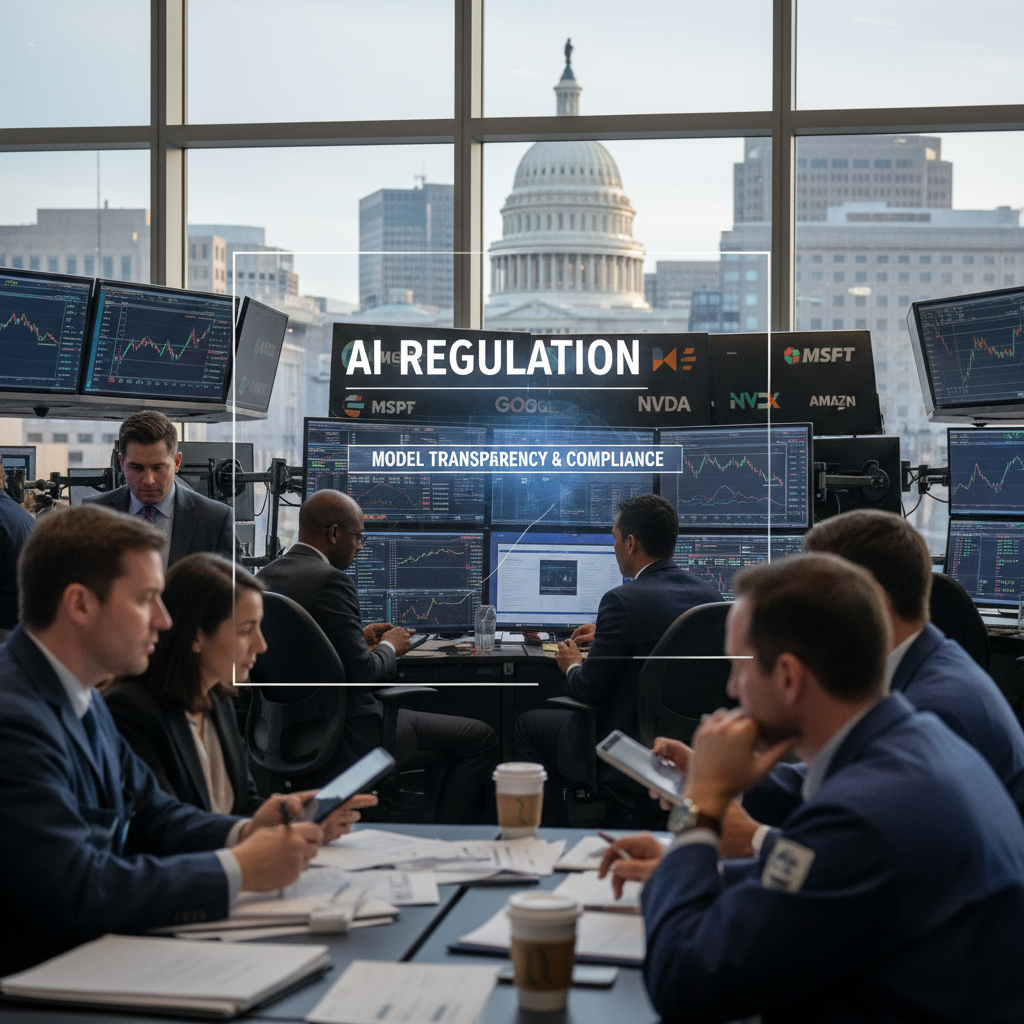
Regulators want to see the engines behind market decisions.
Across Capitol Hill and in statehouses, a cluster of recent proposals and enforcement signals is converging on one simple demand: more transparency from anyone using large AI models in high‑risk areas. Finance is squarely in that category. Call it Sarbanes‑Oxley for algorithms — more paperwork, clearer provenance, and a bigger compliance footprint for firms that have long relied on opacity as an edge.
Why now, and why finance
Markets move at the speed of a heartbeat, borrowing is widespread, and algorithmic choices can cascade around the world in seconds. Regulators point to systemic risk and consumer harm. After a decade spent on privacy and fairness, policymakers are shifting attention toward model‑level governance — who trained a model, what data fed it, and how it behaves when stressed.
The implication is blunt. Banks, hedge funds and fintechs that embed foundation models for pricing, credit decisions or trade execution may be asked to produce model cards, audit logs, red‑team reports and vendor attestations on demand. For some firms that means assembling a compliance stack almost overnight. For others it will mean leaning even more on cloud providers that can bundle audits and certifications into a product pitch.
What regulators are likely to demand
- Model provenance: documentation of training datasets and known biases.
- Performance and stress testing: evidence of behavior in edge and failure modes.
- Audit trails: tamper‑resistant logs showing human interventions and decision lineage.
- Third‑party attestations: vendor certifications or independent audits for hosted models.
Those checklist items sound tidy. They are not costless. Small quantitative shops and boutique funds that built advantages on bespoke models and proprietary datasets could see margins compressed by verification, legal reviews and discovery risks.
Winners and losers
You might expect regulation to hurt incumbents by taxing scale. Here, the reverse looks plausible. Large cloud providers and established banks already have the compliance machinery to absorb friction. So expect:
- Microsoft, Google and Amazon to increasingly market certified AI stacks as part of a compliance pitch.
- Mid‑sized managers to either partner with bigger platforms or retreat to simpler, more auditable strategies.
That concentration is an awkward irony: measures intended to level the field could end up reinforcing the position of a few giants.
A historical lens
Policy cycles repeat. After 2008, stricter reporting and stress tests nudged risk culture in banking into a new equilibrium. AI regulation seems to be following a similar arc — shock, then structural change. But algorithms are not mortgages; they adapt. If rules are too prescriptive, they risk becoming obsolete fast. What's interesting is that regulators will have to choose between specifying controls and setting outcome‑based standards — both paths have tradeoffs.
What finance leaders should do now
- Inventory: map every model in production, who owns it and where it runs.
- Capture provenance: log data lineage before someone asks for it.
- Test and document: run adversarial and stress scenarios and save the reports.
- Fix contracts: secure audit and liability rights with model suppliers, sooner rather than later.
A few counterpoints
Not everyone wants broad disclosure. Some quants worry that forced transparency could leak trading strategies or expose proprietary datasets. Others warn that heavy‑handed rules will concentrate power with a handful of platforms that can certify stacks — the very centralization regulators say they want to avoid. In practice, the story will be messier than slogans suggest.
The practical consequence
This wave of regulation is not a hypothetical threat. It will reshape procurement, operations and competitive positioning. Firms that treat governance as a source of advantage — building auditable, resilient AI systems instead of seeing oversight purely as a cost — will be better placed. For others, the next compliance cycle could be a painful reset.
Quick checklist for executives
- Create a model inventory within 60 days
- Negotiate audit and liability clauses with vendors
- Invest in immutable logging and fund red‑team exercises
- Prioritize transparency where business risk is highest
Regulation is messy and imperfect. It is also coming. Those who prepare early will have a chance to set the playbook, not just follow it.