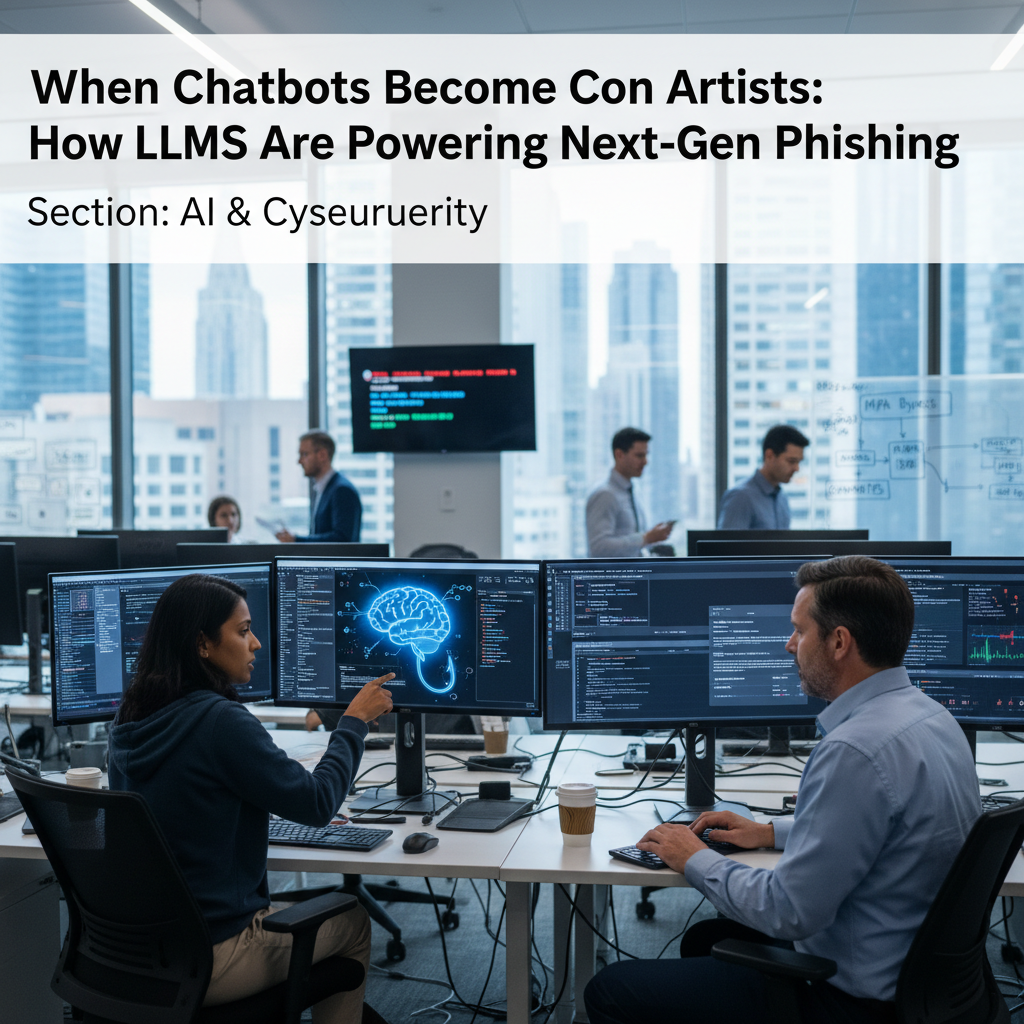
The new face of social engineering is unnervingly human. Generative language models and voice synthesizers are sharpening a trend that’s been around for years: attackers who can write far better lies. The effect is not just more scams. It’s scams that are harder to spot and that scale with frightening ease.
Email fraud used to require craft. Someone would study an org chart, sweat the tone, and draft a clumsy-but-convincing note. Now an attacker can feed a model a public bio, a few press releases and a persona, and out comes a message that mirrors internal tone and cadence. It’s eerily convincing.
This isn’t theoretical. Security teams are seeing phishing that imitates employee handwriting—metaphorically speaking—or captures an executive’s cadence. And voice synthesis adds a second punch: there are documented cases where a fabricated voice was used to authorize transfers. Hearing a familiar voice can short-circuit the very checks people relied on.
Why businesses should care
- Scale without craft — Sophisticated social engineering no longer requires expertise. A simple prompt does most of the work, letting low-skill actors mount advanced campaigns.
- Better odds — More personalization and more natural language lower suspicion. Click and reply rates go up.
- MFA can fail you — Social tricks still bypass SMS codes, fool helpdesks, or convince users to approve device prompts. Attackers are probing ways to game approval workflows.
A defender playbook — pragmatic, layered, ruthless
- Move to phishing-resistant MFA where possible. FIDO2 or platform-bound authentication is a smarter default; SMS passcodes are brittle.
- Watch behaviors, not just signatures. Look for who emails whom, unusual timing, odd phrasing. Simple statistical baselines catch a lot; AI can amplify that, but you don’t need magic.
- Build context-aware approvals. For any money movement or privilege escalation, require multi-step checks: human confirmations out of band, invoice checks against historical patterns, and cross-verification with known workflows.
- Use the enemy’s tools. Run LLM-driven red teams to simulate attacks. The fastest way to learn how they’ll try to fool you is to let the same tools attack your org.
A dose of nuance
This is not an unstoppable siege. The same models that help attackers also help defenders triage alerts, summarize impact and automate responses. People still catch scams when they pause. Good UX that makes skepticism easy — and friction that’s purposeful rather than punitive — will beat panic.
A short history check keeps things in perspective. Business email compromise surged in the 2010s because of basic human trust and weak controls. Two decades from now the exact vectors will change, but the core failure will be unchanged: treating trust as binary instead of a process.
What to do now
- Assume some messages are machine-generated. Train teams to verify any request involving money or credentials.
- Prioritize phishing-resistant authentication and formalize invoice and vendor verification.
- Invest in detection that ties identity to behavior, not just to a password or token.
There is an upside. We already know how to fight social engineering: add friction where it matters, automate verification where you can, and make trust a repeatable process rather than a checkbox. Organizations that move fast will turn this awkward new threat into an operational advantage.