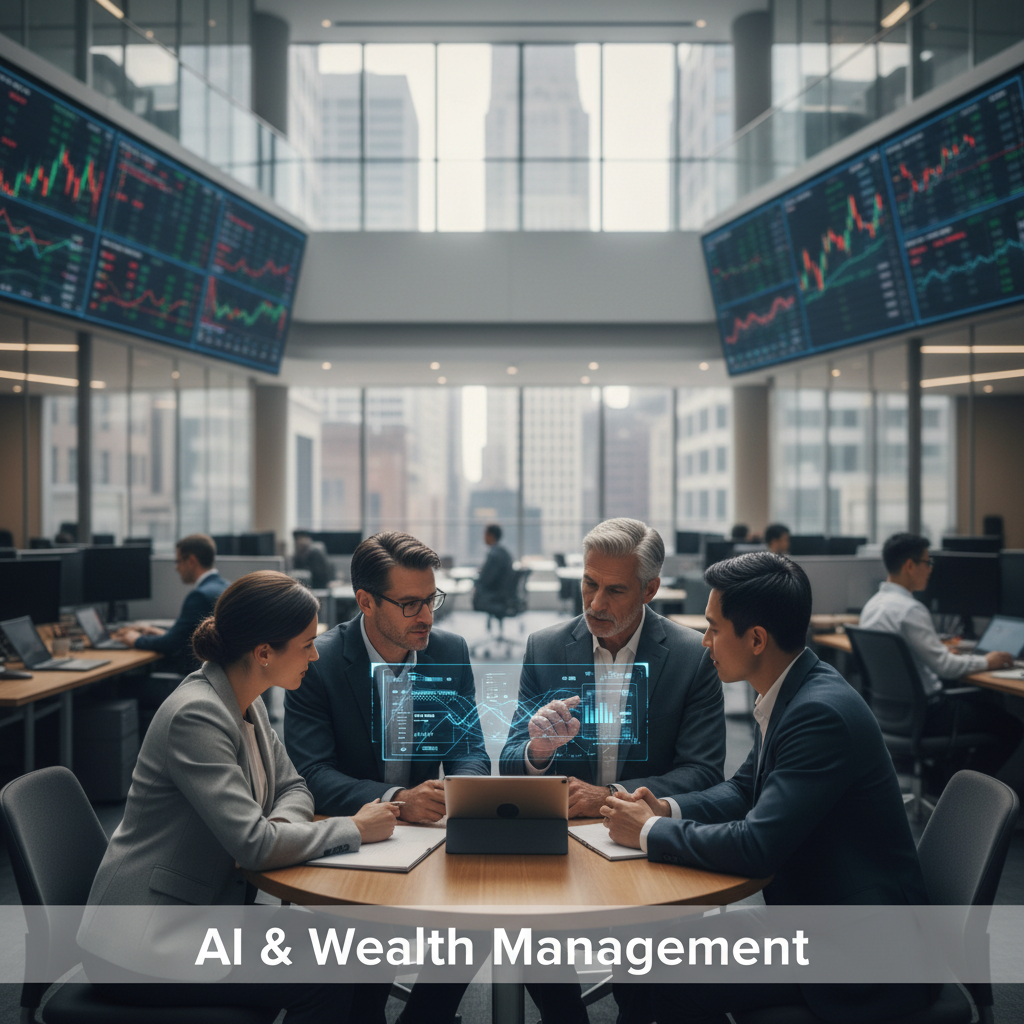
AI is no longer a back‑office trick; it’s becoming the client‑facing brain of wealth management. In the past 18 months the change has picked up pace: advisory firms and robo platforms are embedding large language models and advanced analytics directly into the client experience. The effect goes beyond faster rebalancing. We’re seeing narrative-driven portfolios, chat-style planning, and real‑time scenario runs that feel more like a conversation than a report.
Compare that to the spreadsheet era of the 1990s. Back then automation replaced pencil‑and‑paper grunt work. Today the shift is quieter and, in some ways, weirder: pieces of the adviser’s voice can be automated. That fact raises immediate questions about trust, liability and what wealthy clients will tolerate.
What’s actually new — and useful
- Personalized storytelling. Models can turn an allocation into plain‑language scenarios — income at 70, drawdown tolerance, tax‑aware withdrawal sequencing. Clients respond to stories; these tools let firms scale the narrative.
- Fast scenario checks. Monte Carlo runs and interpretation that used to take hours can now happen in seconds, so advisers can test trade‑offs in front of a client.
- Smarter onboarding and discovery. Automated interviews surface hidden preferences, family dynamics and nonfinancial goals that matter to high‑net‑worth households.
- Compliance and audit trails. AI can tag recommendations and produce explainable logs for compliance teams. That said, model explainability is still messy.
Where the friction sits
- Fiduciary duty and model risk. Advisers remain responsible for recommendations. If a model suggests a tax move or a concentration change and it’s wrong, who signs off? The industry is only starting to grapple with that.
- Data privacy. Wealth clients expect confidentiality. Feeding household data into third‑party models without airtight controls invites legal and reputational risk.
- The human premium. Affluent investors pay for relationships — empathy, judgment, discretion. AI can augment those qualities; it rarely replaces the instincts built over decades.
Real implications for firms and investors
Smaller RIAs can now punch above their weight, offering analysis and personalization that once required a big team. That shrinks some advantages for mid‑sized firms, but scale and proprietary data still matter — the sorts of private signals institutional players or diversified wealth managers hold in depth.
Public tech and finance firms will benefit indirectly. GPU and cloud providers are prime beneficiaries as firms train and host models. Brokerages that thoughtfully fold models into adviser workflows may defend margins by offering a hybrid product: human oversight plus machine speed.
A few counterpoints
- Not every client wants a chatty assistant. Many prefer simple tools and periodic human check‑ins.
- Herding risk. If advisers use similar prompts and constraints, portfolios could unintentionally become correlated.
What to watch next
- Regulatory guidance on using generative models for investment advice.
- New explainability tools that trace outputs back to data and assumptions.
- Pilot case studies that show real effects on P&L or client retention.
Think of the technology not as a single product but as an orchestration layer — a synthesizer for a symphony that still needs a conductor. Advisers who pair technical rigor with human judgment will have the advantage. Those who treat these systems as cost‑cutting black boxes risk losing client trust. Practically speaking: experiment, measure outcomes, keep strict guardrails, preserve human oversight and treat privacy like a nonnegotiable.