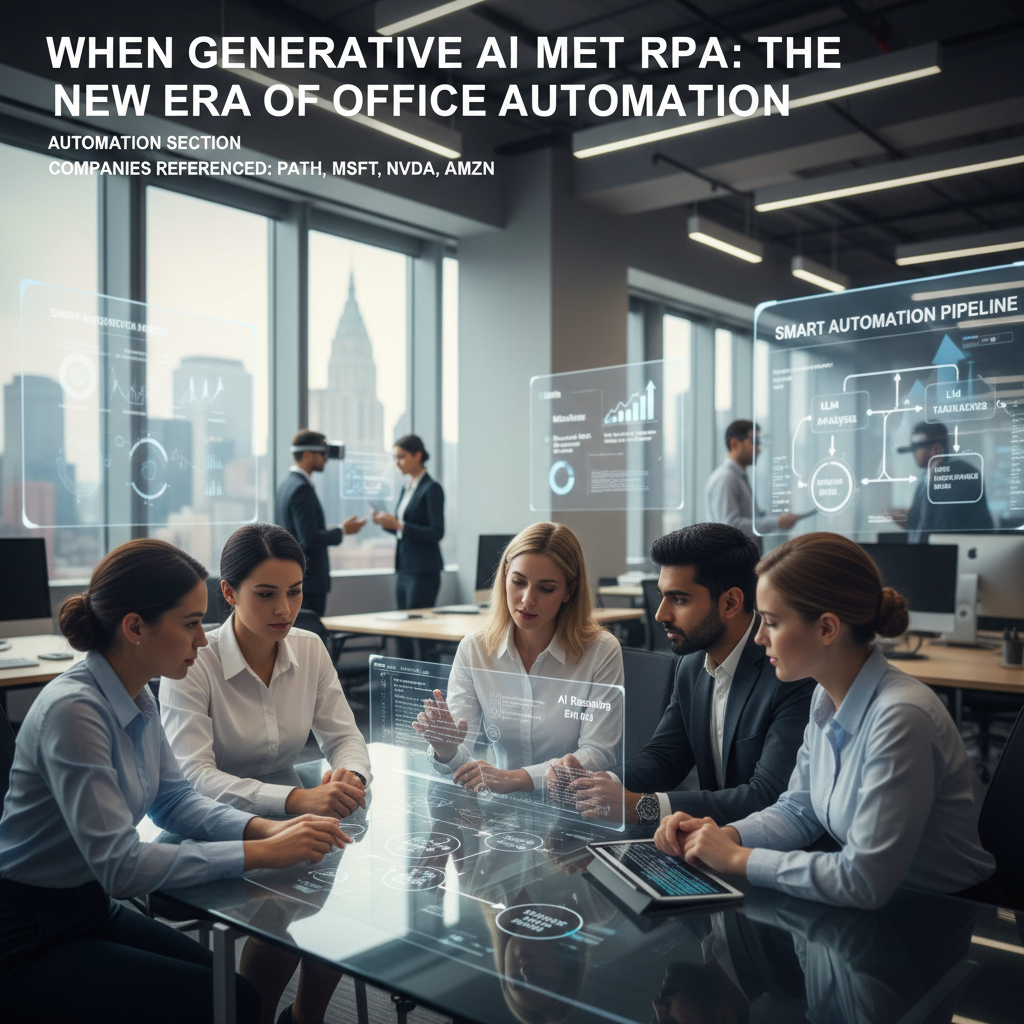
Generative AI did for RPA what electricity did for factories — it didn’t just speed things up, it changed what could be automated.
RPA started as a practical fix for tedious screen-scraping and rigid, rule-based workflows. For years its sell was simple: cut clicks, cut mistakes, shave hours off routine work. Those bots were predictable — deterministic scripts doing one thing well and nothing else.
Throw a large language model into the mix and the world shifts. Bots that once broke on any ambiguity can now read contracts, summarize exceptions, draft emails and flag unclear cases instead of crashing. The pattern is straightforward: RPA handles the plumbing; generative AI handles language and judgment. You see this combo popping up in banks, insurers, healthcare billing and finance back offices.
Why this matters now
- Firms have already paid to automate the simple stuff; generative AI raises the bar on what’s economical to automate. Tasks that needed human interpretation yesterday can be feasible targets today.
- Vendors are bundling LLMs into automation stacks. Expect deeper integrations from Microsoft Power Automate, UiPath and the cloud providers — and more industry-specific products, especially where regulation matters.
- For people the change is mixed. Repetitive steps will vanish, yes. But new jobs appear too: supervising automations, managing exceptions, writing and testing prompts.
Real implications — beyond buzz
- Compliance and hallucination risk. Language models can invent plausible answers. Human oversight, auditable logs and conservative fallback rules aren’t optional; they’re mandatory.
- The cost picture is different. Now you must account for inference fees and data protection, not just bot licenses. Sometimes the simplest RPA script still wins on cost.
- Talent and org design shift. The best hires are those who map processes, craft prompts and validate edge cases — not just traditional coders or legacy RPA builders.
One mid-size regional bank combined RPA scripts with an LLM to classify loan documents. Result: far less manual review and better capture of exceptions. It’s a neat example of augmentation, not replacement. The point being: automation is getting more surgical, not merely broader.
What executives and investors should watch
- Which vendors try to lock customers into proprietary LLM stacks versus those that let you choose models. Open stacks reduce lock-in but add integration work.
- Whether proofs of concept include governance, accuracy thresholds and rollback plans. A POC focused only on speed, without controls, is probably a sunk cost.
- Talent pipelines. Are operations teams being retrained to run AI-augmented workflows? Companies that invest here will see gains compound.
A quick investor lens
- UiPath illustrates an RPA incumbent shifting toward AI-first automation. Microsoft is aggressive with Power Automate and cloud AI. And then there are the infrastructure plays — NVIDIA, for one — which benefit as inference loads grow. Watch partnerships as much as product roadmaps.
A practical recommendation for leaders: treat generative-AI-enabled automation like a platform bet. Build repeatable guardrails. Start with the highest-friction processes. Measure cycle time, error rates and actual employee hours reclaimed. For those who expected bots to be pure cost-cutters, there’s a cultural surprise: automation is now part tool, part colleague — often both.
Pedro Marini