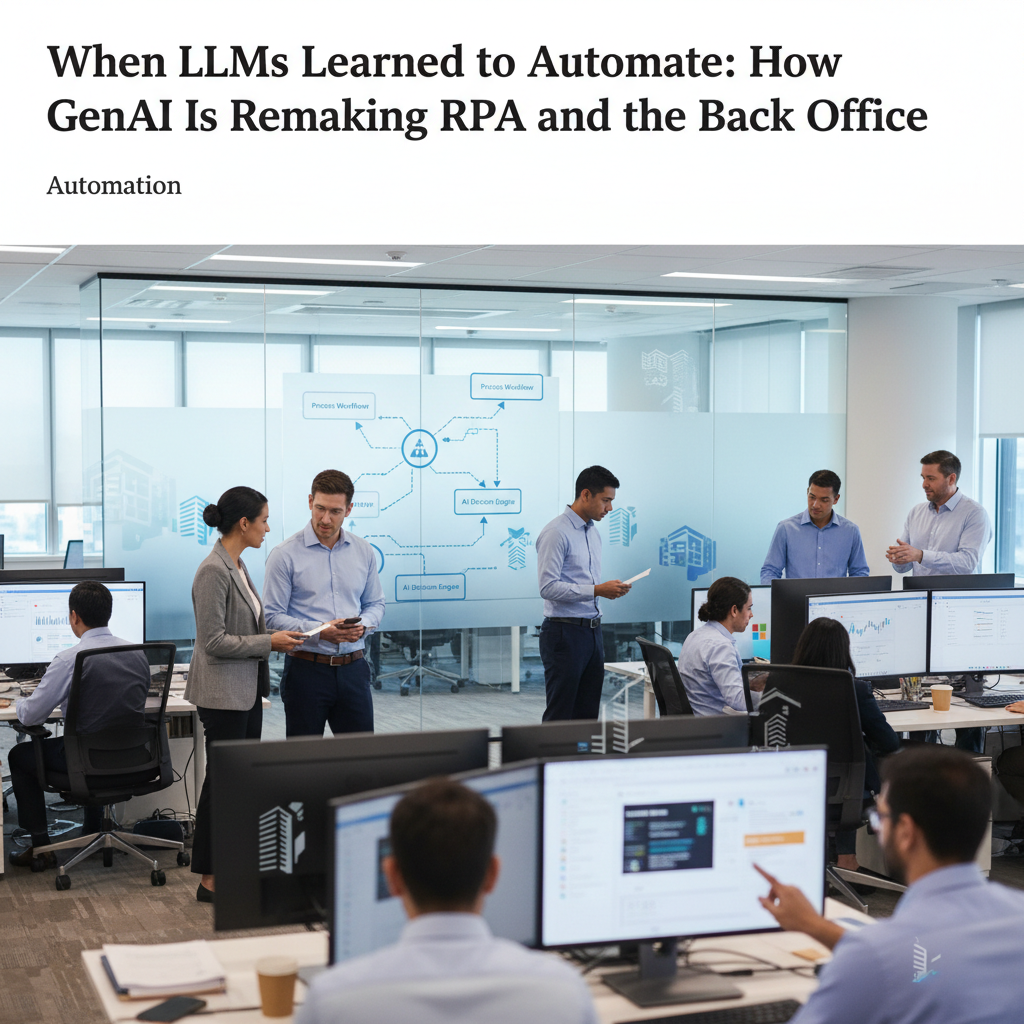
A quiet tectonic shift is under way in automation. For about a decade RPA lived as a toolbox of deterministic screen-scrapers and workflow choreographers that were excellent at repeatable, highly structured work. Now large language models are giving those bots a new muscle: they can interpret contracts, summarize messy email threads, and choose actions when the data isn't neat.
This is not mere incremental efficiency. It's a change in capability. RPA plus generative models can handle context, ambiguity, and language in ways older systems could not. That pushes automation beyond invoices and form fills into things like claims triage, compliance review, and even preliminary legal analysis.
Why this matters now
- Faster throughput and fewer human exceptions when models can extract meaning from unstructured documents. In practice, though, results depend on model quality and how you engineer prompts and pipelines.
- New outcomes: judgment calls, synthesis, and conversational handoffs instead of purely transactional work.
- A shift in labor: people who handled routine tasks move toward oversight, exception handling, and validating model outputs. That transition is nontrivial — it requires new skills and new incentives.
Real examples that matter
- Insurers are piloting systems that read claim narratives, flag likely fraud indicators, and assemble recommended payout packets for human sign-off. It sounds neat; the edge cases still need people.
- AP teams use LLMs to map vendor invoices to PO language, cutting match exceptions and speeding payments.
- Customer support blends RPA for context collection with generative models to draft responses agents edit, trimming average handle time while preserving quality.
Vendors and market signals
Legacy RPA vendors are wiring LLM hooks into orchestration tools, and hyperscalers are adding document-AI and model-hosting primitives. That lets enterprises stitch best-of-breed models into existing automation — if they can tolerate the integration complexity. Integration and ops work will be the bottleneck, not raw model capability.
The downside: hallucinations, drift, and governance gaps
Generative models are not deterministic. They confidently invent plausible-sounding outputs. Under pressure, they will do that. For finance and operations teams this creates concrete risks:
- Accuracy risk: an LLM might misclassify a contract clause and trigger a wrong automation decision — costly in regulated contexts.
- Data leakage: cloud-hosted models can expose sensitive business data unless prompts, logs, and access are tightly governed.
- Monitoring load: teams must build new metrics — semantic accuracy, hallucination rate, model drift — alongside the usual KPIs. That is extra work and it never stops.
Practical playbook for leaders
- Start small and measurable. Pick one high-volume, high-value process with clear exception paths.
- Keep humans in the loop at first. Treat model outputs as recommendations, not final actions.
- Instrument everything: prompt history, model version, confidence scores, and downstream outcomes.
- Build guardrails: red-team prompts, output validators, and strict access controls for sensitive data.
- Reskill people: move teams from transaction processing to oversight, prompt design, and model auditing.
- And a reminder: don't automate just to shave a few seconds. Automate where it meaningfully reduces risk or cost.
My take: this moment is less about replacing people and more about redefining expertise. Firms that treat generative models as components inside a controlled automation architecture will pick up speed and scale. Those that chase raw throughput without governance will inherit subtle operational and compliance risk.
The technology is arriving faster than many organizations can rewrite policies. That gap is where vendors, auditors, and automation leads will jockey for influence — and where CIOs must decide whether to sprint or steady the ship. Either way, the next big wave of productivity in finance and operations will be powered by generative models, but only as reliable as the governance that surrounds them.