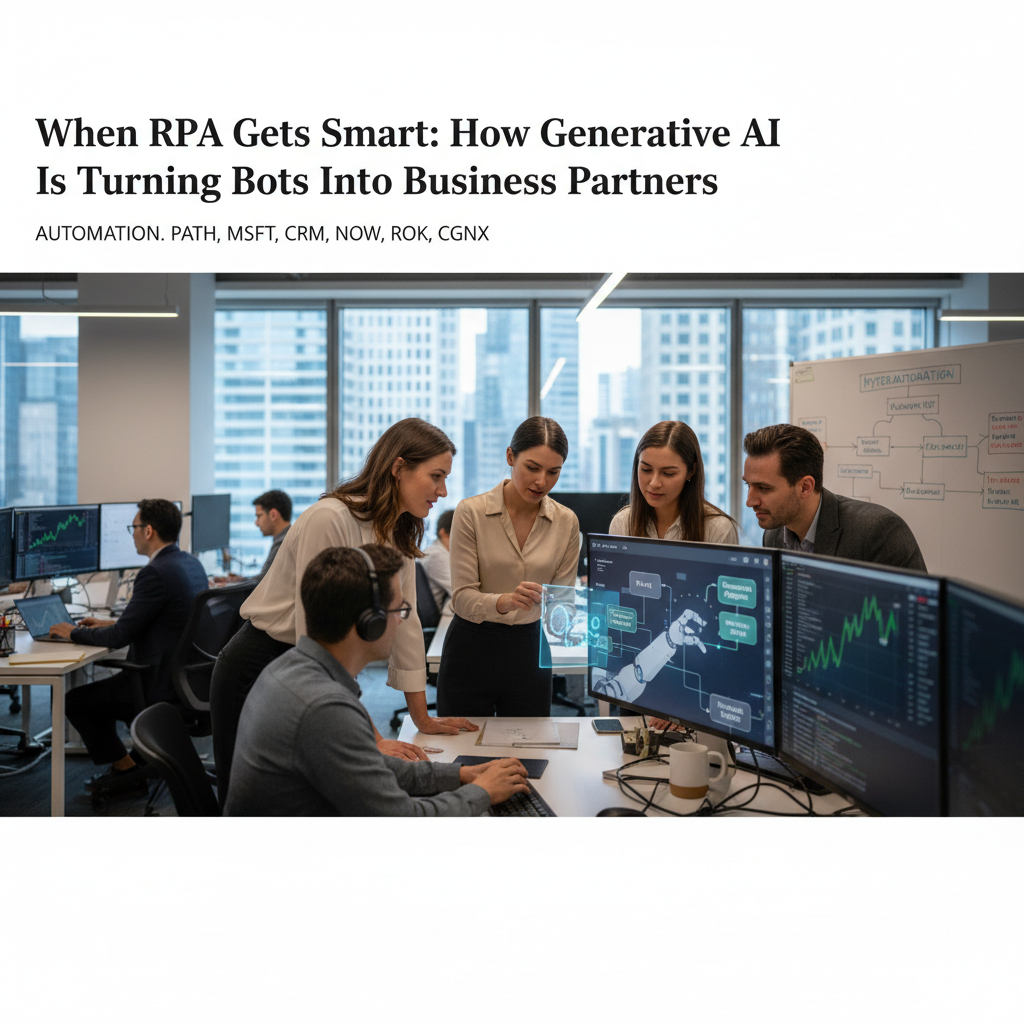
The headline is simple: RPA is getting a brain.
For about ten years robotic process automation promised clerical nirvana — fewer spreadsheets, fewer manual reconciliations, faster back-office throughput. Reality was different: brittle scripts, high maintenance bills, and scale that never quite arrived.
Now generative AI is being grafted onto those scripts. Vendors call the result hyperautomation: bots that can interpret messy invoices, draft exception emails, summarize regulatory text and even suggest process redesigns. It reads like incremental efficiency on the surface, but the consequences are structural. That shift matters more than it initially seems.
Why now
- Cheaper compute, widely available pre-trained models and workflow platforms ready to host AI components finally lower the bar. Tasks that were too irregular for classic RPA are now plausible targets.
- Platform plays are accelerating. UiPath and Microsoft Power Automate are pushing orchestration; ServiceNow and Salesforce are tying automation into CRM and IT workflows.
- Investors are watching. The winners will be the ones that lock in customers, sustain recurring revenue and prove real ROI.
A short history, with a twist
RPA's first wave automated highly repetitive, rule-based work. It often looked like screen-scraping dressed up for the enterprise. Adoption plateaued once rules multiplied and exceptions ballooned. Generative models address a key weakness: ambiguity. Where scripts broke as soon as data formats changed, GenAI can normalize inputs, infer intent and draft responses — approximating the graceful degradation human teams used to provide.
Real-world use cases worth noting
- Invoice processing: instead of ten people chasing problems, an AI-augmented pipeline reads invoices, flags anomalies and drafts resolution notes for a single reviewer.
- Customer support triage: bots summarize long threads and propose next steps, cutting handle time and lowering training overhead.
- Compliance monitoring: combining NLP with rule engines surfaces risky wording or suspicious patterns across large document sets.
Risks and counterpoints
- Hallucinations and auditability: models can invent plausible but false details. For regulated finance back offices, that is a real operational and compliance headache, not a footnote.
- Job mix, not job elimination: expect fewer repetitive clerical roles and more hybrid positions — auditors reviewing AI outputs, engineers building guardrails, data stewards cleaning inputs.
- Vendor consolidation: deeply integrated enterprises may favor big platforms (Microsoft, Salesforce) over niche RPA shops, which will squeeze margins and drive consolidation.
What to watch — signals that matter
- Product moves that tie GenAI into orchestration and monitoring. Platforms that can retrain models with enterprise data, log decisions and offer rollback have an edge.
- Customer case studies with hard ROI: time-to-resolution, FTE reduction and invoice-cycle compression that can be measured.
- M&A and partnerships: automation vendors acquiring ML teams or embedding more tightly with cloud providers.
Investor thinking
Winners will combine scale with sticky contracts and clear governance tools. Look for vendors showing usage-based revenue growth and low churn. Also be wary of hype: the first wave yields efficiency gains at the margin; broad labor disruption will be sector-specific and play out over years, not quarters.
The upshot
Generative models don't replace automation so much as free it from its brittle past. We're moving from fragile macros to systems that can reason about messy inputs. That will create platform winners, spawn hybrid jobs and test compliance frameworks. For CIOs and investors the sensible path is to pilot widely, measure rigorously and insist on auditability before scaling.
Quick checklist for executives
- Start with high-volume, exception-heavy processes.
- Demand explainability and human-in-the-loop safeguards.
- Measure time-to-value and downstream error rates, not just shaved FTEs.
This is not another shiny vendor promise. It is a pragmatic, incremental — and potentially far-reaching — upgrade to enterprise automation.