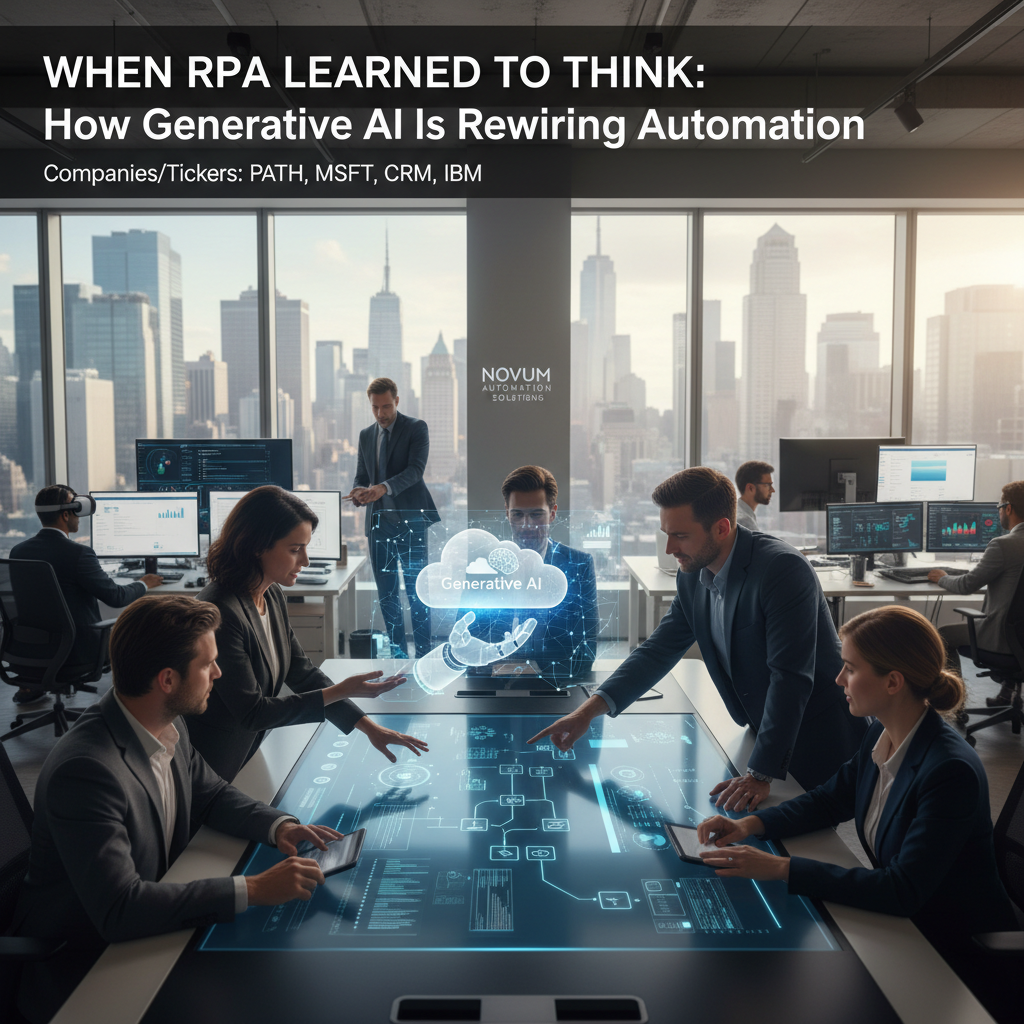
The moment automation stopped being dumb
For years robotic process automation meant rule-based scripts clicking through screens, pulling fields and routing forms. It worked because a lot of enterprise work is repetitive and predictable. Then things got messy—context, nuance, fuzzy language—and the robots fell apart.
Now large language models are giving those robots a sense of context. Tie an LLM to a workflow engine and an invoice bot can flag ambiguous line items, draft a supplier query, and escalate only the genuinely tricky cases. Not science fiction; it's quietly rolling into finance, HR and customer service teams right now.
Why this feels different
- These models bring probabilistic understanding instead of brittle if-then rules. So automations can handle edge cases rather than crashing out.
- Vendors are wrapping this in low-code tools, which means business people (not just engineers) can sketch decision-aware automations.
- The shift is less about wholesale replacement and more about redistributing cognitive work: people focus on strategy and judgment, bots take the monotonous middle.
What's interesting is how quickly exceptions move from being showstoppers to manageable outliers once the machine actually understands language.
A short history
Automation waves keep repeating a pattern: a new tool simplifies tasks, adoption scales it, and new work appears where the tool can't reach. Hand tools gave way to machines on factory floors; spreadsheets remade accounting and spawned analysts. Generative automation is the next layer — it consumes text and context that classic RPA and spreadsheets never could.
Real examples, not marketing fiction
- Accounts payable teams are building hybrid pipelines: OCR plus LLMs parse vendor notes and slash manual invoice triage by a wide margin.
- Customer service centers now triage with an LLM, routing only the complex queries to human specialists — handle time drops and first-contact resolution improves.
- Compliance groups layer generative checks over rule engines to surface plausible risks instead of only hard-coded violations.
These are practical deployments, not proofs of concept.
Trade-offs you should expect
- Accuracy versus explainability. Probabilistic models find patterns well but they don't naturally produce crisp audit trails unless you engineer for that. Important for regulated sectors.
- Drift and upkeep. Models that work today may degrade as language and documents change. Expect to borrow MLOps practices that many organizations haven't fully adopted.
- Job reshaping, not pure elimination. Clerical roles may shrink, but new jobs emerge: automation designers, exception managers, model governance leads.
None of this is free; it requires governance and ongoing investment.
Where vendors and investors are placing bets
Large enterprise players are embedding generative layers into orchestration platforms instead of shipping standalone chatbots. The likely winners will be those that can:
- Orchestrate workflows across many systems,
- Provide governance and auditability,
- Offer low-code tools that sit between business teams and IT.
Pay attention to companies that combine data scale, deep integrations and productized governance — they will have a clear competitive edge.
A short playbook for executives
- Start with high-frequency, low-risk processes: invoice triage, basic HR onboarding.
- Form a center of excellence with business analysts, RPA engineers and a model governance lead.
- Instrument automations for drift and feedback so models get retrained on real exceptions.
- Audit for bias, data leakage and regulatory exposure before wider rollouts.
Small bets, measured scaling.
A final, human note
Automation has always felt threatening until organizations learn how to speak its language. The twist now is that the language itself is probabilistic, messy and persuasive. That raises real risks — but also a rare upside: offloading routine cognition so people can focus on judgment and creativity. How leaders choose to apply these capabilities will shape who captures the efficiency gains, who protects customers, and who ends up fighting the legal battles over the next decade.