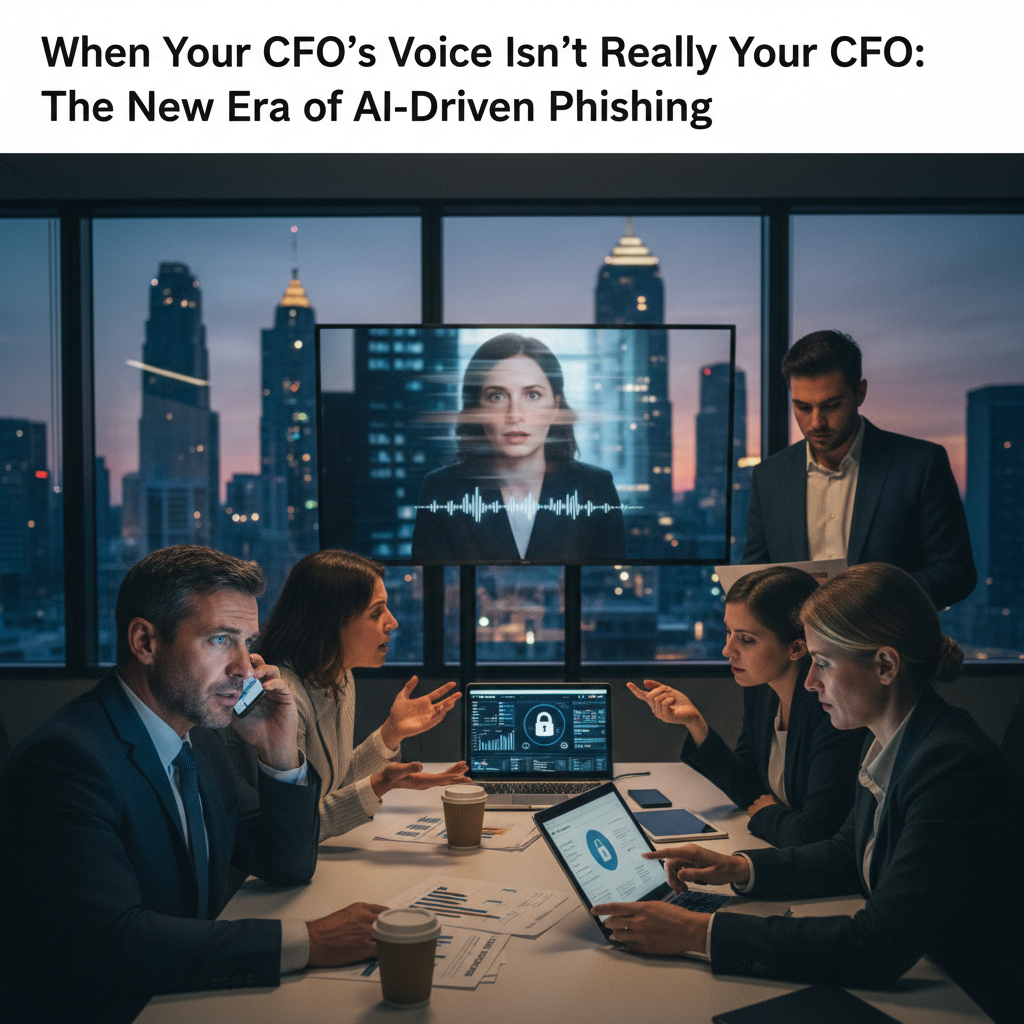
Here’s the ugly truth: audio and text deepfakes aren’t sci‑fi stunts anymore — they’re profitable attack tools. In the last year the security world has shifted from broad, low-effort phishing to highly targeted social engineering powered by generative models. The upshot: faster, smarter fraud that shows up in a CEO’s inbox or the CFO’s mobile voicemail.
This is not just a faster cat-and-mouse between new attacker toys and signature updates. It changes the economics and mechanics of authenticity. Where fraud once required insider knowledge, awkward voice snippets, or expensive audio editing, now a short sample — or an off-the-shelf voice model — can be stretched into a believable voicemail, paired with context-aware email copy, and used to press for an urgent wire.
Why this matters for finance and tech
- Banks and payment rails were built around identity and authorization models that assume human limits. Generative models break those assumptions.
- Cyber insurers are already narrowing coverage and tightening terms as exposure increases; premiums are rising, and social engineering exclusions are more common.
- Public firms suffer direct losses and second-order fallout: regulatory scrutiny, customer churn, and damaged investor sentiment when fraud becomes public.
Dynamics to watch
- Detection is strangely binary: easier today because of crude playback artifacts, harder tomorrow as generators improve. That means defenders get fleeting windows to act.
- Defense is shifting toward behavior signals: transaction context, odd timestamps, device and geolocation friction, and continuous authentication instead of one-off voice checks.
- Insurers will push mandatory controls. Expect requirements for multi-step approvals, call provenance or signed channels, and documented employee training to qualify for coverage.
What companies should do now
- Move high-value approvals off a single channel. Out-of-band confirmations — a texted code, a secondary app prompt — add real friction attackers struggle to fake at scale.
- Tie anomaly detection across systems. Look at behavior across accounts, endpoints, and networks rather than trusting message content alone.
- Try cryptographic call provenance or signed-voice channels where practical. These are early-stage, but they matter for the riskiest workflows.
- Harden verification protocols and run red-team drills that include AI-driven impersonations. Realistic exercises reveal gaps far faster than policy memos.
Investor takeaways
- Vendors that marry behavioral analytics with orchestration will find demand. Look for products that fuse endpoint, network, and identity telemetry.
- Insurers willing to price specialty cyber policies aggressively will see near-term revenue tailwinds, provided they can show disciplined underwriting and loss-control services.
- Legacy detection companies that depend on signatures face a painful product transition.
A skeptical counterpoint
Not every executive will be duped by a polished audio clip. Scepticism, strong internal processes, and an alert culture still blunt many attacks. The problem is complacency — trusting any single control. Layered defenses that assume authenticity can be cheaply faked are the smarter play.
Historical context and a short warning
Scams have followed where friction falls: forged letters, social-engineered calls, phishing emails — now synthetic voice and text. That pattern suggests this isn’t a one-off flare; it’s an inflection. Organizations and regulators that rethink authorization design, insurance incentives, and detection models sooner will save money and reputation later.
Actionable first steps for C-suite leaders
- Require dual-channel confirmation for transfers above a configurable threshold.
- Audit cyber-insurance for social-engineering exclusions and update controls to retain coverage.
- Run an AI-impersonation tabletop this quarter.
Generative models made impersonation cheap. The sensible response is to make trust harder to fake.