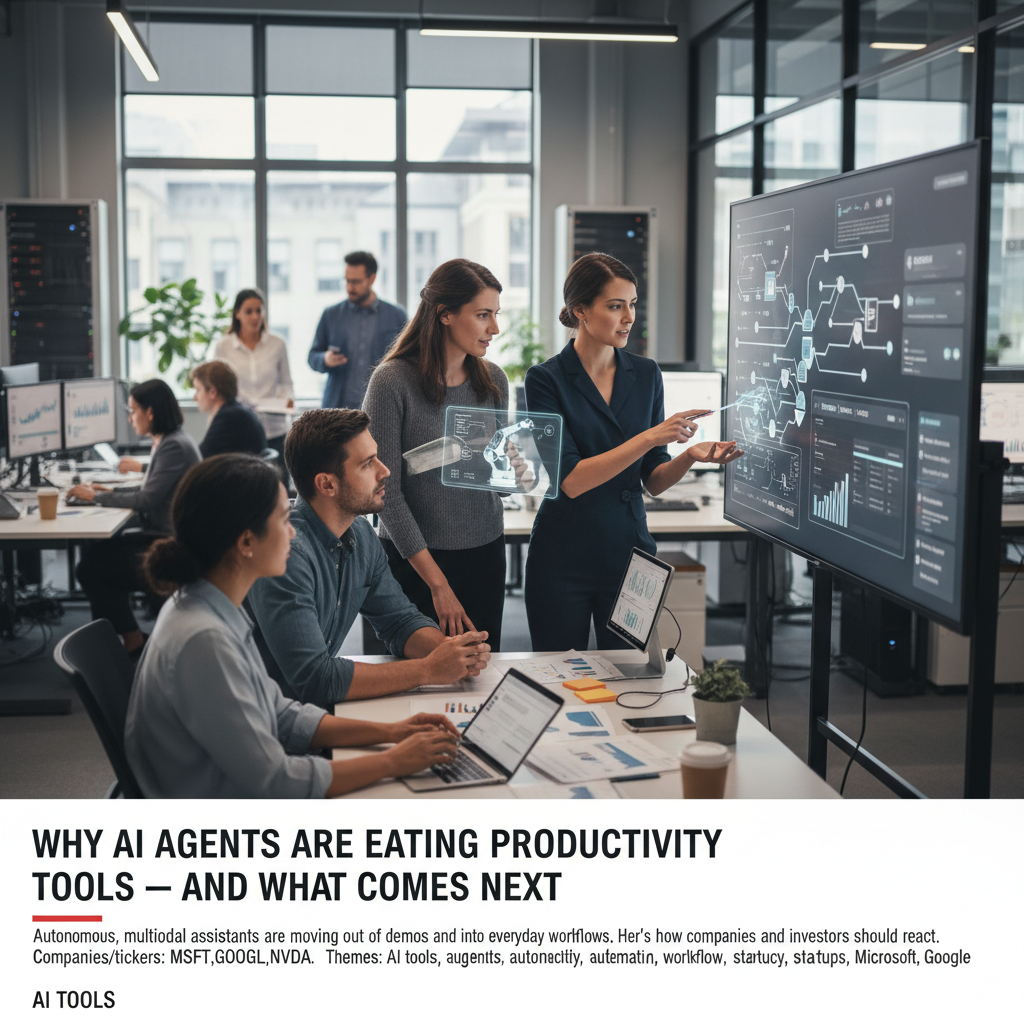
A few weeks ago I handed a junior analyst an experimental AI agent to run an outreach campaign. It drafted messages, prioritized leads, booked calendar slots and flagged risky language — all without any prompting after the initial brief. It saved hours and felt almost magical. It also left a small mess: hallucinated contact details, awkward privacy questions and a few embarrassed follow-ups. That tension — astonishing efficiency paired with brittle trust — is starting to define everyday reality.
This is not just another chatbot update. We are seeing a move toward autonomous, multimodal agents: systems that reason over documents, calendars, email and web content and then take multi-step actions on our behalf. They combine model reasoning, API calls, browser automation and pre-built connectors to move a task from intention to completion. In plain terms: they don’t just answer; they act.
Why this matters
- They compress tool stacks. Instead of toggling between a dozen apps, an agent can coordinate them. That changes what CRMs, project-management suites and low-code platforms have to sell.
- They rewire workflows. Work that used to wait for human attention — scheduling, first-pass research, outreach personalization — can now be run at scale.
- They create a new product layer. Expect vendors to offer vertical agents: a recruiting agent, a churn-prevention agent, a personal-finance assistant. Niche, usable, and often profitable sooner than a generic LLM toy.
Concrete examples
- Big platform players are folding agent-like features into enterprise copilots to automate multi-step processes across Office suites and cloud services. The effect isn’t mass job loss overnight; it’s a change in which tasks are prized.
- Open-source agent frameworks and community workflows let small teams prototype agents that scrape a page, summarize it, update a CRM and schedule a follow-up. That used to require a developer; now a technically savvy analyst can pull it off.
Economic and market stakes
- For incumbents, agents are double-edged. Embedding them raises stickiness and ARPU, but the same agent layer can abstract away individual apps, turning them into interchangeable components.
- For startups, vertical agents are a faster path to revenue than another generic LLM app. Solve a clear pain point, hook into an existing workflow, and you can monetize before you ever become a platform.
Risks and limits
- Hallucinations scale with action. A single incorrect API call can create financial, legal or privacy harm. Instrumentation, verification and human-in-the-loop gates aren’t optional — they’re table stakes.
- Governance and liability move from theoretical to operational. Who signs off when an agent emails customers or executes a trade? Organizations and regulators will have to get specific.
- UX matters. Agents that over-automate irritate users; those that under-automate waste time. Finding the adjustable-autonomy sweet spot is part science, part judgment.
A quick historical lens
Think back to the spreadsheet in the early 1980s. It automated bookkeeping and spawned new job categories. Agents will do something similar for knowledge work: routine orchestration gets automated, and value drifts toward judgment, relationships and strategy. That’s where people will matter more.
What leaders should do
- Inventory: map repetitive, multi-step workflows that now need human orchestration.
- Pilot: launch narrow agents with clear success metrics and rollback controls.
- Guardrails: require verification for any agent that can take irreversible actions.
- Upskill: teach employees to supervise agents, audit outputs and provide the judgment machines lack.
For workers
Learn to pose problems for agents, audit their work and add the human judgment machines can’t. People who master orchestration — the glue, the audits, the context — will be in demand.
Final thought
Autonomous agents aren’t some far-off assistant; they’re practical efficiency layers that will rewire workflows, vendor economics and job tasks. They can deliver large productivity gains, but they also demand new governance, transparency and humane design. Treat them like powerful tools: they can build or break a business depending on who holds the manual.