The shorthand has changed — copilots, not assistants.
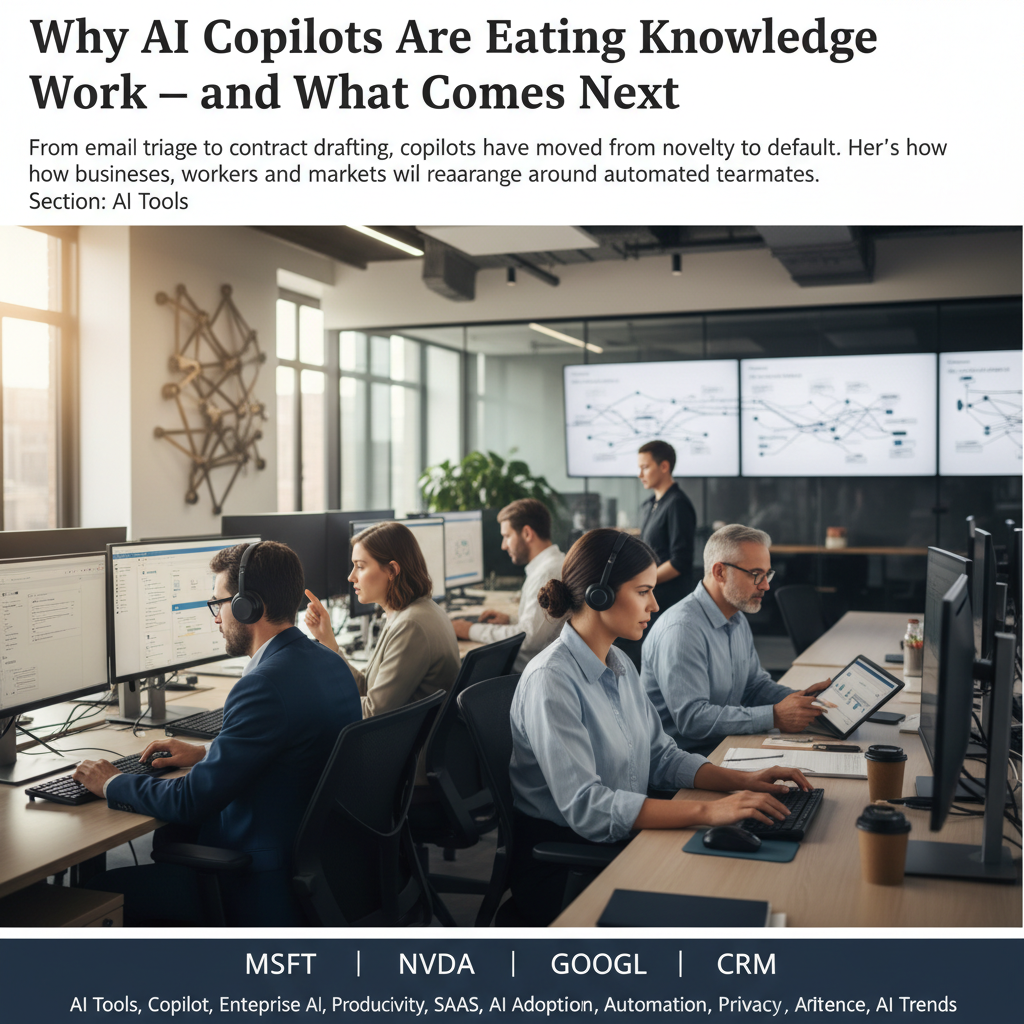
In the last two years the promise of AI moved from neat chatbots to copilots that live inside the tools people already use. That shift matters because attention is the business being fought over, and copilots insert themselves where work actually happens — calendars, inboxes, CRM screens, document editors. They sit in the middle of the flow, not on the periphery.
What’s new is less a single breakthrough than a pattern: verticalized models plus deep app integrations. Big vendors are bundling the model, domain tuning, and workflow hooks so the AI can suggest and act — summarize an M&A memo, draft a cold outreach, produce a first-pass clinical note. Together those pieces do more than any generic chat window ever could.
Why this changes things for American businesses
- Faster loops. Tasks that once ate an hour can become an interactive ten-minute cycle: prompt, tweak, finalize. That compresses transaction costs across knowledge work in a way spreadsheets never did alone.
- Pricing pressure. SaaS vendors are rethinking per-seat licenses and testing usage-based or outcome-linked pricing; buyers will increasingly demand measurable ROI rather than novelty.
- Talent arbitrage. Template-driven roles will shrink. Firms will redeploy people to work that really needs judgment, negotiation and institutional memory.
A few concrete examples
- Sales teams embed copilots to draft outreach from CRM history and buyer signals; reps edit and send, shaving hours off weekly work.
- Law firms run copilots for first-draft briefs and citation cross-checks; attorneys still sign off, but prep time falls dramatically.
- Healthcare pilots use copilots to turn visit summaries into H&P notes; clinicians grumble about hallucinations but value the documentation time saved.
The pushback, and real limits
Copilots are not magic. Hallucinations remain a business risk when models invent facts or misstate precedent. Data leakage and compliance are serious: once a model is embedded in a workflow, sensitive inputs travel farther and faster through vendor systems. Expect regulators and legal teams to insist on clear audit trails and provenance for AI outputs.
There’s also a human reaction curve. After an initial productivity bump some teams reintroduce manual checks, or managers begin to expect too much and blame the copilot when things go wrong. It’s familiar — think of the early spreadsheet era, when automation amplified both productivity and mistakes.
Watch for these signals
- More vertical copilots. Finance, legal, healthcare and manufacturing will see tailored copilots; generalist tools lose value unless they tap niche data.
- Pricing experiments. Look for subscription-plus-usage hybrids and outcome-based models tied to time saved or revenue influenced.
- On-prem and hybrid options. Companies with compliance needs will push for local models or private-cloud deployments with logging and controls built in.
- Labor shifts. The competitive edge will go to firms that reskill people to supervise and orchestrate AI, not simply to those that cut headcount.
For executives: the real choices are how to govern, measure and fold AI into human workflows so it increases capacity without offloading responsibility. That balance — not the hype — will separate winners from losers in the next wave of SaaS.
For investors: this is as much a software-architecture story as it is a model story. Companies that combine rich vertical data, sticky integrations and clear compliance controls will capture the economics. Pure model providers may win developer mindshare; platform owners who control the workflow often capture the value.
Pedro Marini