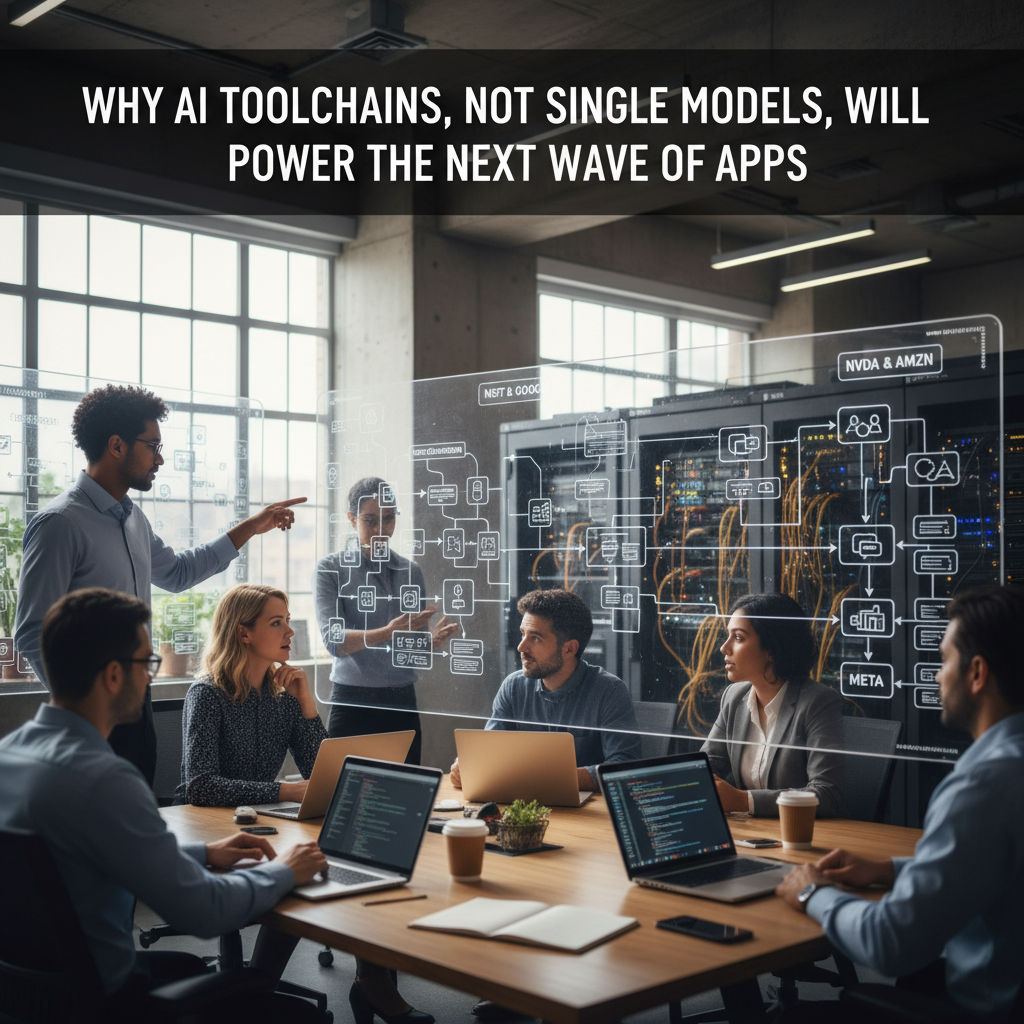
Not long ago, shipping an AI product usually meant picking a single large model and spending a lot of time on prompts. That approach is fraying. Fast-growing apps today are stitching together many specialized pieces — vector databases for retrieval, orchestration layers that run agents, model hubs for choice, and inference tuned to specific hardware. Think of it less as a soloist and more as an orchestra.
Why now?
- Latency and cost are real constraints. For many applications a custom pipeline is cheaper and faster than a one-size-fits-all API.
- Data governance and privacy push teams to mix local models, private embeddings, and cloud services in the same flow.
- New frameworks — LangChain, LlamaIndex and the like — turn what used to be brittle glue code into reusable building blocks.
This changes things structurally. Companies are no longer betting everything on one LLM provider. They assemble stacks: a vector DB (Pinecone, Weaviate, Milvus), a retrieval layer, an orchestration/runtime (LangChain, Rubrix, Airplane-style operators), inference (OpenAI, Anthropic, Hugging Face, NVIDIA) and monitoring. Each layer creates a business opportunity — and, if done right, a moat.
Concrete examples
- A support app routes queries through intent classification, retrieves relevant passages from a product KB, applies a grounding step to cut hallucinations, then generates a reply tuned for tone. That pipeline beats a raw LLM on both accuracy and cost.
- Startups are productizing vertical stacks: law firms buy prewired systems for contract review; fintechs buy pipelines that respect KYC data residency. Works in practice, though adoption is uneven — some teams still try to shortcut the plumbing and then get surprised.
Winners and losers (a quick read)
- Infrastructure players win. Expect ongoing demand for GPUs and inference chips, and for companies that make vector search fast and cheap.
- Cloud giants can bundle and create stickiness. Still, focused vendors that solve a painful problem cheaply are obvious acquisition targets.
- Pure single-model vendors will feel pressure unless they add orchestration, connectors, or unique data advantages.
Pushback and risks
- Complexity increases. More moving parts means more failure modes and more monitoring work.
- Vendor lock-in is real: every connector or low-level optimization makes migration harder.
- Regulation could push teams back toward simpler, auditable stacks rather than elaborate agentic pipelines.
A short history detour
This pattern is familiar. The web moved from static pages to LAMP stacks to microservices and containers. Each shift built a new tooling ecosystem and new winners. The AI toolchain feels like the microservices moment for models: infrastructure, orchestration and observability become table stakes.
Signals founders and investors should watch
- Vertical stacks will carry premium multiples — a packaged domain pipeline is easier to sell than a general toolkit.
- Observability and guardrail tooling that expose hallucination, bias and cost will be indispensable.
- Latency tuning and hardware-aware runtimes matter. Squeezing GPU cycles is not glamorous, but it pays.
The era of the solo model is not gone overnight, but composition is clearly winning ground. Developers who learn to conduct the orchestra — balancing models, databases and runtimes — will build the most compelling apps. For startups, the playbook is getting clearer: choose a vertical, bundle the stack, and productize the plumbing.