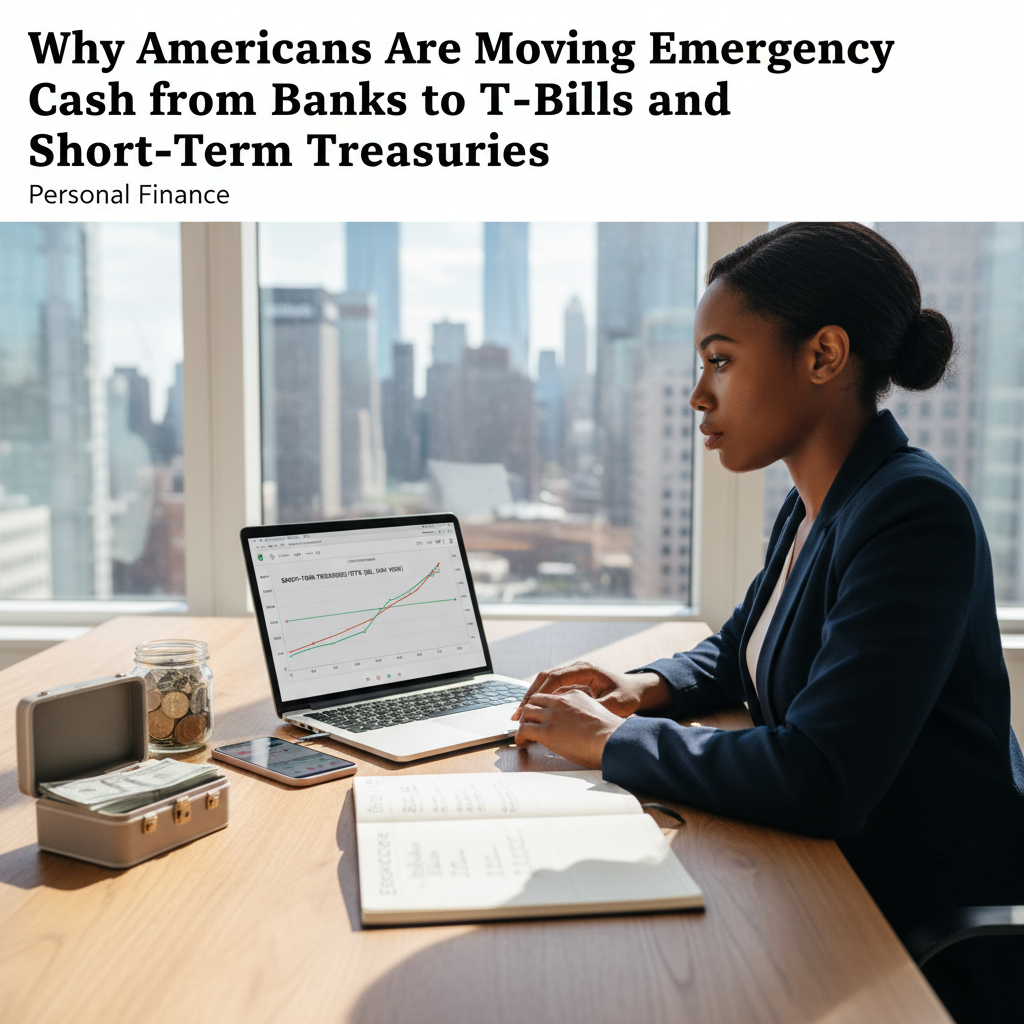
For most of the past decade, keeping cash felt like punishment — savings rates were tiny and there was little point to fussing over where to park money. That has changed, at least for the moment. With very short-term Treasury yields sitting noticeably above many brick-and-mortar savings rates, a growing number of Americans are shifting emergency funds into T-bills, Treasury ETFs and ultra-short funds.
This isn’t a speculative punt. Think of it as an incremental change in cash management: simple arithmetic meets a renewed appetite for safety, liquidity and lower fees. Below I walk through why it matters, how people are doing it, and where the trade-offs live.
Why put cash into short-term Treasuries now
- Yield edge: One- to three-month T-bills and comparable T-bill ETFs often pay meaningfully more than retail savings accounts, especially at small local banks. An extra one or two percentage points on an emergency fund actually compounds into real dollars over time.
- Very low credit risk: Treasuries are backed by the full faith and credit of the U.S. government. That isn’t FDIC insurance, but for most practical purposes the credit risk is minimal.
- Liquidity choices: T-bills have short, certain maturities — you collect cash at maturity. Ultra-short ETFs and money market funds provide intraday liquidity if you need it.
A quick comparison
- Savings account: FDIC insurance up to $250,000, immediate access, but often a lower yield.
- T-bills: No FDIC protection, yet government backing and higher short-term yields; you can hold to maturity or sell on the secondary market.
- Ultra-short ETFs / money market funds: Trade intraday (ETFs) or offer same-day liquidity (many money funds); tax treatment and fees vary, and yields typically sit near short Treasury rates after costs.
How ordinary investors actually get exposure
- Buy T-bills directly through TreasuryDirect or via a brokerage. TreasuryDirect is fee-free and straightforward for buy-and-hold, but it's clunkier if you want to roll holdings frequently. Brokerages let you trade in the market — handy, but watch bid-ask spreads and execution.
- Use Treasury ETFs such as BIL or SHV if you want stock-like liquidity and don’t want to manage a stack of maturing paper. They’re convenient for smaller emergency funds or if you access cash regularly.
- Build a short ladder. Stagger 1–3 month maturities so there’s always a piece coming due when you might need it.
Risks and frictions people tend to underestimate
- Market risk with ETFs: Ultra-short ETFs can trade at small premiums or discounts. In thin markets a quick sale might cost you a bit.
- Taxes: T-bill interest is exempt from state and local taxes but still taxable federally. Money market funds can distribute taxable income or gains.
- Operational traps: Some bank sweep programs still pay very low rates. If your brokerage sweeps idle cash into partner banks, check the APY — you may be earning far less than Treasuries would deliver.
Where this sits in historical context
Before rates collapsed in the 2010s, parking cash in short-term government paper was normal for corporate treasurers and retail savers alike. Since 2022, that sensible option has come back into play. It feels a bit like a return to pre-2008 practices, not a radical reinvention.
A simple emergency-fund approach to consider
- Keep 1–2 months of expenses in a true checking account for daily needs.
- Put the next 4–8 months into a ladder of 1–3 month T-bills or a mix of BIL/SHV for quick access.
- Revisit once a year, or sooner if rates or your cash needs change.
Some counterpoints
- If you live in a state with no income tax, the state tax exemption on Treasuries matters less, so high-yield savings accounts or CDs might look more attractive after fees.
- If you need absolute intraday access without any market movement risk, FDIC-insured online savings or jumbo CDs still win for simplicity.
Short-term Treasuries and ultra-short ETFs aren’t just institutional toys anymore. For many households they offer a practical, low-risk way to lift emergency-fund returns without giving up safety. It’s less about chasing the highest yield and more about updating old cash habits to a different rate environment.