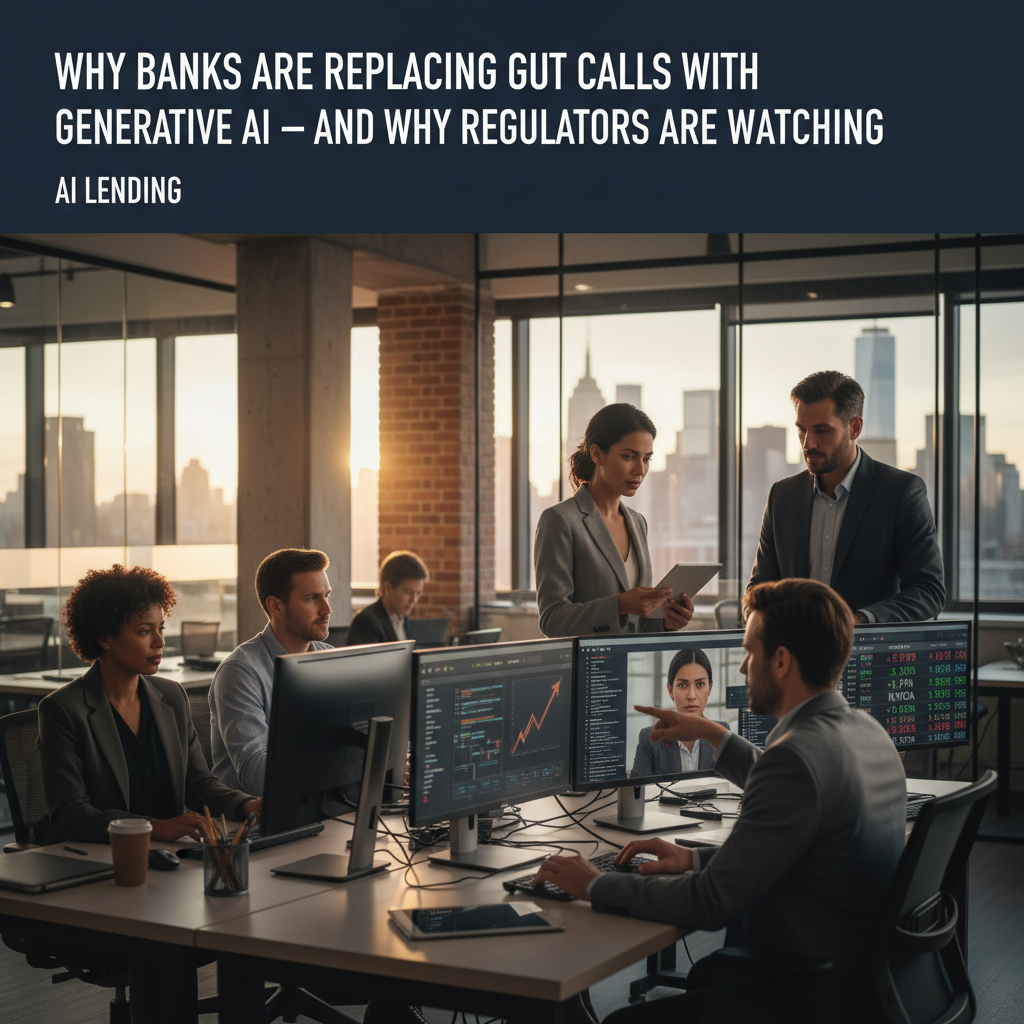
Headline: banks and fintechs are racing to fold generative AI into underwriting, customer service, and fraud detection. What looks like an efficiency play quickly becomes a consumer-rights and policy story the moment an algorithm says yes or no to credit.
A bit of history, because it matters. Credit scoring did not begin with models that predict everything. FICO scored behavior; alternative-data approaches widened the net for thin-file borrowers; now generative models read documents, synthesize bank statements and build complex features that even experienced analysts struggle to unpack. It’s a shift from a pocket calculator to a black-box instrument.
Why firms are pushing this
- Speed. Decisions that used to take hours or days can now arrive in minutes, sometimes seconds.
- Scale and cost. Automation drives down per-loan processing costs and lets lenders absorb demand spikes without hiring in proportion.
- Opportunity. Models can surface creditworthy people traditional scores miss, expanding addressable markets.
Who’s doing it — and why that mix matters
- Upstart and other fintechs popularized ML-based underwriting with higher approvals for thin-file applicants. Big banks have responded by building internal AI stacks or partnering with cloud and chip providers to run models at scale.
- Big banks bring longitudinal data and compliance muscle; fintechs bring product focus and speed. Trade-off: conservatism versus quick iteration.
The downside: opacity, bias, and drift
- Generative and ensemble models are hard to interpret. A denial backed by dozens of derived features is often impossible to explain convincingly to a consumer or a regulator.
- Proxy signals in alternative data can recreate historical discrimination unless actively guarded against.
- Models trained in a benign cycle will fracture when credit conditions change, producing surprises and losses. That’s not hypothetical — it’s a predictable weakness.
Regulation is closing the gap
- Consumer protection offices and state regulators have moved from curiosity to active oversight. History suggests that every major tech-driven change in finance gets audited once it scales.
- Expect pressure for explainability, stricter backtesting, and far more documentation about training data and monitoring practices.
What this means for investors and consumers
- Investors should watch firms that control both the data and the governance around models. Hardware vendors — GPUs and the cloud firms that host inference workloads — will stay strategically important.
- Consumers: ask lenders for reasons when denied and be skeptical about the use of alternative data. Transparency is going to be the battleground.
Two sharper angles worth remembering
- Compared with the FICO-era battles over which bureau or score dominated, the current fight is over unseen features and continuous retraining. That’s a harder problem to police.
- AI can responsibly broaden access to credit. It can also scale mistakes much faster than people can correct them. Model risk is not a compliance box to tick; in certain circumstances it becomes a systemic concern.
The upshot
Generative AI in lending is real, profitable, and messy. Winners will be the firms that pair technical edge with ironclad governance — not just clever models. For everyone else — consumers, investors, regulators — the open question is whether oversight moves faster than deployment. Historically, deployment usually wins until a high-profile failure forces a reset.
Signals to follow next
- Regulatory guidance on model explainability and the use of alternative data
- Quarterly results from fintech lenders and big banks that call out model-driven volume
- Revenue trends for GPU and cloud providers tied to financial-services inference workloads