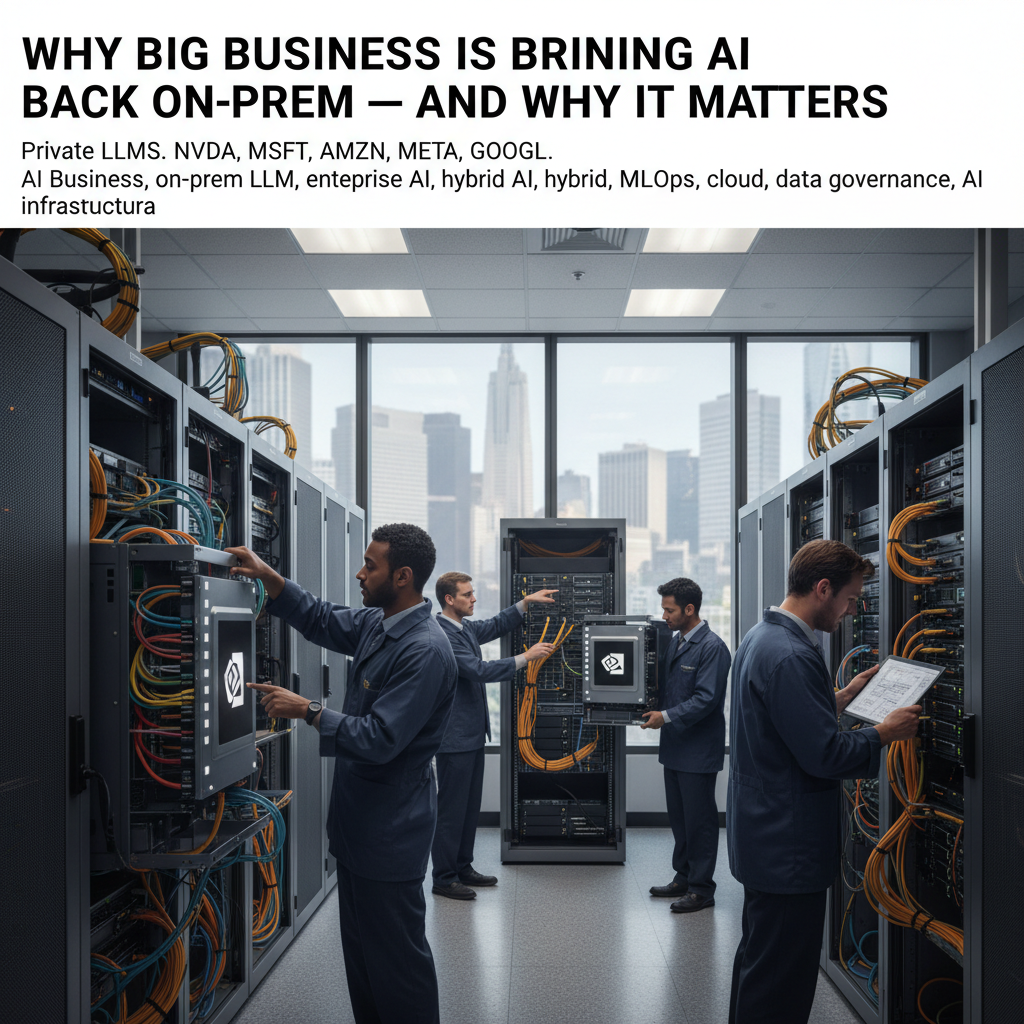
Short version: companies that sprinted to public cloud LLMs are quietly building private, on-prem AI infrastructure. The drivers are practical, political and financial — and the aftershocks will reshape vendors, talent pools and corporate IT budgets.
Right now
Across finance, healthcare and defense many teams run private LLMs or hybrid stacks instead of depending only on public-hosted models. This is not a nostalgia tour for old servers. It’s a reaction to three blunt constraints:
- Data control and compliance — regulated sectors often can’t allow customer data to pass through third-party model APIs.
- Cost and predictability — heavy use of hosted LLMs can explode bills; fixed capex on-prem can be simpler to forecast at scale.
- Latency and customization — low-latency inference and fine-tuning for proprietary workflows favor local infrastructure.
What’s interesting here is how practical concerns beat hype. Fine-tuning a model for a workflow, or cutting inference latency from 200 ms to 20 ms, isn’t glamorous, but it matters.
Why this matters for the market
Winners and losers will emerge as compute moves back into enterprises.
- Hardware vendors gain bargaining power. Customers are buying not just GPUs but integrated stacks and managed appliances, so suppliers must offer more than raw silicon.
- Cloud providers won’t vanish; they’re adapting. Expect more private racks, dedicated on-prem services and orchestration that blurs the line between data center and cloud.
- Startups focused on private LLM orchestration, data governance and MLOps suddenly look like strategic acquisition targets.
A sideways history lesson
If this sounds familiar, it’s because it is. Think client-server in the 1990s: workloads left mainframes, then many shifted to the cloud, and now some are shifting back. The cycle repeats as tradeoffs change — here, cost and legal scrutiny around data handling are the accelerants.
Concrete implications
- Expect AI clusters to appear as capex line items, not just as cloud op-ex. CFOs will ask for unit economics on prompt-heavy apps.
- Hiring will tilt toward SREs, inference engineers and MLOps folks who can squeeze performance out of constrained environments.
- Vendors will package hardware and software together; contracts and license terms will become negotiation focal points, not just sticker prices.
Counterpoints and risks
On-prem is not a cure-all. It comes with trade-offs:
- More operational complexity and a slower cadence of new features compared with cloud rollouts.
- Significant upfront spend and the need for internal operational maturity.
- The danger of lock-in to particular hardware or stack vendors.
Many teams will land in the middle: keep sensitive workloads local and burst to public clouds for peak demand.
Signals to watch
- Partnerships between chipmakers and systems vendors focused on private AI.
- Cloud providers expanding on-prem offerings and rolling out pricing aimed at heavy LLM use.
- M&A in firms that provide governance, deployment and observability for private models.
This is not merely a technical migration; it’s a strategic reset. Companies are weighing the shine of hosted LLMs against the gritty realities of compliance, cost and control. The upshot will be a more fragmented, competitive market — and real opportunity for operators and investors who see the pattern early.