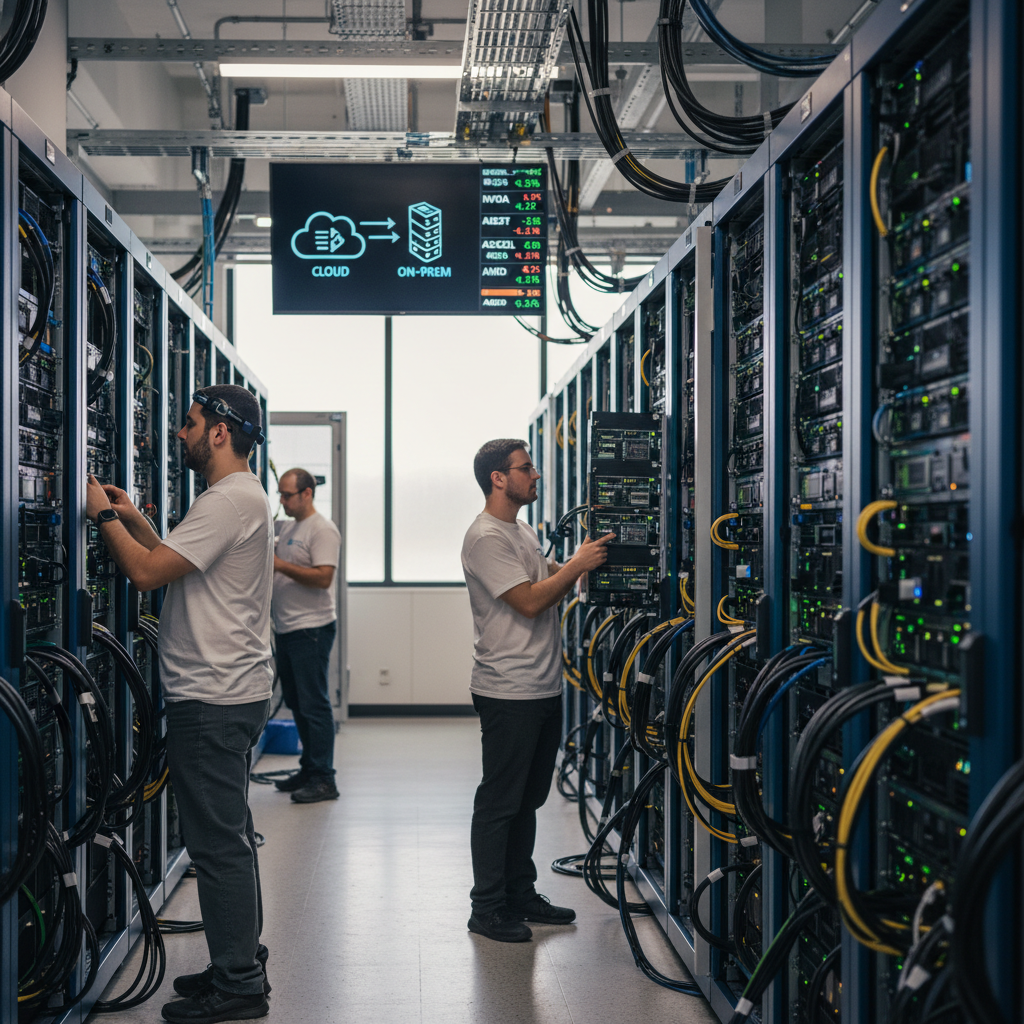
The headline feels familiar but the direction is different: companies are quietly shifting AI workloads out of public clouds and into private GPU infrastructure. What reads like a technical tweak is actually a strategic move driven by money, control and compliance.
For years enterprises rushed to the cloud for speed and convenience. That solved agility problems — yes — but it introduced others: runaway egress bills, unpredictable per-inference pricing, and a loss of bargaining power as hyperscalers bundled models with proprietary optimizations. Increasingly, firms that handle sensitive data and high inference volumes — think finance, healthcare, retail — are opting for on-prem GPU clusters or colocated racks.
Why this matters now
- Cost predictability. If you run steady, heavy inference, owning or colocating hardware can beat volatile cloud bills once utilization crosses a threshold. Think capex in place of surprise opex.
- Data control and compliance. Keeping models and proprietary datasets inside the organization reduces leakage risks and simplifies audits for regulated industries.
- Performance tuning. Resident models let teams tweak software stacks, exploit model sharding and shave latency in ways cloud-managed services sometimes won’t allow.
Not an all-or-nothing reversal
Most companies are not abandoning the cloud. The reality is hybrid. A typical pattern is messy but recognisable: cloud for experimentation, bursting and global distribution; on-prem or colo for production-critical, high-volume models. Cloud remains the dev engine; predictable production workloads move to infrastructure you can actually control.
Real trade-offs — nothing is free
- Operational overhead. Buying racks means hiring ops people, dealing with cooling and power, and negotiating chip supply. Not glamorous, and not cheap in management attention.
- Capital allocation. CFOs must balance depreciating GPUs against flexible cloud spend. For many smaller firms, the math still favors cloud.
- A different kind of lock-in. Escape one set of hyperscalers and you can become dependent on chip makers and appliance vendors instead.
Market ripple effects
- Chipmakers and server OEMs gain clout. Nvidia, AMD and the server builders are obvious beneficiaries; hyperscalers will feel margin pressure on AI services.
- Cloud providers will respond. Expect new pricing tiers, dedicated hardware offers and bundled services aimed at keeping workloads on platform.
- Watch enterprise capex cycles and infrastructure vendor sales as early indicators of where spend is shifting.
A couple of concrete examples
- A mid-sized fintech with 24/7 fraud detection might find colocated GPU racks and a private model registry are cheaper and more reliable than constant cloud inference.
- A regional health system doing patient NLP could prefer on-prem inference to keep PHI inside controlled boundaries and avoid cross-border compliance headaches.
Perspective and counterpoint
This echoes the late 2010s talk about cloud repatriation, but the drivers are different now: hardware economics and model governance, not just legacy lift-and-shift. Still, the cloud is often the fastest route to experiment and iterate. Where inference scale, latency and regulatory risk intersect, private GPUs will matter most.
The practical expectation
A measured, durable shift toward hybrid AI infrastructure. Winners will treat infrastructure as a product decision — balancing cost, control and speed — rather than a tick-box IT project. For investors, that means watching GPU supply chains and the OEMs that package them almost as closely as the hyperscalers.
Quick hits
- Not an all-in migration, but a strategic rebalancing toward private GPU capacity.
- Predictable costs and tighter data control are the main drivers.
- Keep an eye on Nvidia, server OEMs and cloud pricing moves for early signs of how this plays out.