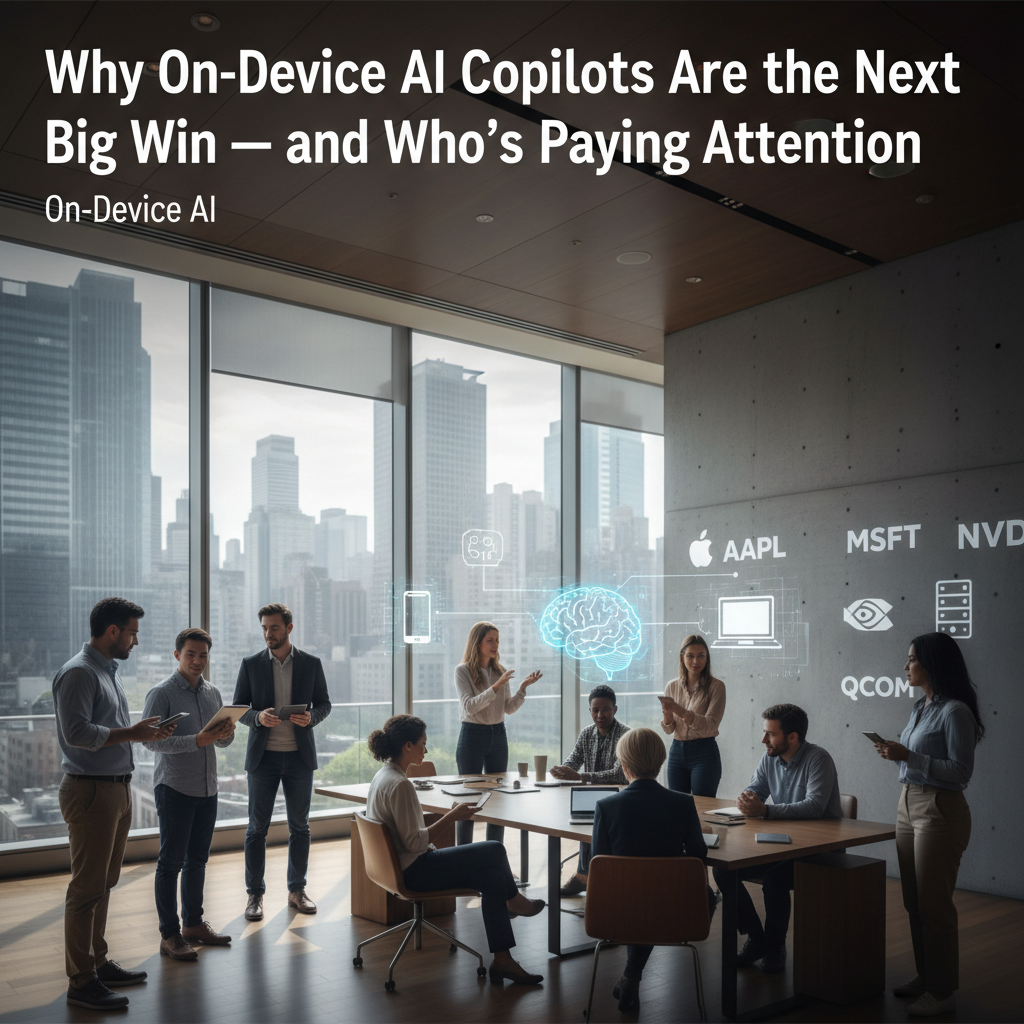
Quieter than a product launch, louder for strategy. Tech headlines have fixated on giant cloud models and headline-grabbing LLMs. The actual revenue story for the next couple of years is subtler: capable AI copilots moving onto devices — phones, laptops, edge servers — where privacy, latency and cost actually change the equation.
This is not a call to resurrect old offline apps. It’s a pragmatic response to three forces colliding: users getting more nervous about sharing data, the rising bill for large-scale cloud inference, and hardware finally reaching a point where local inference is genuinely useful.
Why it matters now
- Faster feedback loops. Local models shorten round-trip time for things like live transcription, on-the-fly drafting and camera-driven multimodal features. Interactions feel immediate.
- Privacy and compliance. For sectors from healthcare to legal work, keeping prompts and outputs on-device reduces regulatory exposure and the blast radius of breaches.
- Lower marginal costs. When millions of users summarize meetings or generate transcripts, moving inference off the cloud can meaningfully cut operating expenses.
Winners and losers — not as straightforward as headlines imply
- Chipmakers and device OEMs gain new bargaining power. The earlier CPU/GPU races were warm-ups; control of the neural compute stack matters more now.
- Cloud providers stay relevant, but their role shifts toward model hosting, orchestration and heavy-duty tuning. Expect hybrid arrangements: everyday work on-device, occasional cloud bursts for expensive tasks.
- Startups that specialize in compact architectures, smarter quantization and privacy-preserving tricks will be highly attractive acquisition targets for incumbents that need on-device features fast.
There are trade-offs, though. On-device models are constrained by size and updateability, which fragments the developer experience. A feature that runs beautifully on a new flagship phone may stumble on older hardware — and that inconsistency costs time and support.
A short history lesson, because patterns repeat
This moment echoes two earlier shifts. First, the mobile app boom after the iPhone showed new hardware could unlock fresh experiences. Second, the move from mainframes to client-server, where capabilities drifted closer to users in predictable waves. What’s different this time is the cost center: compute energy and who owns the models, not merely connectivity.
Practical use cases to watch
- Personal productivity copilots that draft, summarize and redact locally so PII never leaves the device.
- Field tools for clinicians and technicians that must run offline while keeping patient data on-prem.
- Creative apps letting photographers and editors apply generative filters in real time without a round trip to the cloud.
Counterpoints and risks
- Fragmentation and UX inconsistency could slow mass adoption.
- Pushing frequent model updates to devices is hard without draining batteries or eating storage; that often nudges teams back toward hybrid designs.
- Energy accounting gets weird. Local inference can reduce net carbon for some workloads, but ubiquitous, powerful NPUs could raise per-device power use.
What leaders should do next
- Product: design hybrid pipelines. Ship core features on-device; use the cloud for personalization and heavy lifting.
- Security: treat the device as a distinct trust boundary. Code signing, attestation and secure update paths matter more than they used to.
- Finance: build total-cost models that include device-specific support, update logistics and the possible cloud savings.
On-device AI copilots are not a niche experiment. They’re the logical next step toward faster, more private and cheaper everyday AI — though the shift will be messy. Winners will be those who manage hardware partnerships, developer ergonomics and hybrid economics better than competitors. And don’t be surprised if a tiny startup that perfects quantization ends up steering the user experience more than a household-name cloud provider.