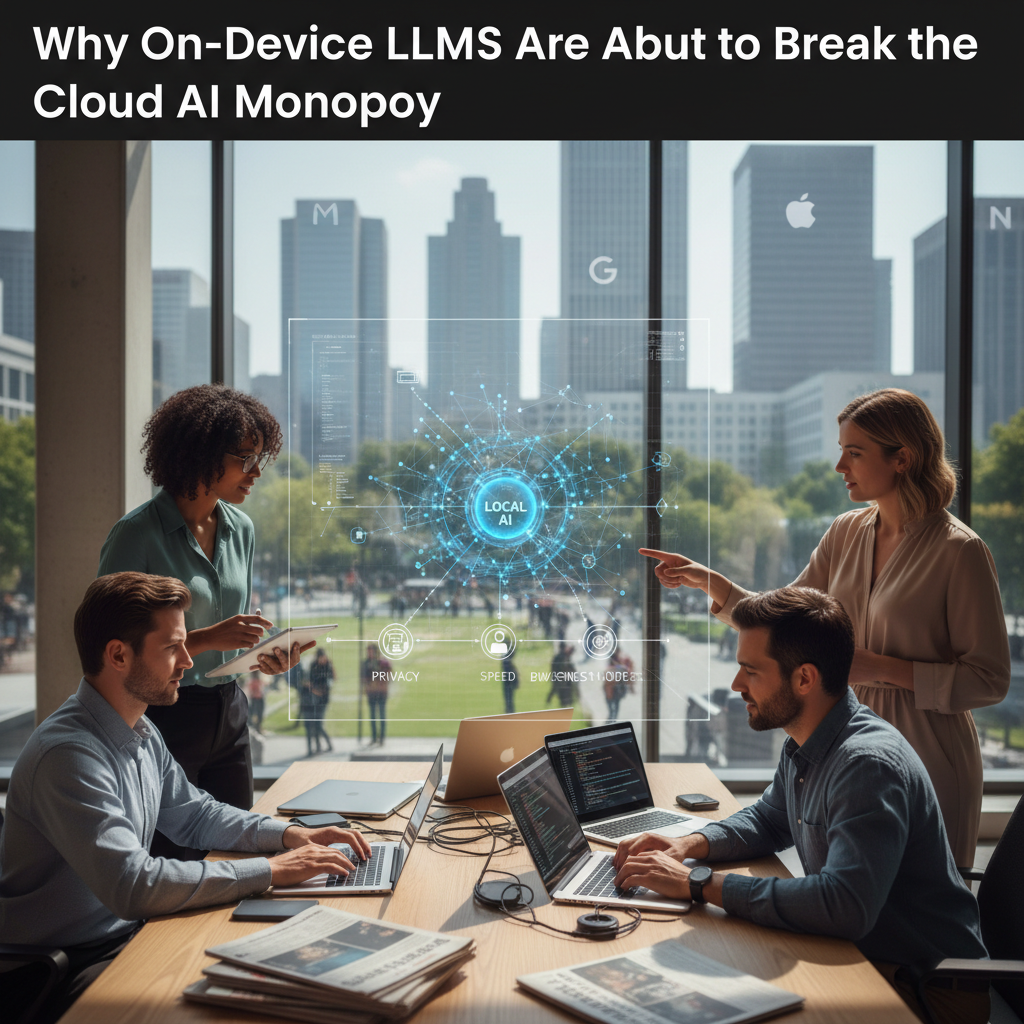
The headline is simple: compute moving closer to the user changes everything. What began as a race to build ever-larger models in the cloud is quietly shifting into a contest over who can run useful, multimodal models on phones, laptops and edge servers.
I watch this because it feels less like incremental product work and more like a tectonic rebalance. Remember client-server to cloud? This is cloud back toward edge. Winners will do more than ship models; they’ll stitch local AIs into workflows so models can call tools, access data, and stay current without sending every prompt across the internet.
Why this matters now
- Speed and latency. On-device inference slashes round-trip time — often by orders of magnitude. Combine that with local retrieval and workflows start to feel instantaneous.
- Privacy and compliance. Health, legal and finance teams prefer keeping sensitive text local to reduce regulatory exposure and breach risk.
- Cost dynamics. Cloud inference is expensive and scales with use. For companies with millions of active users, moving inference to endpoints changes the unit economics.
These are not theoretical. Imagine a clinician with an assistant on their tablet that summarizes notes and suggests citations without ever sending patient text to a public API. Or a salesperson with a laptop LLM that pulls CRM records locally to draft outreach. Startups and incumbents are building exactly these products.
Who wins and who loses
- Hardware and chip makers gain. Expect firms selling accelerators and optimized silicon to pick up leverage as inference migrates to endpoints.
- Cloud providers must reframe. Their edge is shifting from pure inference to hybrid orchestration, secure model hosting and continuous training services.
- Device makers who control the software stack get a strategic leg up — they can pre-bundle tuned models and services into the OS.
Some caveats and limits
Local models are powerful, but not a cure-all. Very large models still live in the cloud when the task needs extreme fluency, massive context windows, or ongoing retraining. Rolling out secure updates to millions of devices is hard. And for some enterprises, a centralized audit trail is actually a feature.
One useful way to think about this is platform fragmentation. On-device AI could recreate an app-ecosystem effect similar to the mobile era: more choice and speed, yes, but a headache for developers who must target many hardware and model variants. That tension will create demand for middleware and standards.
Signals to watch
- Traction from startups shipping compact models and robust connectors to local tools.
- Deals between chip vendors and model providers to deliver turnkey on-device stacks.
- Messaging shifts from cloud vendors toward hybrid orchestration and distributed security primitives.
So no — this is no longer only about model size. The battle is about where inference runs, how models hook into tools and data, and who captures the economics of convenience and privacy. Builders need to design for heterogeneity. Investors should split attention between cloud incumbents and emerging edge specialists.
I’m skeptical of narratives that claim the cloud will vanish. Expect a bifurcated future: centralized, heavy-duty models powering research and niche workloads; and smaller, local models running day-to-day productivity and privacy-first apps. That split will open room for new tools, new business models, and some surprising winners.