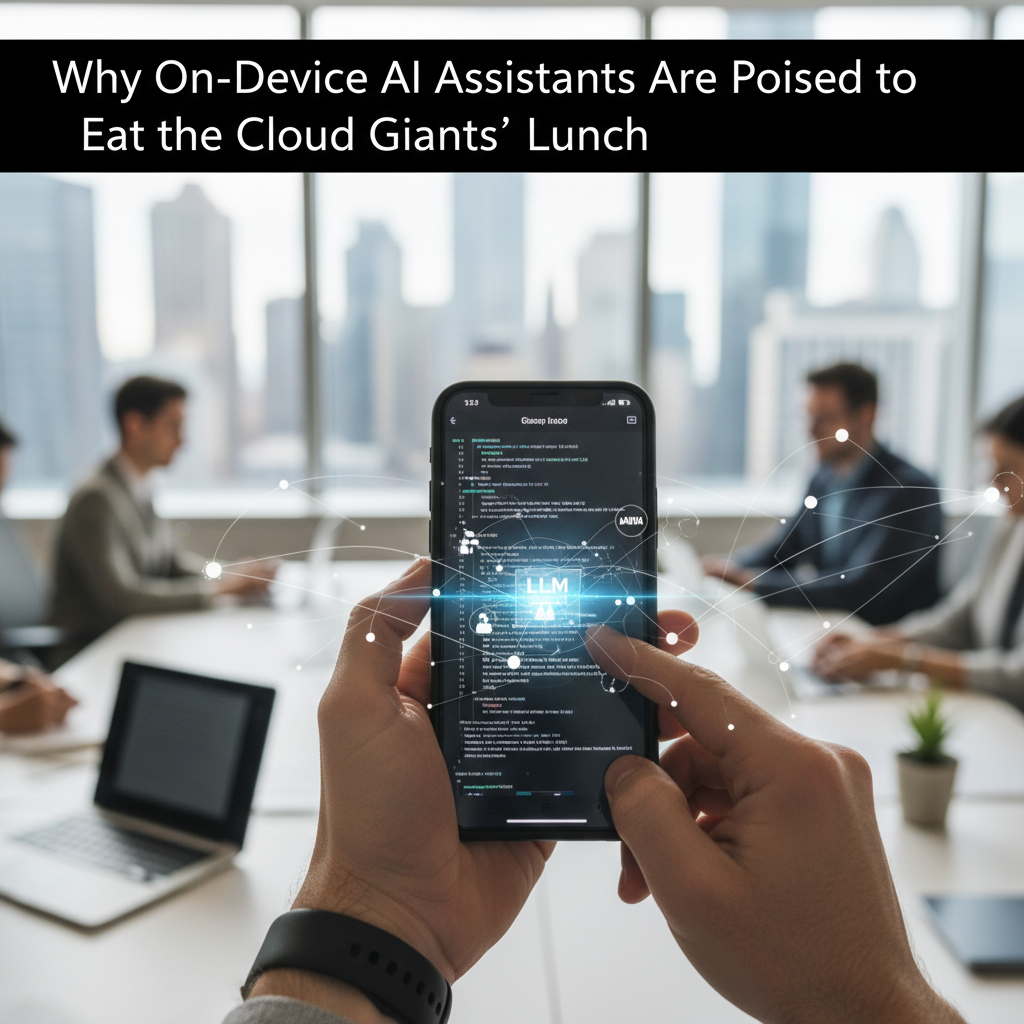
Short version: expect a scramble. The next wave of AI tools won't just live on servers — they'll run locally, privately and fast. That changes consumer apps, enterprise risk calculations and which companies actually capture value.
What’s shifting
The industry is quietly moving toward on‑device LLMs and personal agents. Open weights and permissive licenses, together with quantization tricks and better compilers, mean models that once needed racks of GPUs now squeeze onto modern phones and edge chips.
This is not theoretical. Engineers are shipping proof points: assistants that do useful work without a cloud round trip, offline transcription and summarization, and messaging apps that keep models — and data — on device.
Why it matters
- Privacy and regulation. Processing on the device avoids many data‑transfer headaches and reduces legal exposure for apps handling sensitive information.
- Latency and user experience. No network hop means near‑instant responses. Users will start to expect that immediacy.
- Cost. Skip the per‑token API tab and, at scale, the savings add up quickly.
Technical enablers (briefly)
- Better quantization — including 4‑bit formats — shrinks models with tolerable accuracy tradeoffs.
- Smarter architectures and distillation create capable sub‑13B models that run on mobile NPUs and integrated GPUs.
- Tooling — compilers, runtimes and adapters — automates a lot of the hard work of squeezing models onto heterogeneous silicon.
What’s interesting here is how these pieces compound. Alone each is incremental; together they make on‑device AI plausible for real products.
Winners and those under pressure
- Winners: phone makers with beefy neural engines, chip designers focused on edge inference, and middleware startups that handle model updates and privacy controls across fleets.
- Strained but still relevant: cloud incumbents. They’ll keep training the big models and will push hybrid tooling that ties cloud training to local inference.
- At risk: businesses that depend solely on per‑API usage economics and offer no distinct experience or governance advantage.
Investor playbook — signals to watch (and a caveat)
- Watch companies building mobile silicon and developer ecosystems. AAPL and QCOM look interesting for hardware exposure; NVDA still matters for datacenter training and high‑end inference.
- Track firms that monetize model updates and orchestration — an emerging SaaS layer is forming to manage local models at scale.
- Caveat: on‑device does not kill the cloud. Heavy training, fine‑tuning and very large‑context tasks will keep datacenters busy. The real winners will bridge both worlds.
A small, concrete example
Picture a tax‑prep app that analyzes receipts locally, flags likely audit triggers and syncs only anonymized summaries for backup. It reduces compliance risk and avoids hefty API bills — a clear differentiator versus a cloud‑only rival.
What to expect next
- More hybrids: cloud for the heavy lifting, devices for everyday convenience.
- Intensifying competition in model marketplaces and update services.
- Regulation that shifts from simply asking where models run to scrutinizing how data is used and governed.
The upshot: on‑device AI is practical more than ideological. It reshuffles where value shows up — toward silicon, privacy engineering and orchestration layers — and forces a rethink of how companies monetize AI. Teams and investors who treat this as a structural change, not just a feature, will have the advantage.