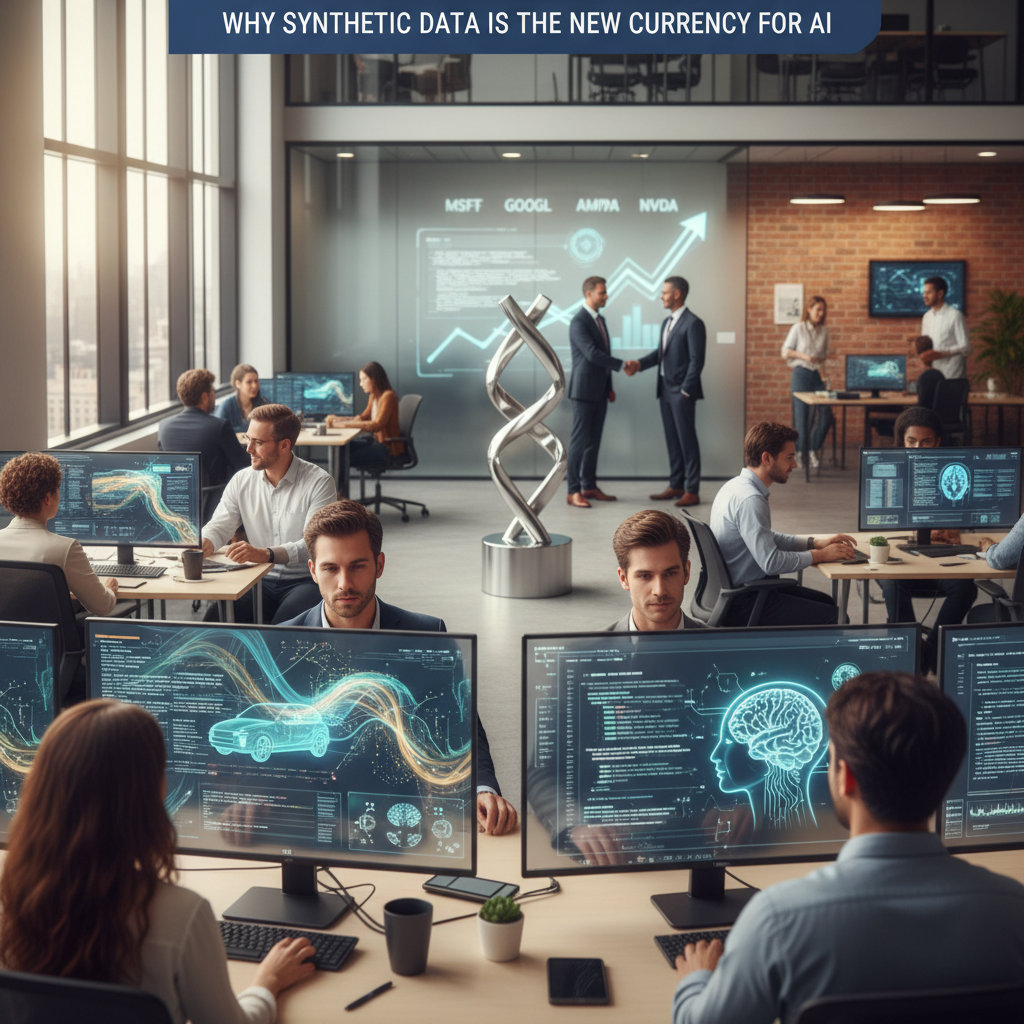
The pitch is simple — generate realistic data where real data is expensive, scarce, or legally fraught. For teams training everything from fraud detectors to self-driving perception stacks, synthetic data promises faster iteration and fewer compliance headaches.
This isn’t theory. Over the past two years a wave of startups — Gretel, Mostly AI, Datagen, Hazy — plus major cloud vendors have shipped tools that produce labeled images, simulated telemetry, and privacy-safe customer records. Insurers, hospitals, adtech shops, and autonomous-vehicle teams are piloting synthetic sets to fill gaps that human collection and annotation struggle to cover.
Why now?
- Cost and speed. Large-scale labeling is painfully expensive. Synthetic pipelines can churn out perfectly annotated edge cases overnight.
- Privacy. Augmenting or replacing real records reduces exposure under HIPAA and emerging state privacy laws.
- Rare events. That near-miss on the freeway, those unusual fraud patterns — you can simulate them much faster than you can wait for them to happen.
But the rosy headlines hide real trade-offs.
What the product brochures rarely say
- Model brittleness. Datasets that look convincing in a demo can leave models blind to messy, low-level realities. If a car’s training never includes real sensor noise, it will stumble on real roads.
- Bias amplification. If your generator bakes in skewed assumptions, synthetic data can harden those biases faster than you can test for them.
- Provenance and auditability. Regulators and auditors will want to know where training signals came from. Synthetic provenance is easy to fabricate and hard to verify.
A couple of concrete stories make the paradox clearer. One insurer used synthetic claims to swell rare-fraud examples and saw false negatives drop in tests — then missed a novel fraud tied to a new payment rail because the simulator never modeled that behavior. A healthcare imaging startup boosted volumes with synthetic MRIs and still found their model underperformed on scans from older machines — an instrumentation gap the generator never captured.
How savvy teams are approaching it
- Hybrid datasets. Keep real core data, use synthetic only for edge cases, and always validate on untouched production slices.
- Red teams and stress tests. Throw adversarial and out-of-distribution scenarios at models to surface blind spots.
- Data contracts and lineage. Versioned, auditable pipelines that tie generators to downstream models so you can trace a weird failure back to a specific synthetic batch.
There’s a macro angle too. Expect consolidation: cloud providers and enterprise vendors will fold these capabilities into broader stacks — acquisitions are likely. Regulators are paying attention as well. Questions will come up about whether certain synthetic sets count as personal data, and whether they can be used to sidestep consent regimes.
Where this leaves investors and product leaders
- Startups should differentiate with verifiable provenance, explainability, and realism tuned to verticals — medical, automotive, financial.
- Enterprises should use synthetic data aggressively for augmenting edge cases, but never as a substitute for validation on real production data.
- Policymakers should aim for narrow, clear standards for data lineage; that would remove a lot of downstream uncertainty.
Synthetic data is not a cure-all, but it is already changing the economics of training models. The next 12–24 months will tell whether it becomes a mainstream utility like cloud compute, or a specialized tool that demands careful governance. Either way, the firms that treat synthetic datasets like a new asset class — with contracts, audits, and red teams — will be better positioned.