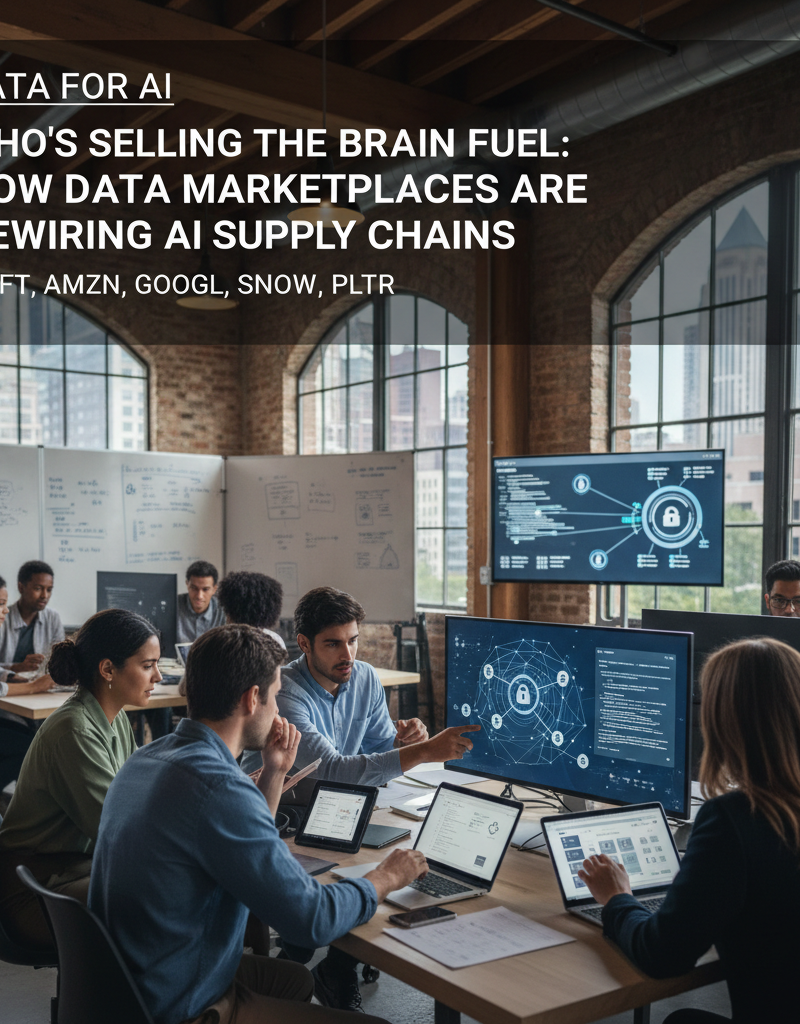
The narrative shift is subtle but seismic. For years the conversation around AI fixated on chips and model size — faster GPUs, bigger parameter counts, clever architectures. Those still matter. But there’s a quieter market forming underneath: synthetic data. It promises to address bottlenecks that real-world data can’t touch — privacy, scarcity, and legal limits — which makes it both an infrastructure opportunity and a form of regulatory insurance.
Why synthetic data matters now
- Training large models is bumping up against a simple fact: labelled, high-quality, legally cleared data is scarce. Synthetic examples can be produced in volume, tuned for edge cases, and scrubbed of personally identifiable information.
- Regulators at home and abroad are tightening rules on data use, especially in health and finance. Synthetic datasets give teams a way to keep building while reducing compliance exposure.
- Ironically, the same generative models we train are getting better at creating training data. That creates a feedback loop: better models → higher-fidelity synthetic data → better models. It’s noisy and non-linear, but the effect is real.
Real implications, not just marketing
Healthcare and finance are the clearest near-term adopters. Banks can simulate fraud scenarios they rarely see. Hospitals can spin up synthetic EHRs to validate diagnostic tools without exposing patient records. Autonomous-vehicle teams can generate the corner cases that would be expensive or unsafe to capture on public roads.
That said, synthetic data is no silver bullet. Domain shift is the biggest technical trap. A model that looks great on synthetic claims data can still stumble on subtle patterns in production. In practice, you need a hybrid approach: synthetic bulk plus targeted real samples, rigorous validation pipelines, and production monitoring.
Where the money flows
Three buckets are already attracting capital:
- Compute and infrastructure — the GPUs and data pipelines to generate huge datasets.
- Cloud and data platforms — those that package datasets, run marketplaces, and offer governance and lineage tracking.
- Vertical synthetic specialists — vendors building high-fidelity generators for specific domains.
Public names to watch: NVDA (compute demand), SNOW (data marketplaces), MSFT and AMZN (cloud and tooling), and PLTR (enterprise data engineering and governance). Each captures a different piece of the stack.
Risks and counterpoints
- Synthetic data can amplify bias if the generator mirrors skewed training corpora. That risk isn’t fixed by simply swapping real for synthetic; bias audits need to be standard practice.
- Relying too much on synthetic examples can hide rare but critical failure modes. Real-world out-of-sample testing remains essential.
- The vendor field will get crowded. Differentiation will come from vertical expertise, governance, and demonstrated production outcomes, not generic sample generators.
A pragmatic playbook for investors and operators
- Operators: prioritize hybrid datasets, invest in rigorous synthetic–real validation, and treat lineage and explainability as first-order requirements. Monitor models in production; assume the synthetic distribution won’t match reality perfectly.
- Investors: favor horizontal cloud and compute plays for long-term volume, and then pick a couple of specialized vendors with deep domain expertise in regulated sectors like health or finance rather than spreading bets across many undifferentiated startups.
Why this matters beyond spreadsheets
This is part of a deeper shift: moving from hoarding what exists to manufacturing what you need. That flips the old data-broker model. Instead of amassing raw logs and hoping value emerges, companies will buy or build datasets tuned to the questions they care about. In U.S. markets, winners will be those who can pair high-fidelity generation with governance and operational rigor — not just those who pour models and capital at the problem.
Expect a bumpy road. The technical and ethical stakes are high, and many experiments will fail. If synthetic data works as advertised, though, it could be the ingredient that finally turns experimental AI projects into repeatable, production-grade advantages.