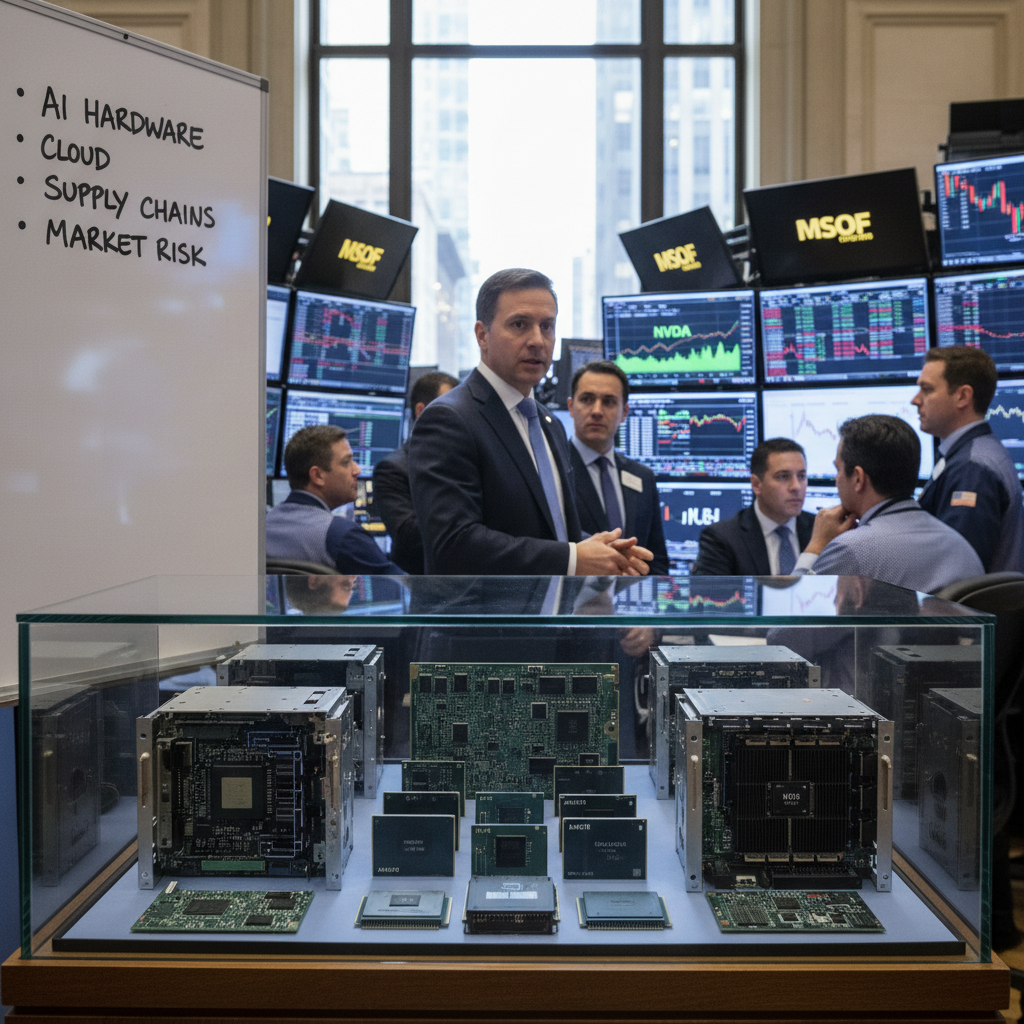
Nvidia is the obvious poster child for the AI boom — but that doesn’t make the trade simple.
There’s a reflex in markets to equate leadership with safety. Nvidia dominates the GPUs that train the big models and power generative systems. That dominance has produced jaw-dropping returns and market caps that grab headlines. But the more concentrated a trade becomes, the more fragile it can be — and investors often underprice a few straightforward risks.
A short history helps. Tech cycles routinely crown a handful of names that carry indexes through frothy phases; the unwind can be abrupt. The current hardware story has the same shape: a genuine technical advantage, yes, but also a narrow supplier base, complicated manufacturing, and plenty of ways the ecosystem could shift toward different architectures or software-first approaches.
Three structural vulnerabilities
- Supply chain and fabrication limits. Cutting-edge GPUs rely on a tiny set of advanced foundries and exotic packaging. Capacity bottlenecks or geopolitical friction can choke supply faster than demand cools.
- Software and architectural competition. GPUs are a dominant route to acceleration, but not the only one. Custom accelerators, novel chips, or clever software stacks could chip away at pricing power over time.
- Market concentration risk. A small group of firms and a few ETFs now carry most of the AI exposure. That amplifies downside moves when sentiment turns.
Why this matters: when one company becomes the de facto vehicle for a whole theme, any company-specific hiccup — missed guidance, shipment delays, or executive drama — can trigger broad selling, even if the underlying demand for smarter systems stays intact.
What investors actually care about — and what they often miss
People want durable exposure to the secular shift toward more capable models. That can mean different strategies.
- Back the hardware leader for the biggest upside — high risk, potentially high reward.
- Spread bets across the stack: chipmakers, cloud providers, and software firms that monetize models.
- Use thematic ETFs to get broad exposure, accepting that some concentration remains.
Many have chased the first route, seduced by outsized returns. But smaller or quieter players — cloud operators selling pay-as-you-go model access, or software companies building vertical models — can produce steadier, less headline-driven returns. Think of providers that turn AI into predictable, subscription-like revenue rather than a single-product moonshot.
Actionable frameworks — without pretending to give financial advice
- Treat large-cap hardware exposure as a thematic bet, not a guaranteed winner.
- Size positions: cap single-stock exposure relative to total portfolio risk.
- Consider alternatives to pure-play chips: cloud AI services, middleware firms, and diversified ETFs that smooth idiosyncratic risk.
Short examples that clarify the trade
- A cloud provider can spread AI revenue across thousands of customers, creating steadier cash flow — but it will rarely capture the same upside multiple that a dominant chip designer can during a mania.
- A systems vendor that squeezes inference costs on cheaper silicon could win enterprise budgets without ever displacing the high-end training market.
The bridge between optimism and prudence
Demand for smarter automation feels structural — companies will adopt models and capabilities will keep improving. Still, structural demand does not remove cyclical shocks or creative disruption. Respect both the upside and the fragility. Some of the biggest losses in tech come when narratives outpace on-the-ground realities.
If you want the simplest takeaway: owning Nvidia today is a concentrated way to own the center of the current stack and its upside. It’s effective but risky. For steadier, long-term exposure, balance hardware plays with cloud and software names, or use a carefully chosen ETF sleeve to reflect the uncertain path from breakthrough chips to routine enterprise value.
Final note
Market stories are seductive. Nvidia matters — no question — but markets only reward stories that survive reality, not just headlines. Watch supply chains, alternative accelerators, and the software layer; they will tell you more about the rally’s durability than daily price moves. Stay skeptical, size positions, and favor diversification if you want exposure without betting the house.