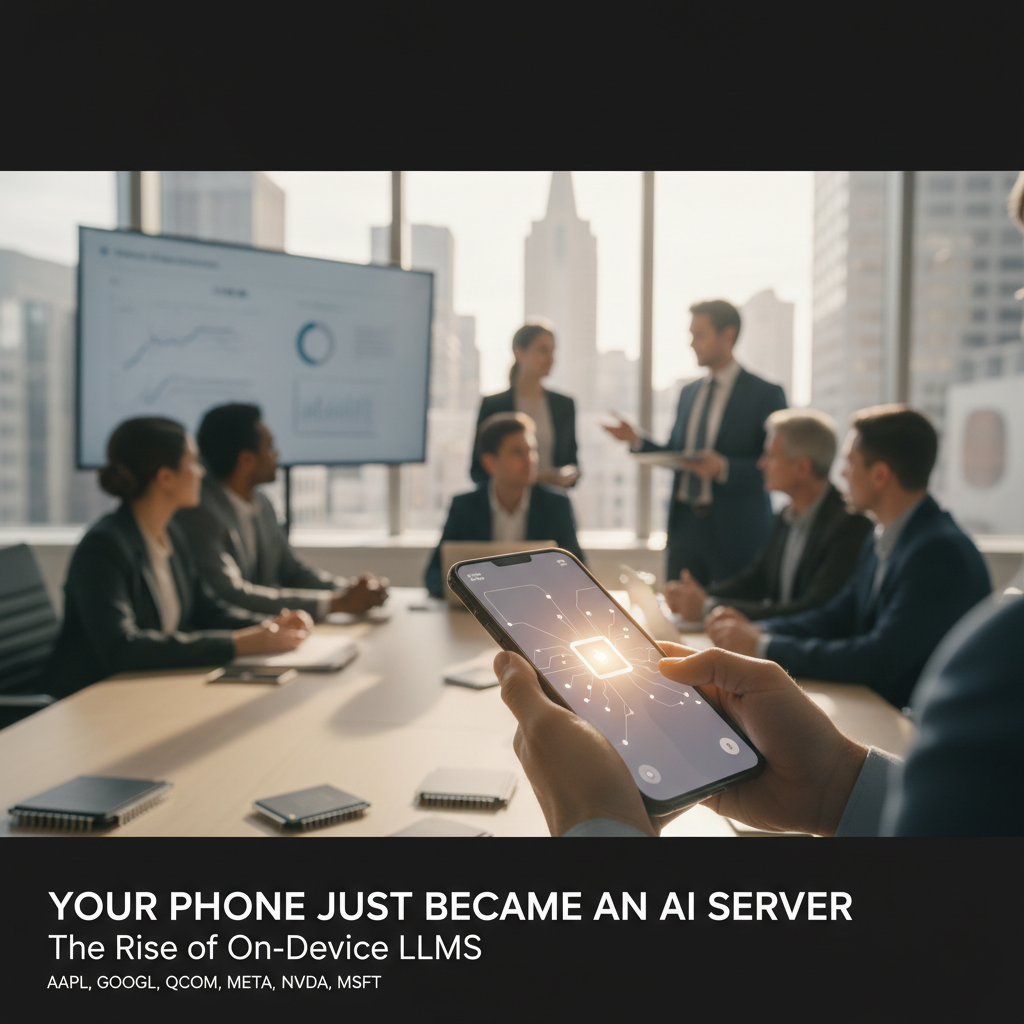
On-device AI stopped being a niche engineering trick last year and quietly became a mainstream battleground. What once needed racks of cloud GPUs now runs — corrected, quantized, sometimes private — on the phones in our pockets. That matters for latency and privacy, yes, but also for business models, regulation, and which semiconductor companies win.
Put bluntly, we are shifting away from a pure client-server model toward a hybrid, client-first reality. Developers want instant, offline inference. Users want assistants that don’t phone home. Hardware makers want chips they can actually sell as differentiated AI features. The result is an ecosystem-level fight that looks a lot like the mobile GPU wars of the 2010s — just faster and more compressed.
Why now — three technical shifts that converged
- Model compression and distillation. Pruning, quantization and distillation have taken many-billion-parameter behemoths and turned them into versions that are useful on-device.
- NPUs and software stacks. Mobile neural engines from Qualcomm and Apple, plus toolchains like Core ML, ONNX runtimes and Google’s mobile stacks, make optimized local inference realistic.
- Tooling and model availability. Open models from labs and startups, and orchestration tools from places like Hugging Face, let developers deploy local LLMs much faster than before.
Stack these together and a conversational assistant that used to need a cloud round-trip can respond locally in milliseconds — even on flaky networks.
What changes for users and businesses
- Privacy gets more real, but it’s complicated. Less raw data leaves the device, which is a clear win for health, finance and other sensitive domains. Still, model updates, telemetry and edge caching create new leak paths. In practice the picture is messier than a simple on-device equals safe story.
- Latency and reliability improve. Offline-first assistants remove awkward pauses and enable features in airplanes, rural areas and factories.
- New monetization and distribution vectors emerge. When the AI lives in apps and device silicon, app stores and chipmakers can insert new capture points. Expect subscription tiers for higher-quality on-device models or paid model packs.
Who benefits — and who risks being left behind
- Hardware vendors with NPUs and efficient compilers gain an immediate edge. Qualcomm (QCOM) and Apple (AAPL) are obvious beneficiaries; ARM’s royalties and ISA role look more important than ever.
- Cloud GPU vendors remain essential for training and heavy inference, so NVIDIA (NVDA) and Microsoft (MSFT) are far from irrelevant.
- Social platforms and cloud-native AI providers will have to rethink UX and pricing if users can get acceptable performance locally.
A few counterpoints and risks
- Local models are not a cure-all. Foundational models at the top end are still too big for phones. The cloud will continue to power the most advanced use cases.
- Security cuts both ways. On-device inference reduces exposure to massive aggregated breaches, but a compromised device can leak a private model and its prompt history.
- Fragmentation is real. If Apple, Google and various OEMs pursue divergent on-device stacks, developers will face higher integration costs — essentially a rerun of old mobile platform problems.
Signals to watch
- Phone shipments that explicitly advertise on-device LLM features and concrete developer APIs.
- Licensing deals or new app store categories for paid on-device models.
- Startups offering optimized model variants tailored to verticals: healthcare, legal, creative tooling.
The upshot: on-device LLMs don’t make the cloud obsolete, but they shift the center of gravity for value. The game for investors and product leaders becomes less about owning an API endpoint and more about owning the silicon, the model distribution channel, and the UX that ties them together. That combination — not any single company — will decide who profits from the next phase of mobile AI.
Quick takeaways
- Expect faster, more private, offline-first assistants in mainstream phones within a year.
- Watch chipmakers and app stores for new monetization plays.
- Cloud providers keep scale and training advantages, but margins on inference could compress as workloads move to the edge.
Pedro Marini