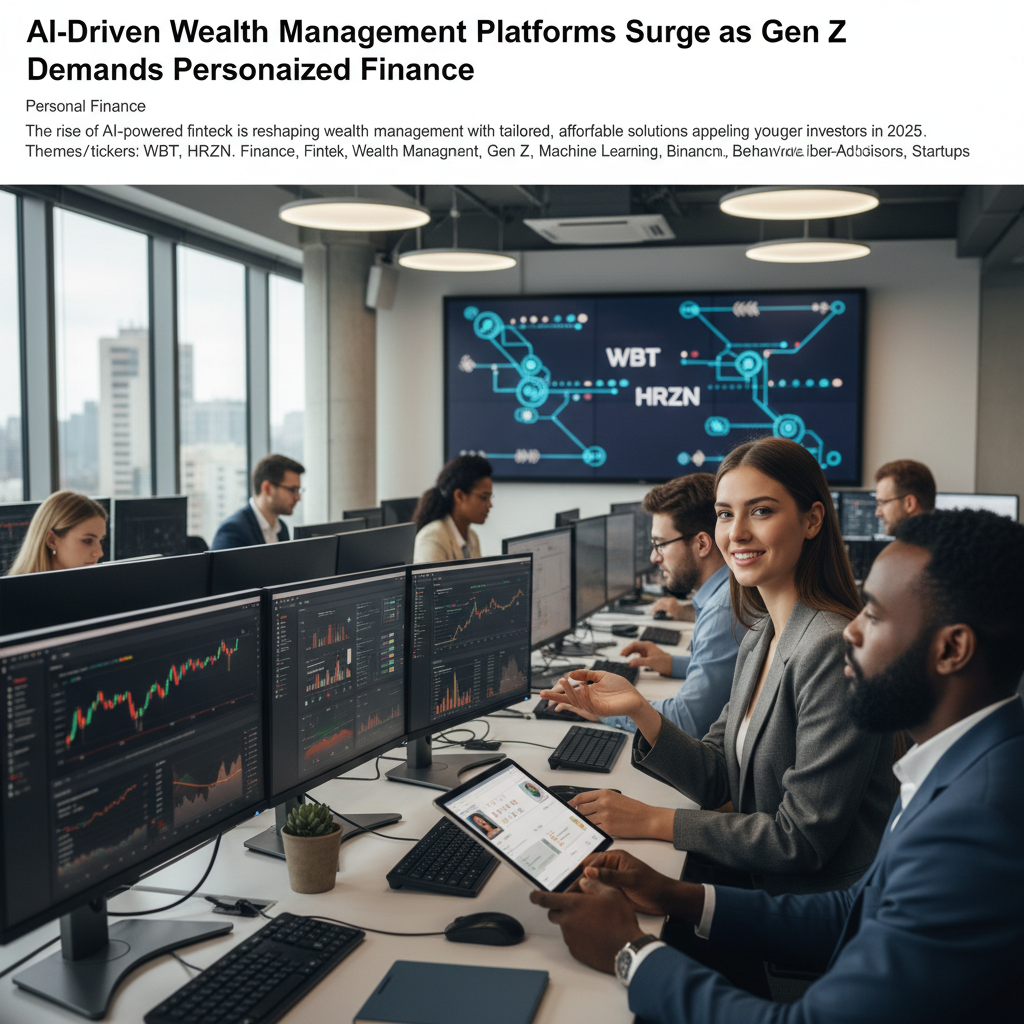
The new wealth managers don’t wear suits — they write models
Call it a migration. Money is quietly moving from brokers with corner offices to apps that speak like your group chat. In 2025 the shift picks up speed: a new generation of AI-first wealth platforms is no longer a curiosity. They're a strategic threat to traditional brokerages and a recruiting headache for old-line RIAs.
Here’s the thesis: younger investors don’t want a lecture. They want portfolios that feel personal, cheap, and responsive. AI gives them that. And it’s not academic anymore — it’s product.
Why Gen Z and younger Millennials matter
- They arrived in the market with phones, not paper statements. They learned to trade on apps and get financial life advice from TikTok, not from a quarterly meeting.
- They’re price-sensitive. A 1% AUM fee that used to be normal looks like highway robbery when you can get automated management for a flat $5–20 per month or 0.25% AUM.
- They value relevance over pedigree. A system that tailors allocations based on spending, subscriptions, career life stage, and even short-term mood signals resonates more than a cookie-cutter 60/40 pitch.
So what’s different now vs. the robo-advisor wave of a decade ago? Two things: richer data and smarter models. Back then, robos were glorified ETFs with low fees. Today’s entrants stitch together everything from transactional data and payroll feeds to social-sentiment indicators and device-level engagement metrics. Machine learning models — not just mean-variance optimization — power what looks like advice: micro-personalized tax-loss harvesting, automated rebalancing tied to real-time macro moves, and behaviorally tuned nudges that actually change saving habits.
Not all startups are the same. Some (think the WealthBot and HorizonAI archetypes) package a subscription-first relationship: flat monthly pricing, in-app coaching, and loyalty mechanics. Others offer zero-commission execution and monetize through ancillary services — credit, refinancing, or exclusive token launches. Meanwhile, incumbents from Schwab to Vanguard have two options: build or buy. Many choose both. Expect more VC dollars chasing the marriage of boutique UX + institutional plumbing.
What the tech actually buys you
- Lower fees, obviously. That’s the doorway drug. But price alone isn’t the story.
- Speed. Models can surface a liquidity event, suggest a stop-loss, or adjust exposure within seconds. In a world where retail flows can swing a small-cap stock by 30% in an hour, that latency matters.
- Behavioral integration. The platforms are learning to predict when you’ll sell at the wrong time and applying subtle friction or incentives to stop you.
These are not vanity features. They change the unit economics of advice. If you can retain a 25-year-old client for decades through subscription and cross-sell, lifetime value looks very different from an advisory fee paid by someone over 60.
The cracks you can't ignore
Don’t assume AI is magic. Models are great at pattern recognition, lousy at rare events and societal shifts that aren’t represented in training data. Overfitting is a feature, not a bug, when a firm rewards short-term engagement metrics.
Privacy is another battleground. To personalize at this level you need data that consumers are increasingly cautious about handing over. Will clients trade frictionless onboarding for greater surveillance? Some will. Many won’t.
Regulation will tighten. The SEC’s focus on fiduciary duty and “best interest” isn’t going away just because an algorithm wrote the advice. Expect questions about model explainability, backtesting disclosure, and who is accountable when an AI’s recommendation blows up. Firms that can’t explain why a model shifted a client into a storm will face enforcement risk and, more painfully, client flight.
Algorithmic bias matters. Models trained on skewed datasets will under-serve certain demographics. That’s not just a moral problem. It’s a business problem. Discrimination complaints, reputational hits, and regulatory probes all cost more than short-term growth metrics.
The human edge isn’t dead — it’s premium
There’s a narrative that humans are going extinct in financial advice. Ignore it. Human advisors still win in complex, high-net-worth cases where judgment, estate planning, tax nuance, and behavioral coaching converge. What AI does is commoditize the middle of the market — the part that was painfully expensive to serve before.
Winners will be hybrids. Think of brands that use AI to handle routine optimization and human teams to manage edge cases and relationships. The human advisor becomes a strategic overlay: storytelling, coaching, crisis management. That’s where margins survive.
Who will win?
- Startups that bake trust into UX and pricing. Young clients are fickle. A glitchy trade execution or a hidden fee destroys credibility fast.
- Platforms that combine retail distribution with institutional-grade risk controls. That’s a rare combo, but necessary.
- Incumbents that stop pretending they can win on legacy alone. Distribution matters; balance sheet matters; but so does a clean, mobile-first experience.
And who will lose? Boutique advisory firms that refuse to automate the routine and charge for things investors now expect for free. Large banks that treat this as a product problem only, not a cultural one.
A few uncomfortable ironies
- The more “personalized” the advice, the more it resembles a product designed by marketing. Personalization can become manipulation if not governed well.
- Platforms promising to remove emotion are themselves powered by models that indirectly encode human sentiment. Algorithms don’t remove bias; they translate and sometimes amplify it.
- Democratization can create new concentration. If ten AI platforms funnel retail flows into a handful of ETFs and securities, then market structure shifts from diversified attention to systemic crowding — a fragile new equilibrium.
What investors and advisors should do now
- If you’re an advisor: automate the parts of your practice that don’t need your brain. Use AI for rebalancing, tax harvesting, and client communications, and charge for judgment.
- If you’re a startup: focus less on novelty and more on retention. Subscription economics only work if churn is low and cross-sell is real.
- If you’re a regulator or compliance officer: prioritize explainability, consent frameworks for data use, and audits of training datasets. This isn’t a theoretical exercise; it’s going to be litigation fodder.
The bottom line
AI-driven wealth management won’t replace human advisors overnight. But it will reshape who pays for advice, how advice is delivered, and which firms control the customer relationship. The fight is not about whether algorithms are better than humans. It’s about which companies master the messy combination of data, design, and accountability.
Short version: if your business model depends on “we’ve always done it this way,” you’re at risk. If it depends on a black box, expect regulatory pain. If you can combine empathy, compliance, and fast models — you’ll own the next generation of assets under management.