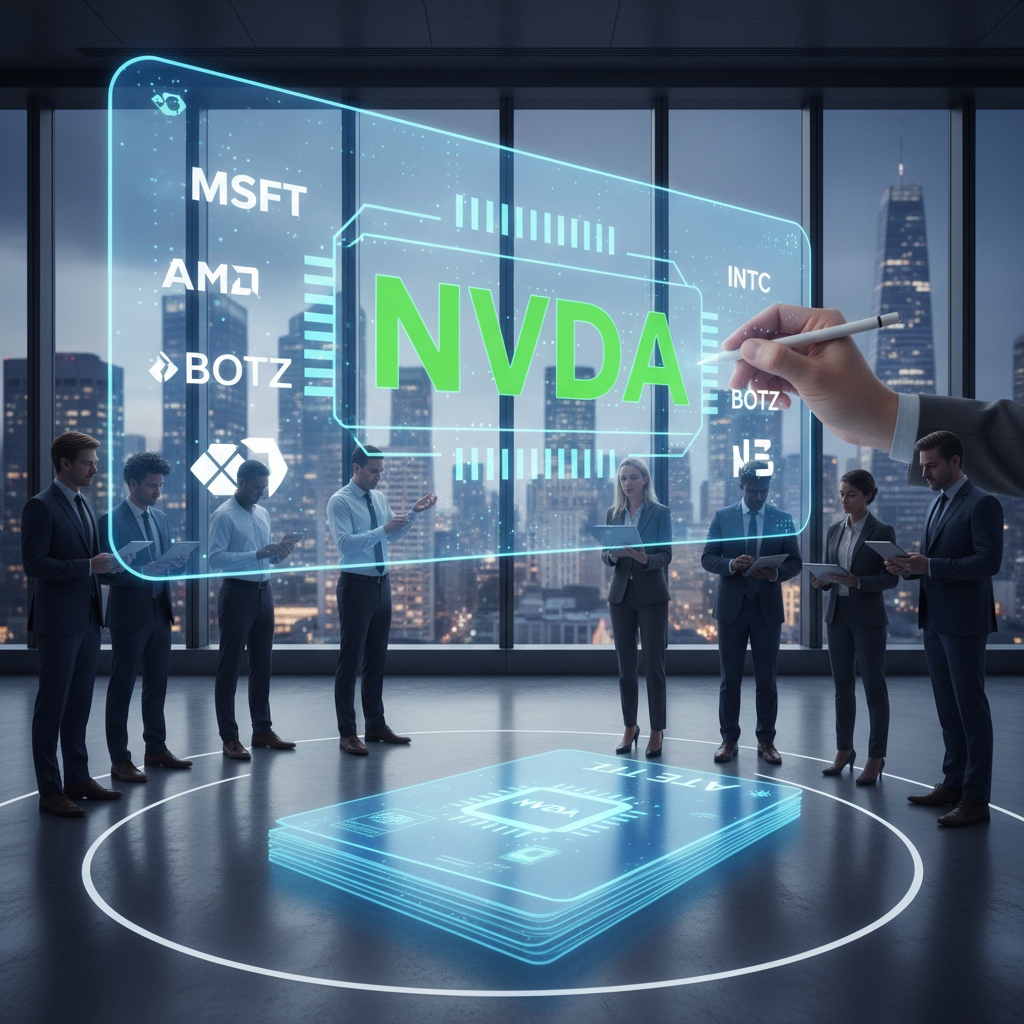
Short version — retail and institutional money poured into AI-themed ETFs, but a few hardware winners, led by Nvidia, now dominate those funds. What started as a sector bet increasingly looks like a concentrated wager on one company.
This isn’t mere fascination; it’s structural. AI workloads need specialized GPUs, and Nvidia built a multi-year lead. That shows up mechanically in index-weighted ETFs: market-cap leaders swell to outsized weights, so buyers who think they’re diversified end up taking idiosyncratic stock risk.
Why it matters now
- Several AI and robotics ETFs have single-stock weights above 20–30%. In some cycles Nvidia has accounted for high-30s percentages of a fund.
- That concentration converts a thematic allocation into a directional call on one company. One bad quarter, one regulatory headline, and the ETF’s performance can collapse with the stock.
- Retail flows tend to chase narratives. People pile in near peaks, which raises the odds of buying at stretched valuations.
Why this concentration happens
- Scale economics. GPUs require huge R&D and manufacturing commitments. Once a firm owns the software stack and the customer ecosystem, returns compound faster than in most software niches.
- Index mechanics. Market-cap or revenue-weighted benchmarks naturally tilt toward winners. It’s not a conspiracy; it’s math.
- FOMO. When a handful of names drive returns, inflows concentrate instead of spreading around.
A few counterpoints — it isn’t black and white
- Sometimes concentration equals a real economic moat, not just hype. Owning the leader can be the sensible long-term call.
- Active managers still find smaller chipmakers, infrastructure plays, and AI software firms that could outpace the giants in the next cycle.
- Plenty of investors are explicit about wanting exposure to the story and accept single-stock risk as the price of that narrative.
Practical moves for investors
- Audit your holdings. Look past the ETF label and check the top 10 weights. If one name dominates, treat the ETF like a sizeable single-stock position.
- Consider alternatives: broader tech ETFs, cloud-computing funds, or active AI strategies that cap single-stock exposure.
- Size and hedge. Use smaller allocations to thematic ETFs, or buy protection (puts) if you need larger exposure to a fund with a concentrated top holding.
- Dollar-cost average into themes rather than making a lump-sum bet at the peak.
Specific examples
- Many popular AI and robotics ETFs behave like large-cap tech plays because their weighting rules favor the biggest market caps.
- Active funds that cap positions or tilt toward mid-cap AI enablers sacrifice some upside but gain risk control — a deliberate trade-off.
A historical lens
This echoes late-90s tech concentration and later FAANG-driven distortions, with a key difference: today’s AI winners sell physical silicon and essential infrastructure, not just attention. That generates more durable cash flows — and more regulatory scrutiny.
Things I’m watching
- ETF rebalancing rules. If issuers cap weights or move toward equal-weight schemes, concentration could ease.
- Antitrust or export-control moves. A policy that restricts advanced chip flows would ripple through every AI-themed fund.
- Real competitive entrants in silicon or servers that materially erode incumbent margins.
If you own an AI ETF, don’t assume diversification by label. Think of your portfolio as a mosaic, not a monolith. Rebalance with intention, size positions to your risk tolerance, and remember thematic investing is as much about managing the story as it is about managing sector exposure.