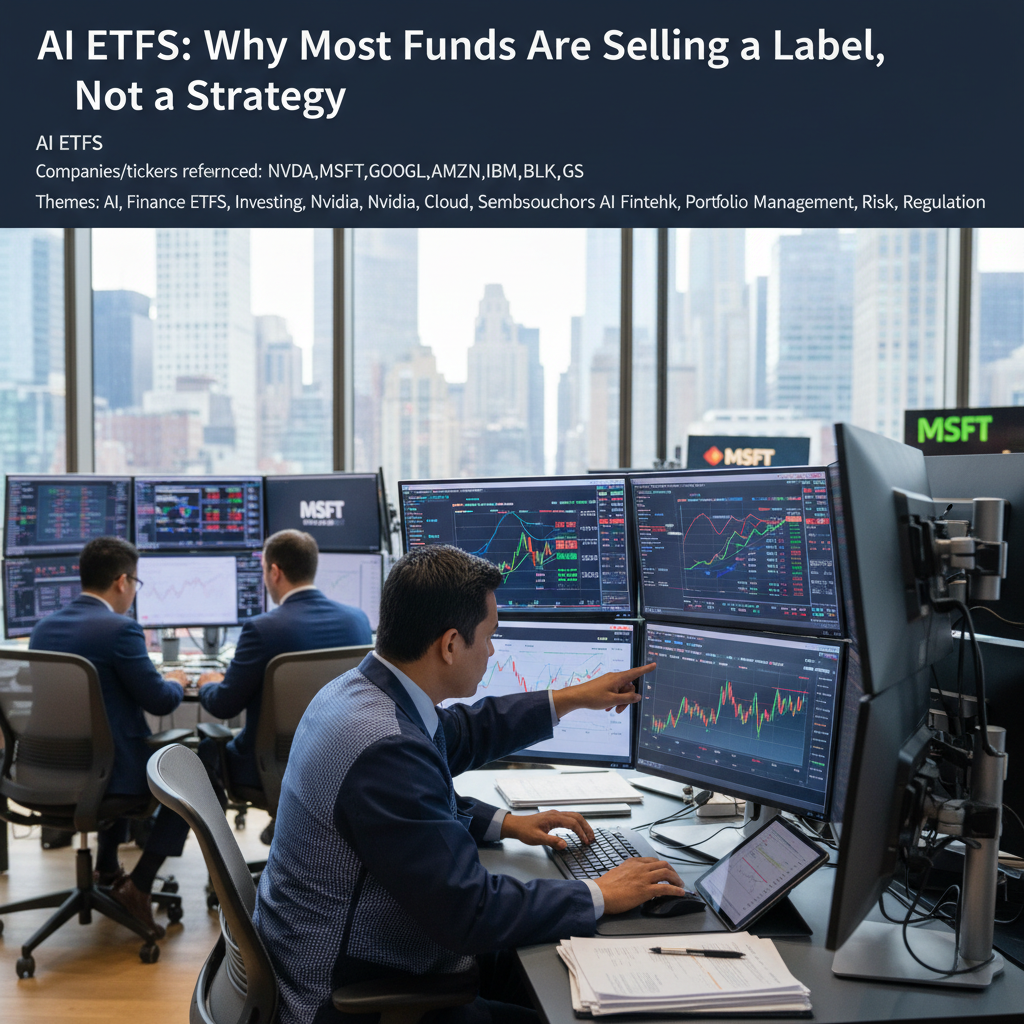
Simple point: money managers are sticking AI on product names faster than they can explain what’s actually inside. That doesn’t make every AI ETF a bad idea — but it does mean buyers need a sharper checklist.
The market feels a lot like the late 1990s naming spree. Back then, tech equaled growth and everything got folded into dot-com stories. Now AI is the hot narrative. But the businesses, valuations and competitive moats behind those tickers are all over the place.
Where your money actually goes
- Hardware concentration. A lot of these funds end up dominated by chipmakers and semiconductor suppliers that feed generative models. That’s exposure to capital-cycle dynamics, not SaaS-like recurring margins.
- Cloud and services. Big cloud providers show up near the top because they host the models and sell model-as-a-service. Durable revenue, yes — but also an oligopoly bet.
- Legacy software and consulting. Some funds tuck in incumbents that will monetize AI through enterprise software and services. Slower growth, steadier cash flows.
How the label can mislead
- The name implies machine-learning‑native managers or algorithmic trading when many funds are simply passive, index-driven plays.
- Outperformance often reflects concentration or factor bets, not secret AI alpha.
- Fees and turnover aren’t uniform. Boutique thematic ETFs can charge a premium while offering little active advantage.
Checklist before you buy
- Read the holdings and sector weights; ignore the slick marketing sheet.
- Check concentration. If the top five names are >40% of assets, you’re effectively buying a handful of bets.
- Decide what exposure you actually want: chips, cloud, or applied AI software—those behave differently in downturns.
- Compare fees and the tracking methodology. Is this a plain index fund or an active strategy wearing thematic clothes? Look at index rules; they can be quirky and matter for returns.
A bigger tension
There is a reasonable case that AI will boost productivity across industries — that’s the bullish intellectual case. The problem is markets have priced most of that story into a small set of winners. If chip demand softens or cloud margins compress, many AI-branded portfolios could re-rate at once.
That said, concentrated thematic clusters sometimes do produce durable leaders that justify higher multiples. The hard part is sorting structural winners from speculative darlings. It’s messy in practice.
Signals to watch
- Earnings commentary from chipmakers and cloud providers for signs of sustainable AI-driven revenue.
- ETF flows and creation activity. Heavy inflows into a narrow set of names can amplify volatility.
- Regulatory moves around AI in finance, which could change how quant shops and asset managers deploy models.
How to think about it
Don’t buy an AI fund because the name sounds futuristic. Buy the specific economic exposure you want, understand concentration and factor risks, and treat AI-themed funds as a tilt in your portfolio — not a magic shortcut to beating the market.
Pedro Marini