Why this matters now
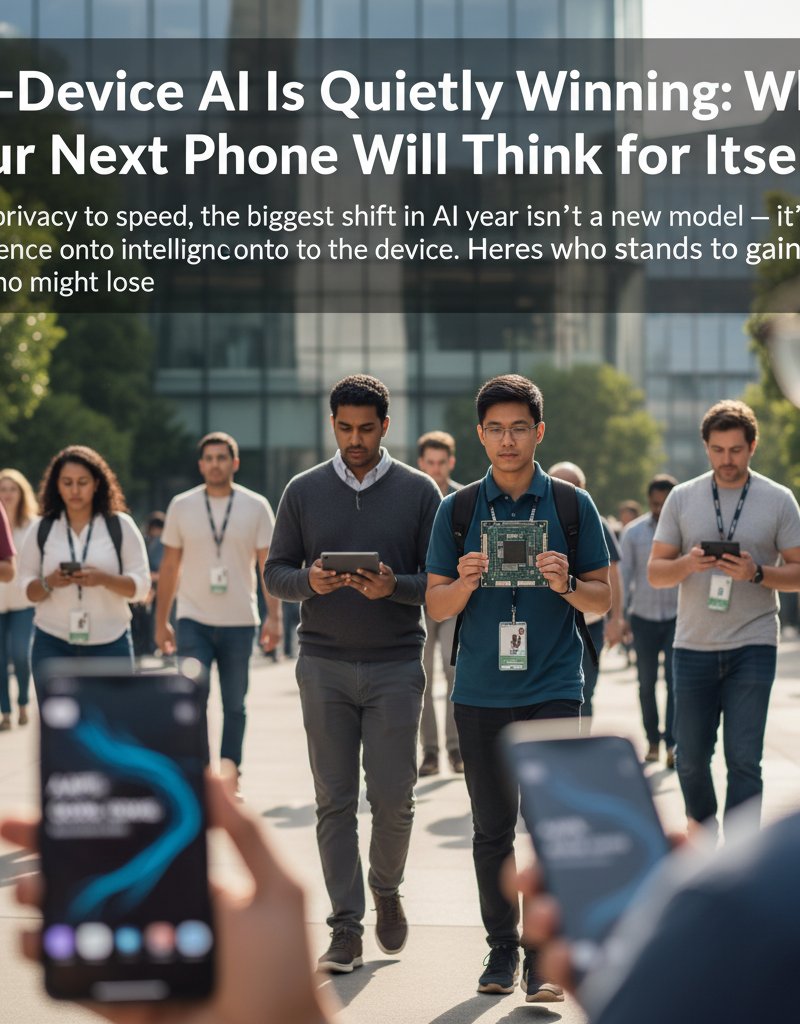
Apple pushing advanced AI to run locally on iPhones and Macs is not just a marketing line. It’s an architectural decision that could shift where the economic value of AI ends up. For years the winners were cloud providers selling compute by the hour. If consumer devices start doing significant portions of inference — even some on-device fine-tuning — the economics flip in surprising ways.
A quick history lesson (not nostalgia)
Think of this as a new swing of the client-server pendulum. We moved from mainframes to PCs to the cloud; now compute is creeping back toward the device, except today the devices are orders of magnitude more capable. Apple’s neural engines plus custom silicon are the new personal workhorse: fast, more private, and harder to dislodge.
What Apple picks up
- Privacy as a real product difference. Running requests on-device cuts the need to send data out, and that maps onto Apple’s brand and gives regulators fewer levers to pull.
- Tighter control over the whole stack. Hardware, OS, and services working together mean smoother updates and deeper integration — and a chance to build a subscription moat.
- Lower recurring cloud bills. If routine features don’t hit public clouds, Apple reduces operating costs and shifts the profit mix toward the device and services.
What’s interesting here is how these advantages compound. Privacy buys trust, which boosts adoption, which makes the on-device model stickier.
What cloud incumbents stand to lose — and how they might fight back
- A change in revenue mix for AWS, Azure, and Google Cloud. If consumer inference workloads slide, the growth engines of those businesses could look different, especially where margins are richest.
- Defensive strategies exist. Cloud providers can double down on training, complex enterprise data services, and hybrid offerings — basically selling the heavy lifting and orchestration that phones cannot practically do yet.
So it’s not wipeout or nothing. Expect competition, not surrender.
Nvidia: collateral damage or partner?
Nvidia dominates GPUs for both training and inference. Apple’s move will probably reduce some consumer-inference demand, but it doesn’t end the need for massive data-center training. That leaves Nvidia in an odd, familiar spot: both a supplier and a competitor, depending on how on-device accelerators evolve.
Practical limits and caveats
- On-device models still lag the largest cloud models in raw capability and continuous learning. Big retrains, multimodal fusion, and extremely large parameter counts stay in the datacenter for now.
- Rolling out model updates and governing behavior across billions of devices is messy. Apple will have to juggle privacy promises with the practical need for frequent improvements.
- Developers might push back if Apple locks powerful capabilities behind proprietary APIs or costly subscriptions. That tension could shape adoption.
In practice, the story is messier than headlines suggest.
Concrete examples you’ll see now
- Better local transcription, inbox summarization, and assistant features that use personal context can run entirely on-device, improving UX while keeping data private.
- Startups are building lightweight, privacy-first LLMs aimed at phones. Expect hybrid patterns where the phone does the first pass and the cloud finishes the harder parts — and new licensing deals to match.
Why investors and customers should care
This is less a product tweak and more a potential business-model shift. Investors should re-check growth assumptions for cloud revenues tied to consumer inference. Enterprises should plan hybrid architectures: keep sensitive or latency-critical workloads local, and use the cloud for scale training and analytics.
The upshot
Apple’s on-device AI challenges the assumption that the cloud is the default home for all AI. Hardware plus software still matters — a lot. We’ll get more variety in how AI is delivered: private, fast, and embedded. It won’t produce a single winner. Expect a bumpy, multiyear transition where partnerships, niche models, and regulation decide who actually gets paid.