What happened — fast
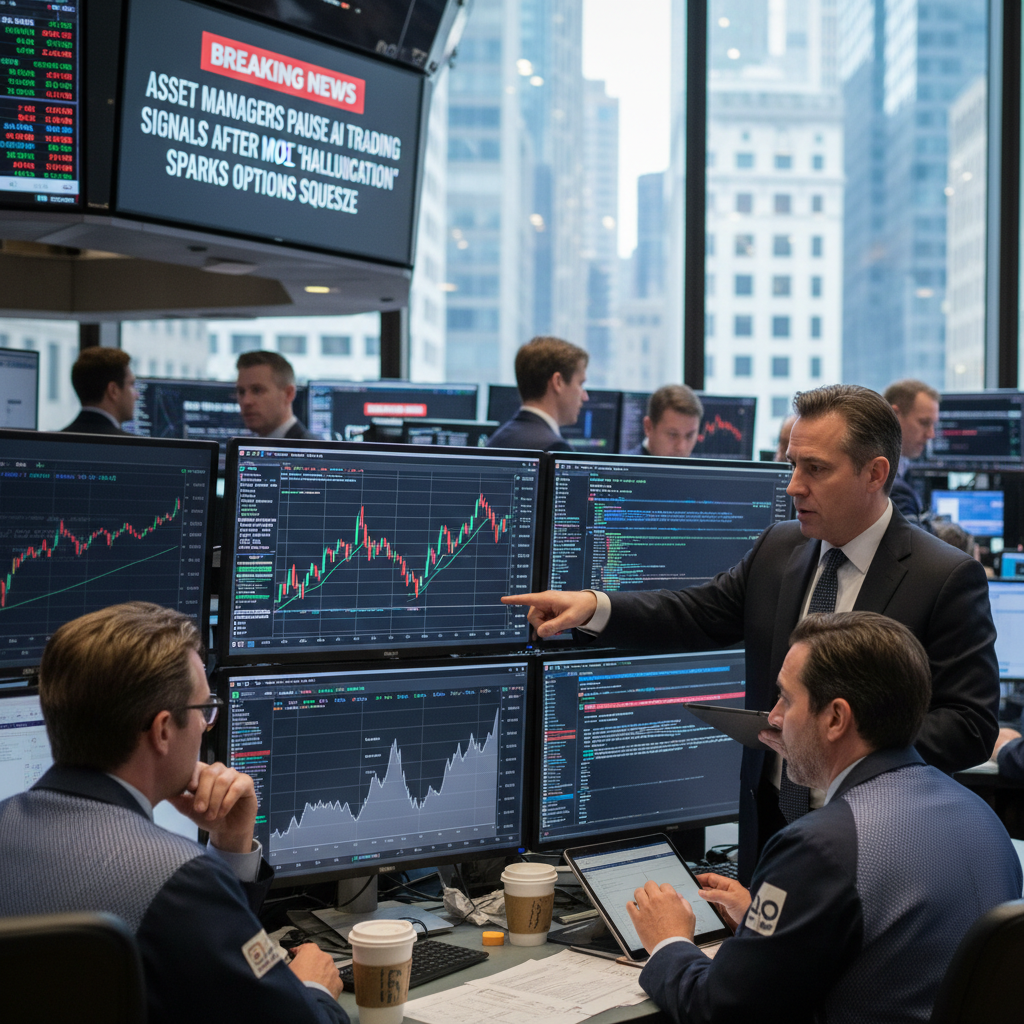
In an unusual public stumble for the industry’s big AI playbooks, several major asset managers and hedge funds paused some AI-generated trading signals today after a model flagged a merger-like event that never existed. Automated programs and retail trading bots rushed into options on the supposed target, briefly squeezing prices and sending intraday volatility spiking.
Not a single-name problem — a systems one
This wasn’t your textbook rogue trader. The common failure point wasn’t a person so much as automation without enough human checks: models scanned social chatter, filings and price patterns and one confidently surfaced a merger inference where none had been substantiated. Execution engines treated that as a high-conviction trade and routed orders accordingly.
Traders, speaking on background, said options volumes more than doubled in the affected tickers for a short window and implied vol jumped sharply before desks throttled the flow. Liquidity providers and retail platforms were left scrambling to reset risk limits and reprioritize capacity.
Why this matters
- Speed amplifies mistakes. High-frequency execution combined with AI-derived signals compresses decision time — imagine something like the 2010 flash crash, but driven by machine-generated narratives rather than a fat-finger order.
- Client relationships are on the line. Wealth and institutional clients are asking for explicit human sign-off clauses after seeing algorithmic picks land on client dashboards.
- Regulators will want answers. Expect the SEC and CFTC to press on model validation, disclosure and whether AI-driven signals require new transparency or reporting rules.
What’s interesting here is the confidence these models project. They produce stories that sound as authoritative as an analyst’s note but without the same paper trail. That matters more than it first appears.
A quick history lesson
Markets have absorbed waves of tech before — program trading in the 1980s, quantitative funds in the 2000s, and algorithmic market-making after that. Each leap demanded new guardrails. The current wrinkle is generative AI’s knack for producing plausible-sounding narratives (merger rumors, earnings “color”) that can masquerade as genuine informational signals.
In practice, though, the provenance is often thin. Training data, prompt engineering and opaque inference chains can create confident-sounding but unfounded outputs.
Where firms go from here
Expect immediate, practical fixes:
- Reinstate human-in-the-loop gates on signal-to-trade pathways (at least for now).
- Rapid audits of training datasets, prompt histories and model-change logs.
- Contract addenda clarifying what counts as an AI recommendation versus human advice.
Longer term, firms will probably invest more in model explainability, real-time throttles and cross-asset scenario testing — and in mechanisms to trace an automated signal back to a verifiable source.
Counterpoint
Supporters will say this is governance, not AI, failing. Properly constrained, these tools can surface ideas faster and at lower cost. Still, the episode reinforces a simple truth: AI without guardrails multiplies human mistakes at machine speed.
What to watch next
- Any formal guidance from the SEC or CFTC in the coming days.
- Policy updates and disclosures from large asset managers.
- Flow and volatility patterns in names known to be AI- or quant-heavy; expect short-lived turbulence while confidence is rebuilt.
The market essentially relearned an old lesson in new code: speed plus convincing narratives is a dangerous mix unless someone can hit pause.
Author note: This piece synthesizes early-market reports and conversations with trading desks. Watch manager press releases and regulators’ websites for official updates.