The cloud is getting crowded. The action is at the machine.
For three decades industrial automation outsourced brainpower to giant data centers. Send the sensor logs up, wait for the verdict, act. That model bought scale and convenience. It also bought delay — fractions of a second that today’s assembly lines, forklifts and 18-wheelers can’t afford.
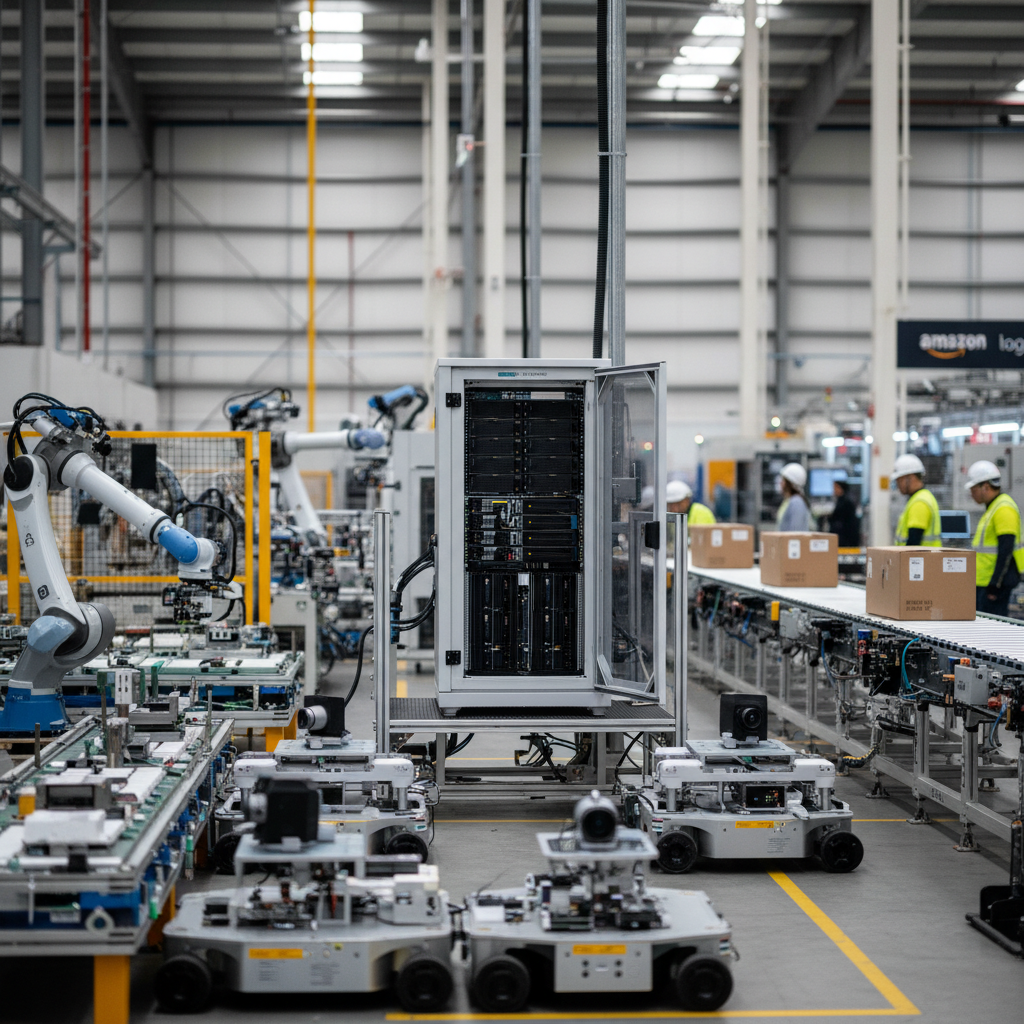
Edge AI changes the timing. Put the model where the metal meets the world: inside a motor controller, on a camera beside a conveyor belt, or in a telematics unit bolted to a trailer axle. Decisions that used to take seconds — or minutes, if human review was involved — now happen in the same heartbeat as the event. That’s not incremental improvement. It’s a reallocation of value.
Short version: companies that master intelligence at the edge will cut downtime, reduce waste and squeeze costs in ways the cloud alone couldn’t.
A few concrete scenes:
- On a semiconductor line, a camera watches wafer edges and flags micro-cracks in milliseconds. That used to mean a bin full of rejected wafers discovered hours later.
- In heavy equipment fleets, local sensors detect atypical vibration patterns and shut down a pump before bearings fail, saving a $60k gearbox.
- In last-mile logistics, smart locks and route-aware cameras let couriers reroute or reattempt delivery instantly, slashing missed-drop costs and improving customer experience.
These aren’t thought experiments. Siemens, ABB and Honeywell are integrating edge inferencing into PLCs and DCSs. Amazon and Microsoft no longer just sell cloud cycles — they bundle edge services (AWS IoT Greengrass, Azure IoT Edge) because customers demand hybrid architectures. On the silicon side, Google’s Edge TPU, Nvidia’s Jetson series and Qualcomm’s Snapdragon platforms show where investment is going: specialized compute for small form factors.
Why this matters to markets
Edge AI rearranges where profits sit. Historically, cloud providers captured recurring revenue from compute and storage while industrial OEMs sold hardware and one-off software. Edge flips the math. Embedded AI is a product feature that can be monetized as subscription services, predictive maintenance packages, or premium firmware. That gives OEMs a lever for higher-margin recurring revenue — provided they can support lifecycle software, updates and data services.
Investors should watch three buckets:
- Chipmakers and IP vendors: Companies that sell efficient inference silicon for constrained environments — think low-power NPUs, FPGAs tuned for real-time tasks — are in the line of sight. Margins in specialized silicon remain healthier than commoditized cloud instances.
- Industrial software platforms: Firms that solve deployment, model management, and over-the-air updates for fleets of edge devices are becoming gatekeepers. The company that makes it easy to push a model to 10,000 pumps and roll it back when performance dips will command sticky revenue.
- Systems integrators and OEMs: Traditional hardware vendors that adopt software-first models stand to defend margins — or lose them if they don’t.
The technical cliff: latency vs. capability
Running AI at the edge is not magic. It’s a set of trade-offs. Local inference cuts latency and reduces bandwidth needs. It also puts pressure on power, thermal limits and model size. You can’t drop a 175-billion-parameter model into a conveyor-belt controller. Engineers compress models, prune them, distill knowledge, or push only the essential features locally while sending summaries to the cloud for heavier analysis.
Then there’s operational complexity. Deploying thousands of devices across factories or vehicles raises questions that CIOs hate:
- How do you update models safely without bricking critical equipment?
- What telemetry stays local for privacy and what goes up for retraining?
- How do you prevent model drift when the environment changes?
Answers are emerging: federated learning, secure boot chains, containerized inference runtimes and device management platforms. But these are still immature in many brownfield deployments where legacy PLCs rule the floor. Interoperability — the industrial “app store” problem — remains unsolved.
Security is not an afterthought
Edge reduces some cloud risks — less raw data in transit — but creates new attack vectors. A compromised edge node can falsify readings, disable safety interlocks, or give attackers a foothold into on-prem networks. That’s why security-by-design — hardware root of trust, signed firmware updates, anomaly detection at the device level — is mandatory, not optional.
Regulators will notice. Privacy rules (think: GDPR for telemetry; sector-specific safety standards) and safety certifications for autonomous decision-making in industrial settings will shape adoption curves. Companies that treat security as compliance theater will find their deployments stalled by auditors and lawyers.
Where the economics get interesting
Predictive maintenance is the poster child because the ROI is easy to calculate: fewer unplanned outages, longer equipment life, lower inventory for spare parts. But the real upside is composability. Once an edge node is in place, you can add vision-based quality control, energy optimization, load balancing, autonomous material handling — each use case leverages the same installed base.
This modularity drives a flywheel: more capabilities → more value per device → lower incremental cost of adding features → higher customer stickiness. That dynamic is why incumbents are racing to build software platforms around their hardware.
The friction: skills and culture
Old-guard industrial firms know nuts-and-bolts engineering. They do not necessarily know model training pipelines, MLOps, or the nuance of model explainability. The talent mismatch is real. Hiring data scientists into an industrial floor operations team is not a plug-and-play fix. Expect partnerships and M&A to fill that gap — software firms bringing MLOps expertise, or chip vendors acquiring system integrators.
Also: culture. Plant managers reward uptime. They distrust “black box” models that make calls without human oversight. The most successful deployments will be those that present interpretable signals and put humans in the loop for critical decisions.
Winners, losers, and the middle ground
Cloud giants won’t be sidelined. They’ll pivot. Their play: be the brain for heavy lifting (model training, long-term analytics) while offering the glue — device management, secure runtimes and subscription services — that keeps them in the loop. That hybrid approach is expensive for customers but familiar. The risk for cloud-first vendors is commoditization: if silicon vendors and industrial software firms create effective, cheaper edge stacks, enterprises will bypass the hyperscalers for on-prem solutions.
Hardware-only vendors face pressure. If you just sell a motor with embedded AI but no ongoing service, you leave recurring value on the table and become vulnerable to aftermarket software players.
Startups will flourish where incumbents are slow: lightweight inference engines, workflow orchestration for fleets, and tools for interpretability in systems where safety matters. That spells more VC money in industrial SaaS and edge-native platforms. Expect consolidation as enterprise buyers favor partners with scale and regulatory credibility.
A not-so-obvious upside: sustainability
Edge intelligence can drive energy savings in real time — optimize HVAC for occupied zones, throttle conveyors to match throughput, or schedule machines to run when renewables are abundant. Those are tangible cost savings and, increasingly, compliance requirements. ESG teams will demand proof-of-impact, and edge systems can provide it at the device level.
Bottom line (and a bit of an opinion)
This isn’t about replacing the cloud. It’s about pattern recognition: where decision speed matters, the compute will move to the point of action. Companies that view edge AI as a feature rather than a strategic platform will get eaten alive by firms that tie software into hardware and monetization. The winners will be those who solve lifecycle management, secure updates, and clear ROI — quickly.
For investors: watch the platforms that sell the orchestration layer and the silicon specialists who make real-time inference cheap and power-efficient. For industrial leaders: start small, prove savings on one line or one truck fleet, then scale. Ignore this shift at your peril — latency is the new margin.
Key takeaways
- Edge AI replaces wait-and-see with instant decisions — that’s where value is captured.
- The prize is recurring revenue: software + services layered on top of hardware.
- The technical blockers are real: power, updates, security and workforce skills.
- Expect a hybrid market: hyperscalers will adapt, but specialist vendors will own niche economics.
- Start-ups and M&A will accelerate consolidation; sustainability use cases give edge a second wind.