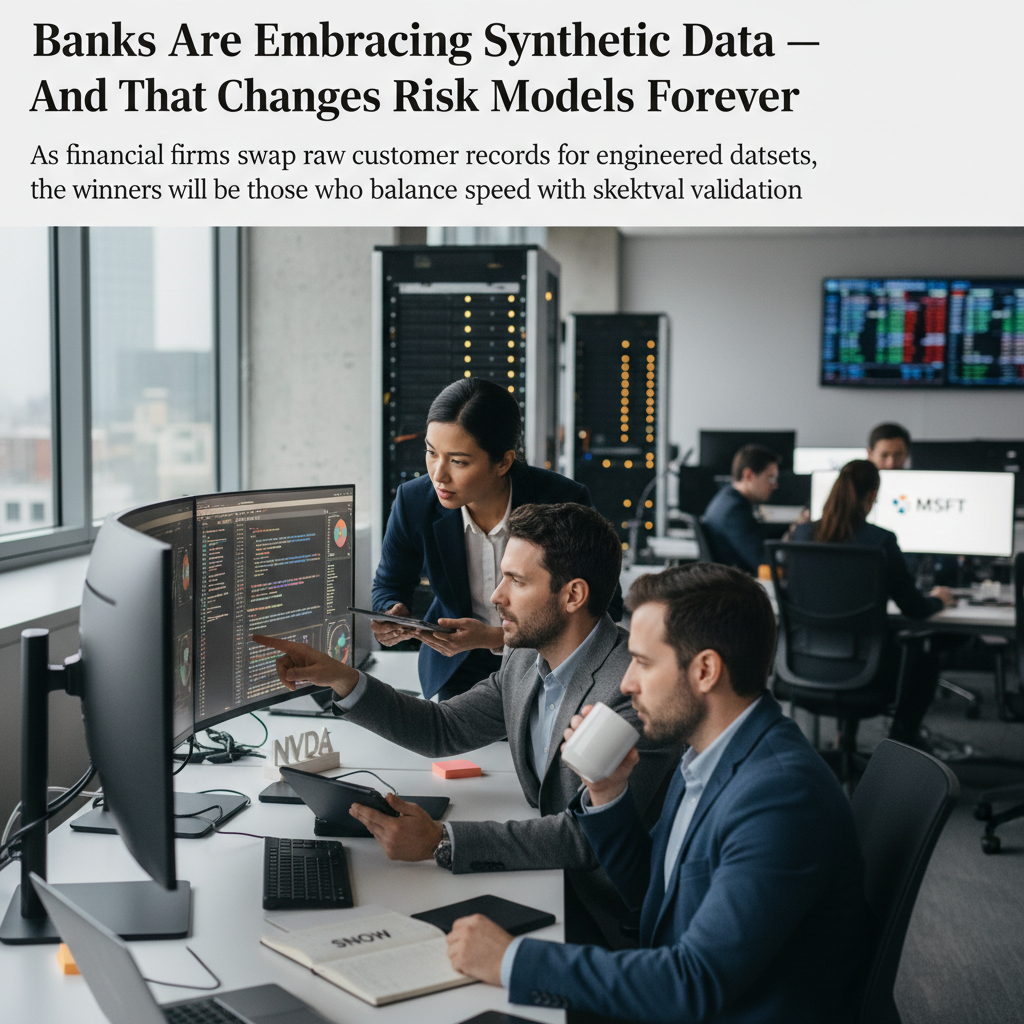
Synthetic data has quietly moved out of research labs and into Wall Street’s model shops. What started as a niche fix — generate fake-but-plausible records so you don’t have to ship real customer logs around — is turning into a practical lever for banks, fintechs, and the cloud companies that host them.
The appeal is obvious: regulators and customers demand privacy; quants and ML engineers demand data. Synthetic lets teams spin up datasets that mirror behavior, train fraud detectors or credit models, and keep PII locked away. Simple in concept. Messier in practice.
Why now
- Bigger models and cheaper compute have made generative techniques far more convincing than the jittery outputs we saw five years ago.
- Consolidated data platforms — think lakehouses and unified pipelines — let organizations run synthetic workflows at scale without reinventing the plumbing.
- Past privacy fiascos (who remembers the AOL search leak?) left institutions wary of releasing raw logs, even internally.
Still, synthetic data is not a free lunch. Three practical risks keep cropping up.
- Distributional dishonesty
Synthetic approaches reproduce common patterns well. They tend to fail at the rare, high-risk tails. Fraud spikes, market dislocations, and weird credit behaviors are exactly the signals models need most. If your training set glosses over those tails, models can look robust in test but fall apart under real stress. It sounds obvious, but you’d be surprised how often teams miss it.
- Hidden bias
Train a generator on biased inputs and it will bake that bias into every sample — sometimes amplifying it. That’s not just a technical problem; it’s a regulatory and reputational time bomb for lending and underwriting systems.
- Auditability and governance
Regulators want provenance and lineage. Synthetic data breaks the neat audit trails people are used to. How do you prove a synthetic set preserves the statistical facts regulators care about while still protecting privacy? There are technical answers, but they require discipline and extra tooling.
Concrete signals in the market
- Vendors are already positioning for a synthetic-data economy. Expect demand for GPUs (Nvidia), cloud credits (Microsoft, AWS partners), and lakehouse tooling (Snowflake and the like).
- A regional bank piloted synthetic training for a fraud classifier and cut data provisioning from weeks to days. Progress, yes — but a staged stress test revealed big gaps in tail-event coverage. Synthetic sped up iteration; it didn’t replace careful validation.
What smart teams are actually doing
- Mix synthetic work with untouched holdout slices of real data. Use synthetic for exploration and speed, but benchmark against production before you deploy.
- Adopt differential privacy and other provable guarantees where rules are tight.
- Red-team the models: inject adversarial and rare events deliberately to see how brittle the system is.
Industry and investment implications
This favors companies that can bundle compute, governance, and model management. Nvidia keeps winning on raw compute. Snowflake-style vendors sell the plumbing. And expect specialist synthetic-data startups to be snapped up by larger enterprise players looking to round out their stacks.
A quick, candid takeaway
Synthetic data changes workflows more than it eliminates risk. The smartest firms will treat it as a high-octane test environment — great for discovery and iteration, not a substitute for final validation. Ignore the tails at your peril; models can look impeccable in a sandbox and fail where it matters.
If you follow financial AI, watch this shift closely. It promises speed and privacy, but success will hinge on governance, skeptical testing, and a healthy suspicion of anything that seems too perfectly engineered.