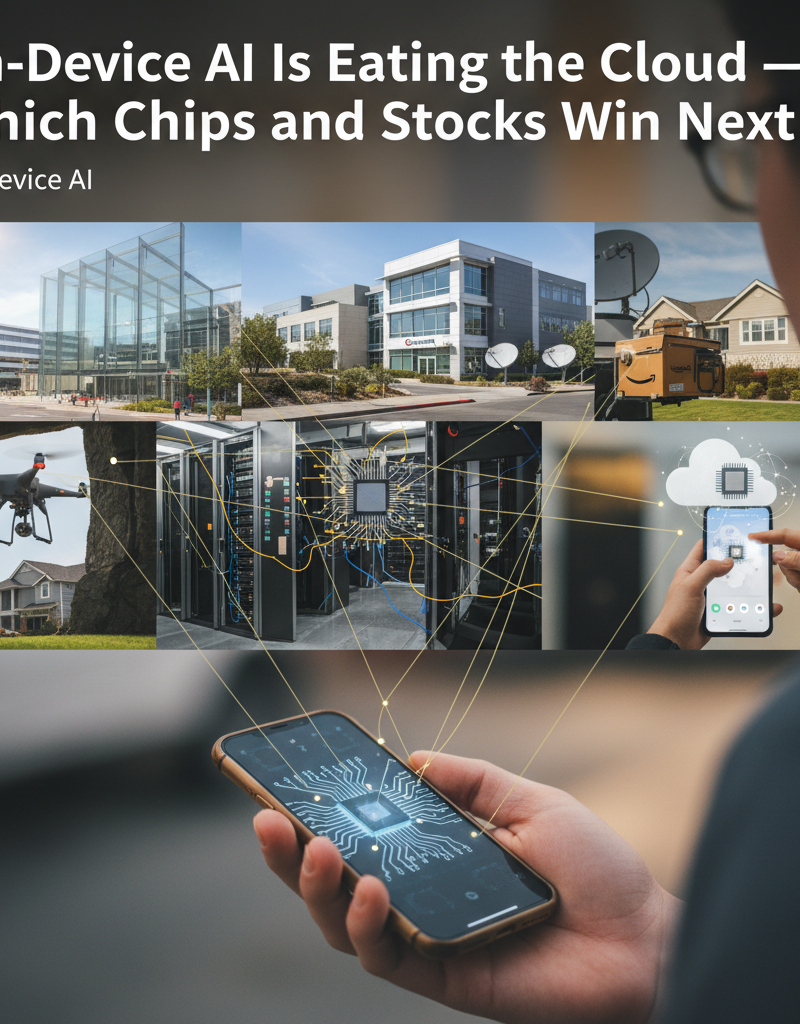
The shift isn’t subtle anymore. What began as occasional on-device tricks — autocorrect, local dictation — has become a deliberate strategy for banks, chipmakers, and app developers. Modern phones now pair dedicated neural engines with model compression and privacy-first design, so meaningful AI can run without a round trip to the cloud.
Why this matters for finance
- Privacy by default. Sensitive transaction signals can be scored locally, so less data needs to leave the device. That lowers exposure to leakage and eases some regulatory headaches.
- Latency and UX. Fraud alerts, budget nudges and conversational helpers feel immediate when inference happens on the phone — a tangible difference for people on shaky networks.
- Cost and scale. Fewer cloud inferences mean smaller GPU bills. That frees budget for product work or wider margins. It also changes how teams think about operating costs.
How we got here
Mobile silicon caught up. Apple’s Neural Engine and newer Snapdragon AI cores put real horsepower into pockets. At the same time, model compression — quantization, pruning, distillation — made small-but-capable language models realistic for phones. Google’s compact-model work and several open-source projects closed the software gap.
Ten years ago voice assistants needed heavy cloud lifting; today a handset can handle intent parsing and next-action suggestions with no uplink. For finance that progress gets repurposed: local anomaly detection, personalized advice, and model access protected by on-device biometrics.
Concrete use cases already appearing
- Offline personal finance assistants that profile spending without shipping transaction histories to vendors.
- Real-time fraud scoring that fuses sensor data and transaction context, flagging suspicious behavior before charges settle.
- KYC and identity checks that pre-validate documents and liveness locally, cutting how much PII reaches third-party servers.
Trade-offs and the hard parts
- Model freshness versus privacy. Updating models or retraining without centralizing data is tricky. Banks need secure update channels and careful telemetry design if they want accuracy without pooling raw customer data.
- New security surface. Moving models to devices reduces cloud exposure but creates other risks when phones are compromised. Ensuring model integrity and protecting weights matters more than ever.
- Device fragmentation. Not every customer owns a flagship with an NPU. Firms will have to choose which features live on-device and which fall back to the cloud, and that choice will affect both UX and cost.
Market implications
Chipmakers and OS vendors benefit when banks ask for secure, efficient NPUs. Expect closer ties between large banks and silicon players, and more tooling aimed at deploying models at the edge. From an investor angle, companies that supply both hardware and the orchestration for secure on-device updates look more interesting.
A skeptical corner
Cloud proponents are not wrong: heavy models, cross-user learning and centralized auditing still favor servers. Auditors often want central logs, which on-device processing can complicate. The practical outcome is probably hybrid — local inference for latency and privacy; cloud systems for training, analytics and regulatory records.
What to keep an eye on
- Bank pilots that actually prevent fraud offline, not just sprinkle UI polish on the app.
- Emerging standards for secure model updates and logging that reconcile privacy with auditability.
- Vendors focused on federated learning and certifiable on-device models for regulated industries.
The upshot
On-device AI is no longer a gadget trick. It’s changing how financial services handle customer data, costs and responsiveness. Expect more invisible intelligence in payments and budgeting — faster and more private, but also messier for compliance teams and security engineers. Consumers should get smarter, less leaky banking apps. For the industry, it becomes a strategic contest over who controls the small models at the edge.
Pedro Marini