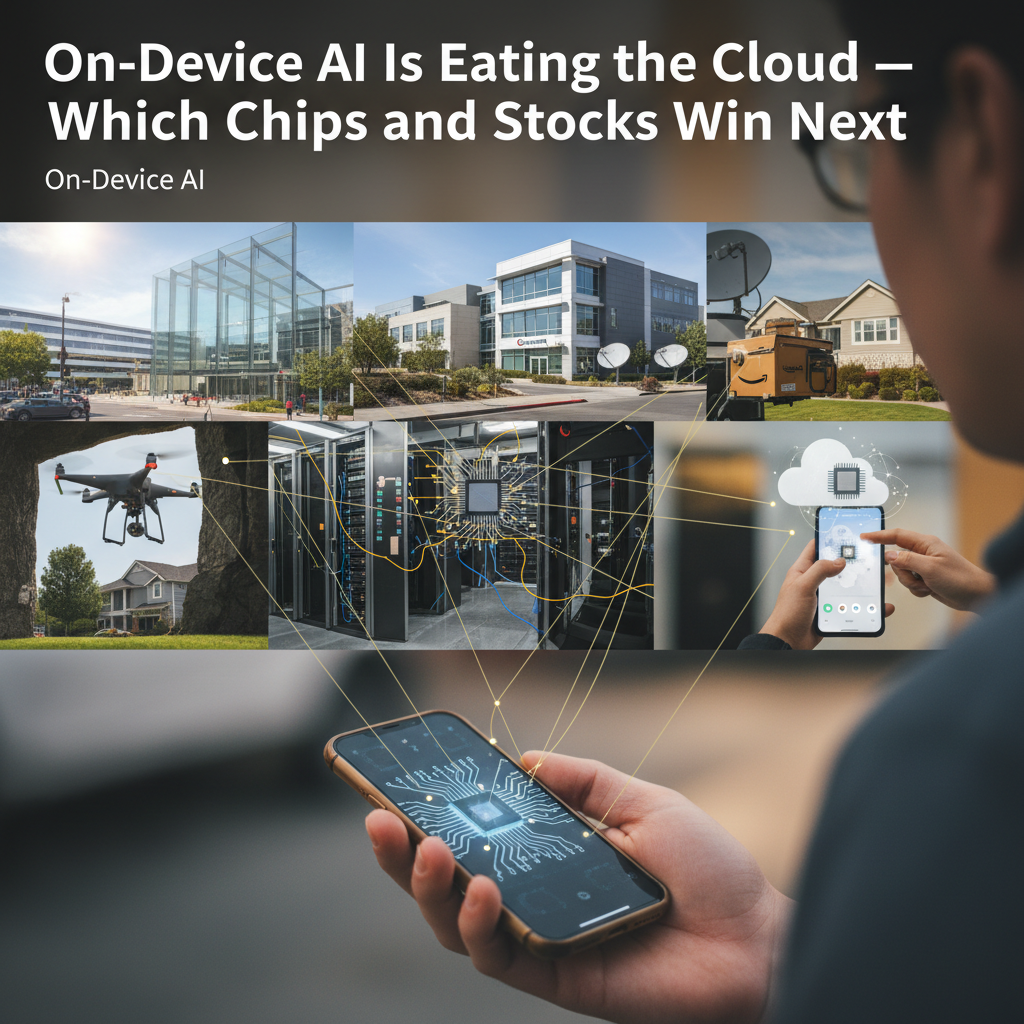
The shift is happening under our thumbs. Phones and PCs are no longer just app platforms — they're becoming hosts for local generative models, personal assistants, and privacy-minded vision pipelines. That migration away from cloud-first inference toward serious on-device intelligence is quiet, but it will bend chip supply chains, software stacks, and investor narratives in ways most people haven't fully internalized.
Why this matters now
- Latency and privacy matter. Users expect instant replies and fewer data roundtrips to servers. Running models locally answers both.
- Power and cost trade-offs are getting better. Dedicated NPUs, smarter quantization, and improved compilers mean useful models can run without killing battery life.
- Software and ecosystem control are more valuable than raw FLOPS. Tight hardware–software pairing can turn into recurring revenue and healthier device margins.
A quick history for perspective
Remember computational photography a decade ago? Complex image processing moved off the cloud and into silicon plus local software. That shift created winners — chipset designers and OS vendors with tight stacks — and losers, like some cloud photo services. On-device AI looks like the same story, only broader: search, voice, camera, productivity — all of it.
Who wins (and why)
- Apple (AAPL) — Vertical integration is their advantage. The Neural Engine combined with system-level software makes premium devices ideal for private, low-latency features. That supports higher device prices and stickier services. It’s not guaranteed, but it’s a clear path.
- Qualcomm (QCOM) — Default silicon for Android OEMs is a powerful position. Hexagon, AI SDKs, reference designs and modem work give Qualcomm scale across phones and tablets. Licensing and integration help protect margins.
- NVIDIA (NVDA) — Not sidelined. Edge inference eases some cloud demand, but NVIDIA still dominates training and large-model tuning. Think of them as the backbone for model development even as inference scatters to devices.
- Alphabet (GOOGL) — Google’s edge is software and model-smithing. Their on-device Gemini Nano demos show how search and assistant experiences can tighten without tossing privacy out the window.
Corner cases and counterpoints
- Fragmentation risk. The more intelligence lives locally, the harder it is to keep a consistent cross-device experience. Testing and updates get messy.
- Model size versus usefulness. Not everything fits on-device. Large multimodal models will stay in the cloud; on-device work will often be distilled, quantized, or adapter-based.
- Security paradox. Less data in transit, yes — but more attack surface on endpoints. Firmware, model access controls, and update hygiene suddenly matter a lot more.
Investor checklist: what to watch next
- Who ships developer tools that real teams actually use in production?
- Signals of recurring IP revenue — chips that produce licensing income are different from one-off silicon sales.
- Replacement cycles and OS upgrades. A major OS release that unlocks on-device AI features can trigger hardware refreshes.
Three trades, conservatively framed
- Buy AAPL for platform strength and high-margin devices.
- Accumulate QCOM for broad Android exposure and licensing upside.
- Hold NVDA for cloud training dominance; treat it as complementary to edge winners, not a substitute.
My take: on-device AI won't kill the cloud, but it will rewrite profit pools. The winners will be hardware makers who pair silicon with usable developer stacks and clear paths to monetize — licensing, subscriptions, platform lock-in. Single-model hype matters less than repeatable revenue.
If you’re an investor, listen for earnings language about on-device adoption, SDK engagement, and partner wins. If you build products, prioritize update strategy and device security — running models locally fixes user friction, but it adds operational overhead.
This is an industry pivot dressed up as a device upgrade. Expect surprises. And don’t be shocked if the next major AI feature shows up in a pocket near you.