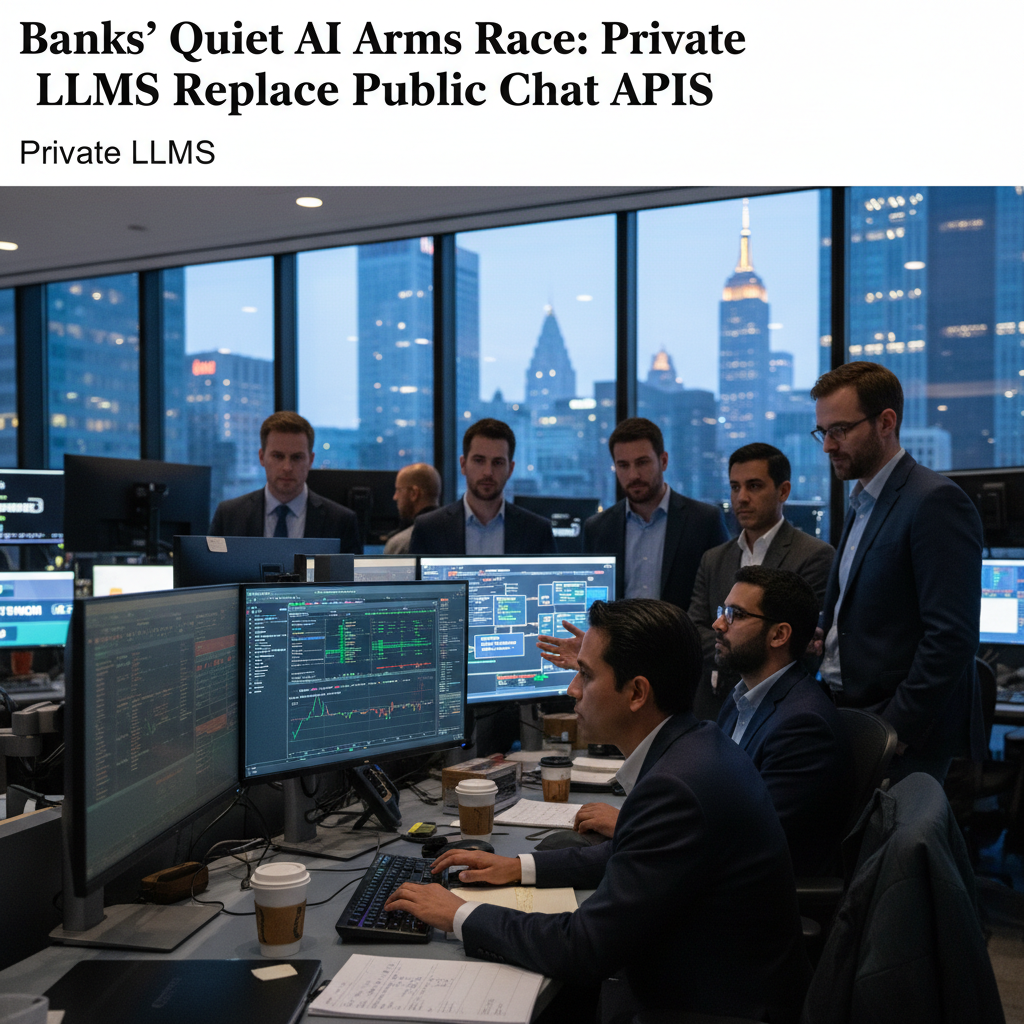
Banks have a habit of buying the newest machinery quietly, then behaving as if nothing changed. This cycle is repeating. Only now the machines are AI — the shop floor is a tangle of GPUs, private clouds and stacks of legal memos.
Why banks are moving to private LLMs
Public chat APIs were a convenient prototype: cheap experiments in customer service, fraud detection and analyst workflows. Prototypes are one thing; mission-critical systems are another. Over the past year many institutions have shifted toward private LLMs for three simple reasons.
- Control. Data residency and model ownership matter when a loan decision can end up in court.
- Explainability. Regulators want traceability; a closed model plus a logging layer is far easier to audit than opaque API calls.
- Cost and latency. Inference bills and network hops add up at scale. Running models on-prem or in controlled clouds can shave milliseconds off latency and millions off operating budgets — at least in many cases.
What’s interesting is how ordinary these drivers feel. They’re not about excitement; they’re about risk management.
Not just a tech story
This is an infrastructure build with a human shape. Banks are hiring ML engineers, model-ops teams and data stewards in numbers that look a lot like the post‑2008 rebuilding of risk departments. It’s not glamorous work — fewer headlines than a flashy consumer app — but the ROI math is straightforward: faster decisions, fewer false positives in fraud systems, and automation of repetitive compliance tasks.
There is, however, a cautionary echo from previous tech waves. Trading firms discovered that faster connectivity created arms races and new fragilities. Private LLMs introduce similar single points of failure and governance blind spots. Shared dependencies — the same training data or third‑party components — can turn local errors into systemic problems.
Where the money goes
The winners won’t be limited to model vendors. Spending will spread across layers, though not evenly.
- Hardware: GPUs and specialized accelerators for training and inference.
- Systems: hybrid clouds, secure enclaves and orchestration software to stitch everything together.
- People and tools: MLops, labeling, explainability suites and continuous monitoring.
That means opportunities for chip makers, cloud providers and niche software firms. It also means the bill looks less like a one‑time software license and more like an ongoing infrastructure budget.
Risks and regulatory friction
Private does not equal safe. Model drift, biased training data and sloppy change controls can create systemic risk if many firms reuse the same datasets or components. Regulators are catching up.
- Expect tougher validation requirements and stronger demands for audit trails.
- Stress testing of model behavior under market strains is likely to expand beyond trading desks to systems that affect credit and liquidity.
Regulatory pressure may slow some deployments, yes. But it also creates a moat. Firms that get governance right first will have a durable advantage.
Watch for
- Banks that publish reproducible governance playbooks — those will become templates.
- Partnerships that bundle financial firms with cloud or chip providers plus compliance tooling.
- Talent flows. If seasoned MLops engineers start preferring banks, the quality gap will widen fast.
The shift to private LLMs is a pragmatic chapter in finance’s long automation story. Banks are trading the convenience of public APIs for control, higher upfront costs and a governance headache. For investors and clients the real question isn’t whether banks use AI — it’s which institutions can turn model governance into a sustainable competitive edge.
Practical signals to follow
- Track GPU orders and hybrid cloud contracts for signs of scale.
- Read bank tech reports for clues about governance maturity.
- Watch small explainability vendors — they look like natural consolidation targets.
Pedro Marini