Why this matters now
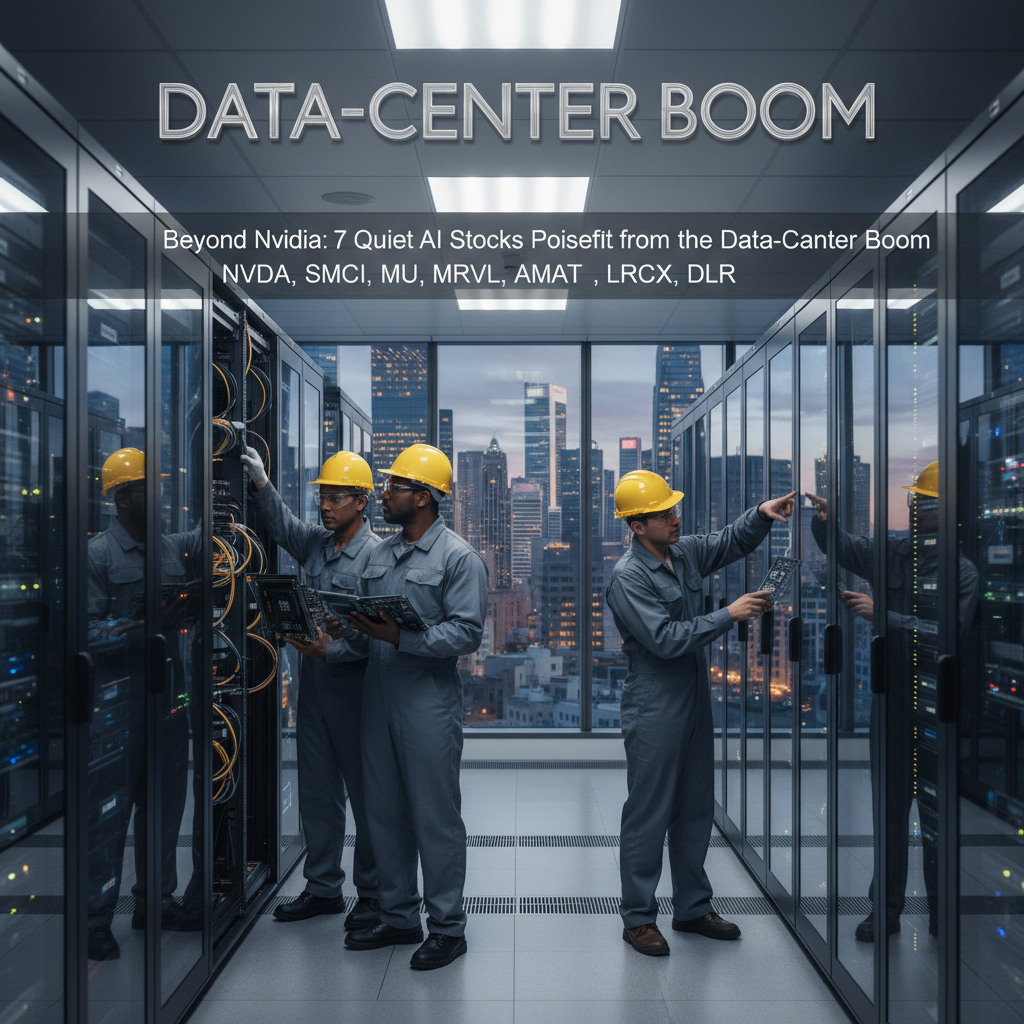
Nvidia has become shorthand for AI investing. That concentration is a double-edged sword. As the largest cloud providers push billions into GPUs, everything behind the chips — memory, boards, networking, cooling, power and the real estate that houses it all — is suddenly under intense pressure and, yes, poised for outsized returns. The system that turns compute demand into racks and datacenters is where the real, less glamorous money shows up.
Quick take: if you want AI exposure without owning a single chipmaker, look down the value chain: servers, DRAM, networking silicon, fab tools and data-center landlords. Some of those plays follow demand more directly and carry very different valuation dynamics than Nvidia.
Seven stocks worth watching (and why)
-
SMCI — Super Micro Computer (servers): Supermicro builds GPU-dense systems. For investors wanting to express conviction about incremental GPU installs, SMCI has been the fastest lever. Think of it as the shipbuilder for a GPU navy. Growth can be uneven, but margins are widening as custom, high-density designs command a premium.
-
MU — Micron Technology (memory): GPUs need huge pools of high-bandwidth memory. Memory is cyclical, true, but the baseline for DRAM demand has shifted up as memory per GPU session explodes. Micron is the most direct U.S. DRAM play.
-
MRVL — Marvell Technology (networking and accelerators): High-speed networking and packet processing are the plumbing that lets GPU racks scale. Marvell’s switches and accelerators are turning up inside AI-optimized topologies more often than not.
-
AMAT — Applied Materials (chipmaking equipment): As foundries chase denser nodes and advanced packaging for AI accelerators, equipment suppliers see the orders sooner than many expect. Applied captures upgrades and capacity additions across multiple fabs.
-
LRCX — Lam Research (etch and deposition tools): Complementary to Applied, Lam is indispensable for advanced logic fabrication. If capex keeps rising, these two benefit disproportionately.
-
DLR — Digital Realty (data-center REIT): GPUs draw lots of power, and not every cloud owner wants to run every datacenter. Digital Realty offers a relatively stable earnings stream with direct exposure to where AI compute actually lives.
-
NVDA — Nvidia (platform leader): Not a hidden gem, just the anchor. Even if you worry about concentration, Nvidia’s platform and software moat keeps demand for the rest of the chain elevated. Ignore it at your peril.
The list is not exhaustive. But it sketches a diversified way to play the hardware side of the AI build-out.
The data, in brief
- Capex emphases have shifted toward accelerated computing; budgets prioritize high-performance racks over generic servers. This is a structural tilt, not just a quarterly blip.
- Memory content per server has jumped by multiples across recent GPU generations. That favors DRAM suppliers and specialized module makers.
- Network bandwidth per rack has roughly doubled in many hyperscale builds to avoid GPU starvation. That creates a multi-year runway for networking silicon.
Risks and counterpoints
- Valuation concentration: a lot of these infrastructure names trade at rich multiples. A broad GPU slowdown would compress those multiples fast.
- Cyclicality: memory and equipment businesses carry inventory and capex cycles. Timing is everything; direction alone isn’t enough.
- Customer concentration: a handful of cloud providers account for a large share of orders. If one pauses or pivots to a different architecture, the ripple effects can be severe.
How to use these ideas
- Diversification approach: pair a platform leader like NVDA with one or two suppliers (SMCI, MU) and a REIT (DLR) to spread exposure across the stack.
- Lower-volatility or income tilt: consider data-center REITs or larger equipment makers with predictable cash flow.
- High-conviction, higher-risk: smaller specialists can outperform, but expect deeper drawdowns and execution risk.
Signals I’d watch
- Large-scale GPU order announcements from cloud providers or major enterprises.
- Memory vendors adjusting guidance on content per system.
- Capex guidance from TSMC, Samsung or other major foundry customers that hints at multi-year increases.
The takeaway
Nvidia is the headline; the real trade for many investors is the supply chain that turns demand for models into physical racks. Less glamorous, often messier, and—once the hype subsides—frequently more rewarding. If you own a single AI stock, fine. Just be conscious of what you’re leaving out: the memory sticks, the switches, the machine rooms and the tools that make the chips run.