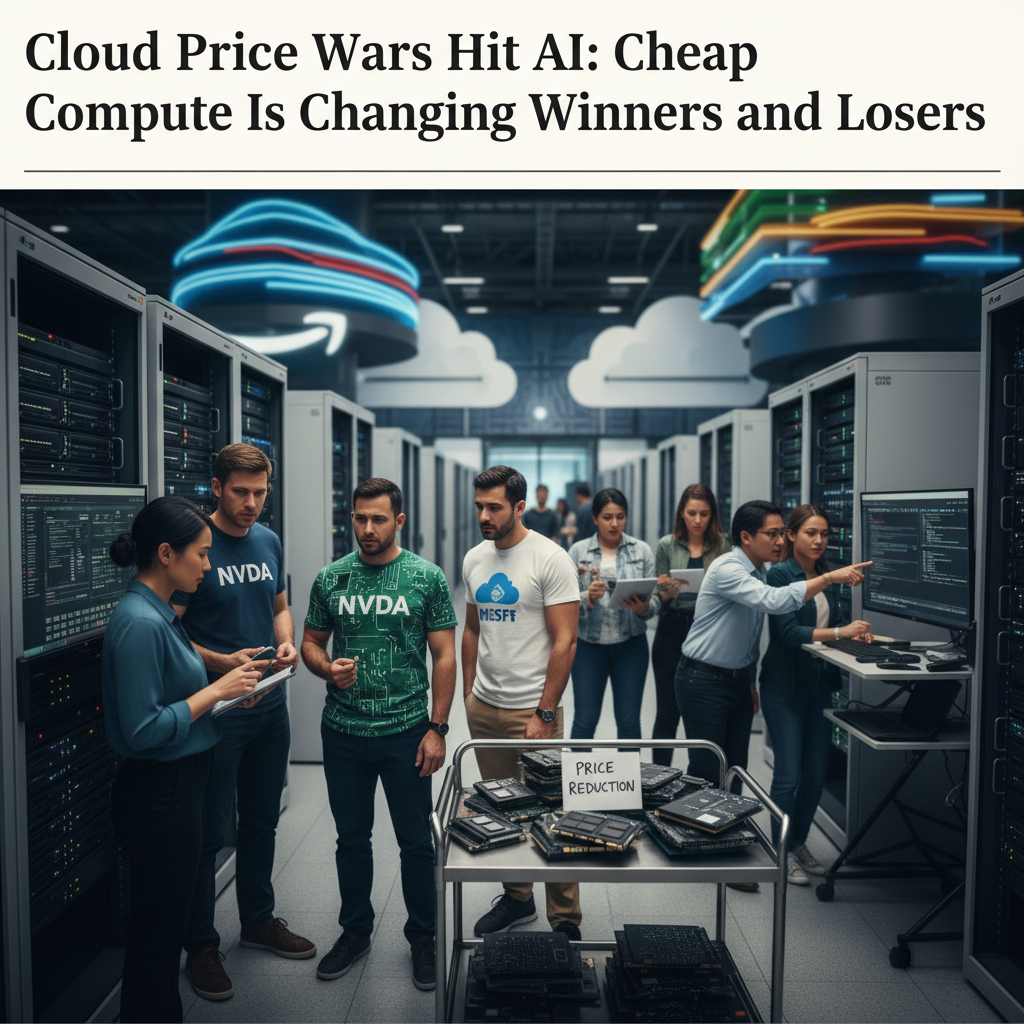
The short story: cloud providers are racing to cut AI compute prices. That’s not just cheaper experimentation. It’s a structural shift — margins, incentives and the pockets where value accumulates in the AI stack are being rearranged.
This feels like a replay of the mobile-subsidy era. On the surface it’s a consumer win; under the hood the economics are being rewritten. For enterprises and investors the real question is who keeps pricing power and who gets pushed into selling features or services.
Why prices are falling now
- Cloud vendors are subsidizing model serving to lock in enterprise accounts and capture downstream services revenue. It’s a customer-acquisition play dressed up as infrastructure pricing.
- Better model compression, quantization and serving tricks (think LoRA-style adapters, distillation and 4-bit inference) cut compute per request by a lot.
- New AI chips and more regionally focused data centers increase supply and bargaining leverage, shrinking the premium for the dominant GPU suppliers.
What’s interesting here is how these things compound. One efficiency gain makes the next discount easier to stomach.
What this means for chipmakers
Nvidia still sits at the center of datacenter AI today. But falling cloud rates and leaner models point to slower unit growth for full-fat accelerators. Not doom — more of a transition. Expect:
- Pressure on average selling prices for mainstream GPUs.
- A shift toward verticalized appliances, IP-rich hardware and bundled software.
- Stronger incentives to lock in long-term deals with cloud vendors.
Timing matters. Specialized, higher-margin accelerators and software upsells can offset volume declines — if vendors move fast enough.
Cloud vendors: winner-takes-more, but at what cost?
Lower compute prices pull in customers. Yet there’s an obvious trade-off.
- Short-term market share versus long-term margin squeeze.
- A growing dependence on higher-value services — fine-tuning, data labeling, vertical apps — to make up for lost per-inference income.
- And a real risk of commoditization if open models and cheap chips become widespread.
In practice, though, the story is messier: some clouds will double down on platform lock-in; others will compete on price until margins evaporate.
Startups and incumbents — different pivots
Cheaper inference buys startups time: iterate faster, ship at lower cost. But it also removes a moat for companies that sold raw performance.
Likely moves:
- Bet on embedded workflows and integrations rather than touting throughput.
- Offer hybrid on-prem plus cloud products for regulated or latency-sensitive use cases.
- Monetize tooling — observability, compliance, model ops — because those are the sticky bits.
Small point: selling outcomes beats selling GPU hours. Always has.
For investors
- Pure-play GPU long positions are riskier now than they were two years ago, unless paired with a clear downstream software or services strategy.
- Cloud vendors with enterprise suites can tolerate lower infrastructure margins if they recapture revenue higher in the stack.
- Watch regional cloud and chip entrants; local price advantages will matter for regulated industries and government contracts.
For CIOs this quarter
- Re-run total cost of ownership with 4-bit and quantized model options. The savings are often bigger than people expect.
- Negotiate bundles that include model maintenance, latency SLAs and data privacy guarantees.
- Invest in observability to avoid surprise costs as usage grows.
This is not a one-off. Compute commoditization has repeated itself — mainframes, PCs, smartphones — and cheaper availability tends to create more winners than losers. But the winners are rarely the same companies that dominated the prior era. Expect a messy transition. Bet on firms that sell outcomes, not just flops of silicon.
Quick facts
- Cheaper inference makes AI adoption viable in legacy industries where ROI used to be marginal.
- Model optimization tools are shrinking the market for raw GPU hours.
- The most at-risk players are those dependent on pure hardware sales without software lock-in.
If you’re deciding where to deploy capital or where to steer product priorities, focus on capture mechanics: who owns the customer relationship after the compute is consumed. That will decide who benefits from the next wave of AI adoption.