What happened — and why it matters
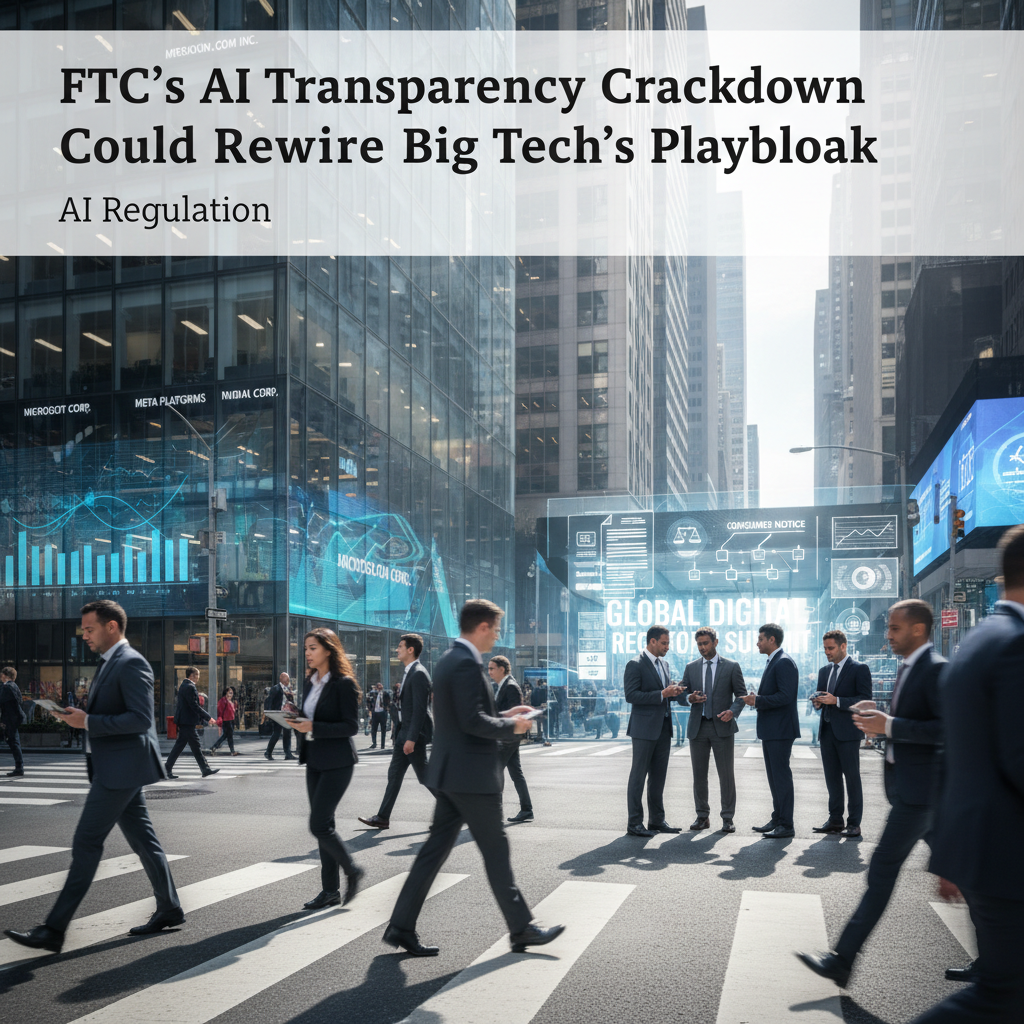
The Federal Trade Commission has signaled it wants to move from warnings to hard rules for commercial AI. The agency is proposing requirements that would force companies to label AI-generated content, document safety testing for models, and keep auditable records showing where training data came from. If these rules stick, they would ripple across ad tech, automated financial advice, hiring tools — pretty much anywhere AI touches consumers.
Not an American outlier
This is not a U.S.-only experiment. The EU AI Act already sketched a tiered compliance approach and transparency obligations; the FTC is borrowing that general idea but doing it in a narrower, enforcement-first way. Rather than redesigning regulation from the ground up, the agency is using existing consumer protection law and civil penalties to push companies to act now.
What’s interesting here is the pattern: regulators tend to start with broad principles, then get prescriptive once a market matures — think privacy rules in the 2010s, content moderation more recently, and now foundational models. Familiar arc, different tools.
What the rule would require — practical points
- Advertisements and consumer-facing communications materially generated by AI would need clear labeling.
- Firms that use AI for recommendations — credit decisions, investment suggestions, hiring scores — would be required to keep audit trails and run tests for disparate impact.
- Businesses would need to document the provenance of training data and attest to steps taken to exclude sensitive or illegally obtained information.
- The FTC would set up a faster consumer complaint and redress channel under its existing authority.
Who wins, who pays
- Large tech companies and well-funded startups can absorb audits and disclosure regimes. They’ll adapt, though it won’t be cheap.
- Smaller businesses and incumbents that bolt AI onto legacy systems face higher marginal costs and fuzzier technical requirements. Expect pain there.
- Consumers get more transparency — labels, records — but transparency isn’t a cure-all. Labels don’t automatically fix biased models.
Market signal: short-term disruption, longer-term change
Markets dislike uncertainty, so expect near-term pressure on ad-heavy platforms and data-dependent businesses. At the same time, providers of compliance tooling, cloud GPUs, and governance software will see opportunity. It resembles what happened after privacy laws: a whole new compliance ecosystem appeared.
Examples that make this concrete
- An online broker using generative models for trade ideas would likely need to disclose AI use and keep logs showing backtests and fairness checks. That raises both cost and legal exposure.
- An ad network that auto-generates personalized creative could be forced to add labels, which may slow campaign velocity and raise production costs.
Pushback and trade-offs
Industry will push back on trade secret and cybersecurity grounds — disclosing provenance could reveal model designs or unique datasets. There’s also a risk of heavy-handed rules entrenching incumbents who can pay compliance bills, squeezing smaller innovators. A sensible compromise might be tiered obligations: light-touch transparency for low-risk interactions, deeper attestations and audits where finance, health, or safety are at stake.
What comes next — timing and legal choreography
If the FTC moves from guidance to a formal rule there will be a notice-and-comment period. Litigation is likely; companies may say the agency exceeded its authority or that disclosure mandates conflict with trade secret protections. Congress could step in too, trying to pre-empt or codify parts of the regime. In short: this will be litigated and negotiated for some time.
For executives and investors
Treat this as a strategic pivot, not just a compliance checkbox.
- Map where AI is used across products and tag consumer-facing or safety-sensitive applications.
- Start basic provenance logging and bias testing now. Cheap, documented steps beat expensive retrofits.
- Revisit vendor contracts to ensure you can get model documentation and appropriate indemnities.
Regulation rarely proceeds in a straight line, but the direction is unmistakable: opaque commercial AI is being pushed into the light. The real question for markets is how quickly firms turn regulatory risk into disciplined operational practices.
The gist
The FTC’s transparency push won’t stop innovation, but it will change incentives. Companies that bake governance into product development will gain regulatory cover and a competitive edge. Those that treat disclosure as an afterthought will likely pay — in fines, eroded trust, or both.