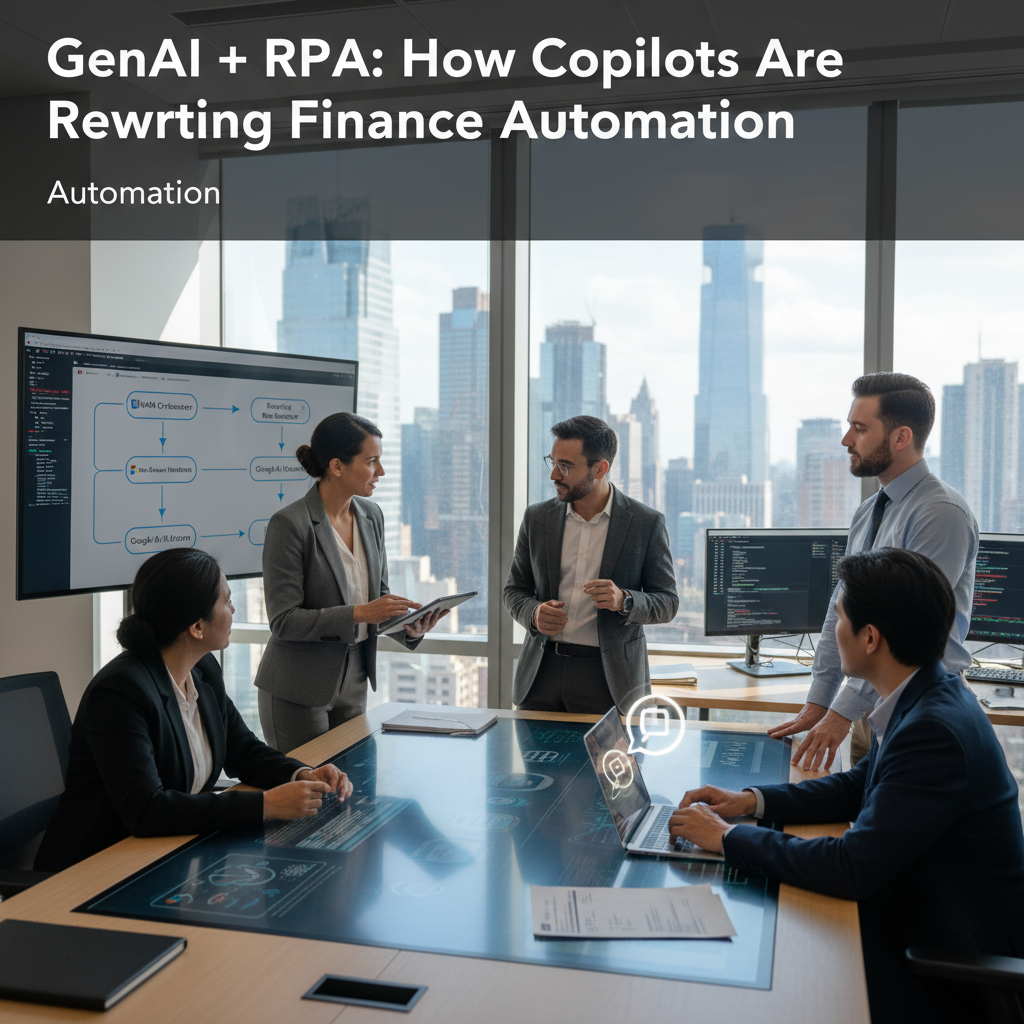
The story so far. Robotic process automation promised to reclaim hours lost to repetitive finance work. It mostly delivered — where processes were tidy and rules fixed. But that was always the limit. Now generative AI is giving RPA something it lacked: a capacity to read contracts, infer exceptions and draft decisions, not merely click fields on a screen.
Why this matters now. Microsoft, UiPath and ServiceNow have moved beyond pilots. They are folding large language models into workflow engines, shipping them as parts of product suites. For CFOs this is more than marginal efficiency: it opens the door to handling unstructured problems — invoice disputes, lease accounting, knotty reconciliations — at a scale that was previously impractical.
How it’s changing. The old playbook — exhaustive flowcharts and brittle screen-scraping — is fading. The emerging pattern looks messy but effective:
- Models pull meaning from PDFs, emails and free-text notes.
- RPA executes the predictable actions: posting, routing, logging.
- A GenAI copilot proposes next steps, flags oddities and writes human-readable summaries.
It speeds throughput. Humans still make the judgment calls. That tension is actually useful; it keeps automation pragmatic rather than preachy.
Three blunt realities. This is not a panacea. Expect problems.
- Accuracy drift. Models can hallucinate or misclassify subtle financial concepts if you don’t monitor them closely. Small errors compound fast.
- Shadow automation. Business units will stitch together shortcuts outside IT control. Great for speed, terrible for audits.
- Vendor lock-in. Major cloud and RPA vendors are bundling LLM services. Cheap and convenient short term; awkward and expensive if you want to move later.
A short history lesson. Automation has been through waves: macros and batch jobs in the 1990s, RPA in the 2010s, now AI-aware automation. Each shift moved work around — from the desktop, to bot farms, to the model layer — and with it the locus of control: IT, procurement, or the platform provider. That matters because whoever controls the rules shapes incentives.
Concrete examples. Where teams are actually seeing results in US finance groups:
- Accounts payable: models parse vendor emails, match invoices to POs and surface exceptions. Early deployments report 30–50% fewer touchpoints.
- Loan servicing: copilots triage documents, flag missing covenants and draft remediation steps, cutting time to resolution on borrower queries.
- Close processes: autogenerated narratives for journal entries and variance explanations speed preparer work and leave clearer audit trails.
None of these are magic; they just reduce repetitive cognitive load and make audits less painful.
What leaders should do. Move faster than the checklist, but not recklessly.
- Treat LLMs as decision support, not decree. Keep human review for high-risk outcomes.
- Invest in monitoring. Track data drift, accuracy, and add explainability layers — these are now table stakes.
- Re-skill people. The best teams pair accounting knowledge with the ability to train and validate models, not only traditional coders.
Small point: governance and talent are the real levers here, not the fanciest demo.
Final take. This is evolution, not extinction. Think of RPA as the hands and GenAI as the brain. Together they make finance more adaptive — but they also concentrate power in platforms and force new governance models. For enterprises that can balance innovation with control, the rewards look substantial. Ignore governance and the benefits will fade.
Editorial note. Expect a scramble. Vendors will promise turnkey copilots while buyers rush to prove ROI. The winners will be the teams that align product choice, controls and talent strategy — not those chasing the flashiest demo.