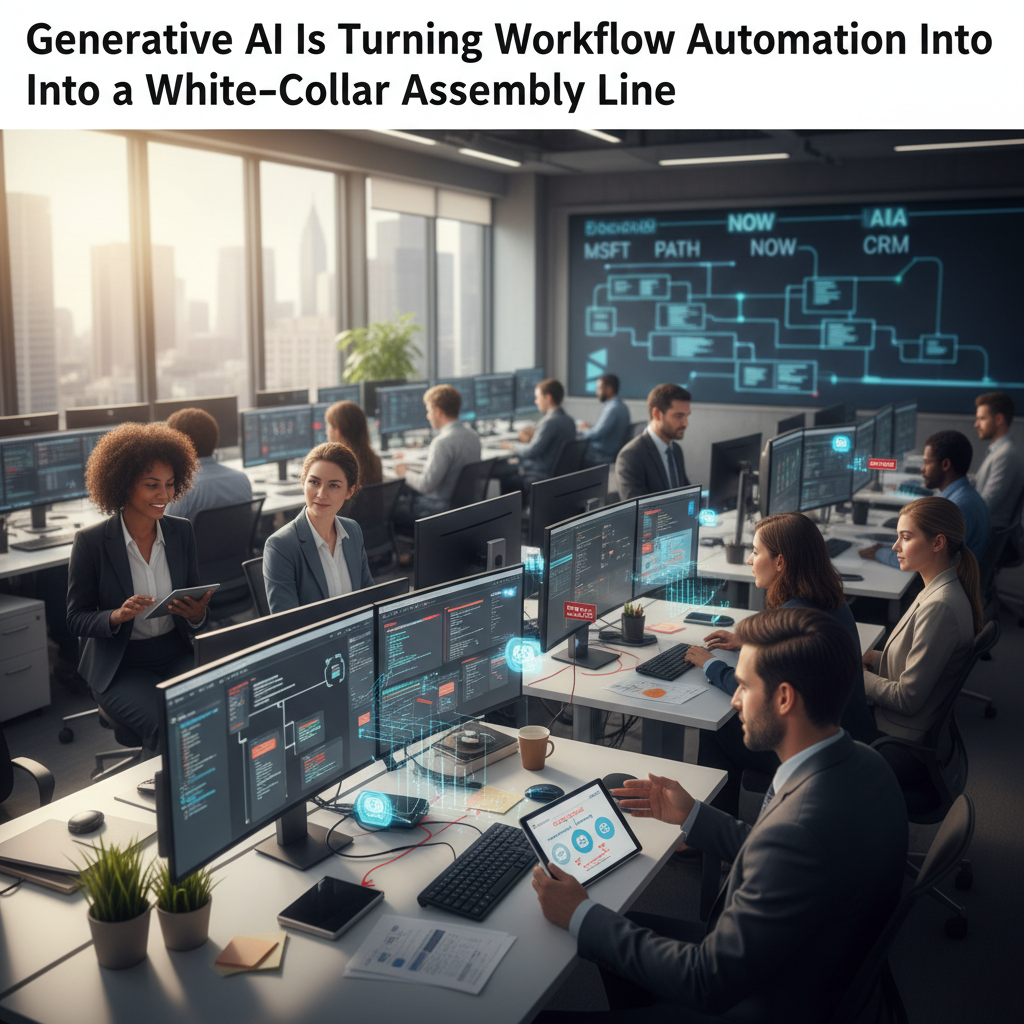
The new automation wave isn't about robots on a factory floor. It's about large language models being stitched into low‑code and RPA stacks so a customer support email, an insurance claim, or a KYC packet can be routed and resolved without a human reading every line.
That sounds familiar, but it's not the RPA boom of the 2010s. Back then firms wrote scripts to mimic keystrokes and shove structured fields between applications. Today the shift is subtler — and in some ways deeper. LLMs ingest unstructured content — emails, PDFs, voice transcripts — and they carry decision logic, not just clicks. That changes productivity potential and multiplies risk vectors.
Early pilots report big time savings on triage‑heavy workflows — think 50 to 70 percent reductions in task time for routine work — but those numbers come with important caveats. Speed depends on data quality, integration maturity, and how tightly the model is governed. Put another way: a fast, sloppy automation spreads errors faster than a slow, careful human ever could.
Who is wiring this stuff into enterprise flows? Public platforms are already embedding LLMs into orchestration layers. Microsoft and ServiceNow are folding AI features into suites; UiPath is putting conversational and document‑understanding models inside its robots; AWS and Salesforce are selling builders model primitives to plug into business flows. For CIOs the decision isn't only which bot runs the clicks anymore — it's who controls the model endpoints, the data, and the governance rules. That shifts bargaining power and lock‑in dynamics.
For American firms a few practical consequences stand out
- Throughput gains come with new error modes. Hallucinations, misclassifications, and silent data loss are real risks.
- Jobs will shift rather than simply disappear. Repetitive roles contract while demand rises for automation ops, prompt engineers, and compliance specialists.
- Regulators will press for auditability. Financial and healthcare firms in particular will face requirements for explainable, traceable decision trails.
- Vendor concentration becomes a strategic vulnerability. Relying on one cloud or model provider creates exposure and weakens negotiating leverage.
Concrete examples help make this real
- An insurer that used to send every claim through human triage now has an LLM extract incident details from photos and adjuster notes, routing high‑confidence claims directly to payment and flagging the rest for review.
- A mid‑market bank embeds an LLM in its low‑code platform to summarize loan documents and flag missing covenants, trimming underwriting prep from days to hours in early pilots.
- E‑commerce teams pair vision models with LLMs to automate returns decisions, cutting manual touches while also tightening fraud controls.
Pushback is warranted. These systems can be brittle with messy inputs, and explainability remains incomplete. There’s a human cost too: people moved into oversight roles often lack the tools or authority to pause a misbehaving automation. That operational friction will determine whether firms see a productivity lift or a governance headache.
A short, practical checklist for leaders testing LLM‑driven automation
- Keep human‑in‑the‑loop thresholds and explicit escalation paths.
- Log inputs, prompts, and decision outputs so audits are possible.
- Treat prompt designs and chain‑of‑thought traces as configuration: test them, version them, and govern their deployment.
- Budget for reskilling — automation ops, prompt engineering, and model‑audit skills are first‑class hires now.
This wave looks less like a single disruptive event and more like a quiet retooling of the white‑collar assembly line. That makes it easy to ignore — and progressively harder to undo. The firms that do well will be those that pair pragmatic governance with iterative deployments, not the ones mesmerized by headline speed numbers and skipping the safety nets.