AI & Finance
How AI Is Quietly Reshaping the Finance Industry's Future
From fraud detection to robo-advisors, the AI wave is transforming financial services in unexpected ways.
P
Pedro Marini
May 21, 2026 · 4 min read
From fraud detection to robo-advisors, the AI wave is transforming financial services in unexpected ways.

Illustration by IMF Alpha editorial · Reviewed by Pedro Marini
The chatter about AI in finance used to sound like conference swag: lots of glow, little substance. That changed. Not with a single flashy product, but through slow, stubborn replacement of the work that actually moves money: underwriting, fraud screens, execution, risk dashboards.
This isn’t about flashy press releases. It’s about banks and asset managers quietly rerouting billions of dollars of decision-making through models that learn from behavior, not just history.
Below are the real shifts, and what they mean for markets, incumbents and investors.
Fraud detection was the first quiet victory. Legacy rules flagged anything that didn’t fit a template — and annoyed customers in the process. Machine learning brought nuance. Systems now weigh dozens — sometimes hundreds — of behavioral signals in real time. Vendors like Stripe (Radar), Feedzai and the large card networks have been rolling out ML layers that reduce false positives while spotting schemes that used to slip past rule engines.
The catch: fraudsters evolve too. As banks tune models to reduce friction, attackers shift tactics — mule networks, synthetic identities, account takeovers that mimic real behavior. The result is a relentless cat-and-mouse. Expect continued spending on detection, but also on model governance, adversarial testing, and cross‑institution data sharing. That’s where regulators will push hardest: you can’t fight criminal finance in private.
If credit scoring was a cottage industry, AI made it an industrial process. Startups such as Upstart popularized the idea of “alternative data” and flexible models; other vendors like Zest AI packaged ML underwriting for banks. The payoff is simple: better risk segmentation, faster decisions, broader access to credit — at least on paper.
Translation for markets: winners will be the firms that own the data pipes. A consumer fintech that controls transaction flows, deposit history and behavioral signals has a massive edge over a bank that only sees a paycheck. That’s why incumbents are building or buying these data capabilities rather than re-training old models. The economics favor scale — more data leads to better models which attract more customers, which supplies more data.
But there’s friction. Explainability is not optional in credit. Lenders must show why someone was denied. Regulators in the U.S. and Europe are sceptical of “black box” decisions. Expect hybrid approaches: ML for segmentation and signal generation, rule-based overlays for compliance. That’s a messy — and lucrative — layer of software services: model interpretation, audit trails, synthetic data for testing.
When people talk about AI and trading they still picture faster algorithms. But the next phase is about smell — sensing market context beyond price ticks. Hedge funds and quantified managers — Two Sigma, Renaissance, Citadel among them — have long used statistical models. Now they’re layering in alternative data (satellite images, credit card receipts, sentiment from scraped filings) and deep learning to extract patterns across unstructured feeds.
Big asset managers are doing the same inside risk platforms. BlackRock’s Aladdin has always been a backbone; the difference now is integrating machine learning into scenario analysis and portfolio construction. For wealth management, robo-advisors like Betterment and Wealthfront have morphed toward more personalized allocation engines that adapt to behavior, not just age and risk tolerance.
Warning: overfitting is real. The same model that crushed backtests can blow up in a regime shift. That’s why funds invest heavily in validation frameworks. Also expect more scrutiny around data provenance — when models trade on alternative sources, whose signal is it and how reliable is it?
Bank bots aren’t new. What changed is quality. Erica at Bank of America, chatbots at JPMorgan and countless fintech assistants now handle routine interactions end-to-end. The payoff is lower cost per interaction and better triage of complex cases to human agents.
Yet this is where sentiment matters. Customers notice a difference only when bots fail. A smooth, automated refund or identity verification creates delight. A broken escalation path creates social-media outrage. So institutions that combine automation with a human safety net win trust — and retention.
Finance is probably the most regulated industry on earth. At first glance, that should slow AI adoption. Instead, regulation is shaping a winner’s-playbook.
Why? Because building compliant ML is expensive. It requires human oversight, audit trails, model risk management, and legal review. Large banks and established vendors can afford that. Small fintechs sometimes cannot. The result is a consolidation trend: the nimble innovators get bought or swallowed into bigger platforms that can scale governance.
Europe’s AI Act and U.S. statements from the OCC, CFPB and SEC are pushing the industry toward transparency, especially for “high-risk” models in lending and markets. That will not stop AI — it will professionalize it.
This is a structural shift in the cost and speed of financial services. That sets up a few clear market dynamics:
Models drift. Adversarial attacks are getting creative. Bias in training data can perpetuate discriminatory outcomes, and that’s not just a reputational risk — it’s litigation and enforcement risk. Then there’s concentration: if everyone uses the same signals, diversification falls and tail correlations grow.
Finally, markets will price in the productivity gains — but not evenly. There will be a stretch where investors bid up “AI-native” names on narrative, then punish those that can’t show robust economic benefits. Remember the Upstart arc: great story, volatile execution. Not every AI play turns into a moat.
AI is no longer an add‑on. It's embedding into critical workflows — underwriting, detection, execution, advice — and rewriting return profiles across financial services.
That doesn’t mean overnight disruption. It means a quieter, more ruthless transformation: margin shifts, consolidation, and a new premium on data and governance. For market participants, the calculus is simple: invest in data, invest in explainability, and treat compliance as product. Ignore those and you’ll be the house that forgot to lock the door.
If you’re watching for investors’ signals, focus on the rails — the cloud, data warehouses, model governance — and the incumbents actually wiring their legacy systems to modern stacks. Those are the companies that will turn AI from a buzzword into revenue.

Nvidia's dominant position in AI chip supply continues to drive hyperscaler capital expenditure, with major cloud providers signaling sustained investment.
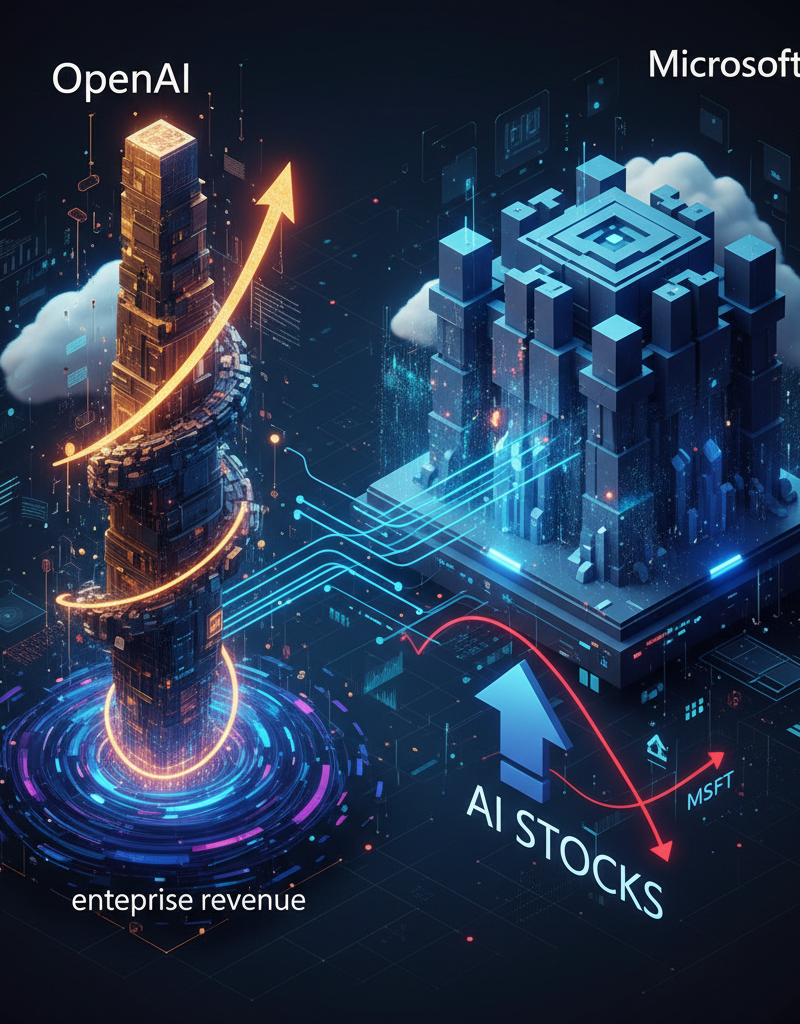
OpenAI's enterprise revenue is experiencing substantial growth in 2024, raising questions about the financial implications for its primary investor, Microsoft.

Companies are trading raw user logs for engineered data and locked-down pipelines. That shift reshapes winners, risks, and regulation in the U.S. AI market.