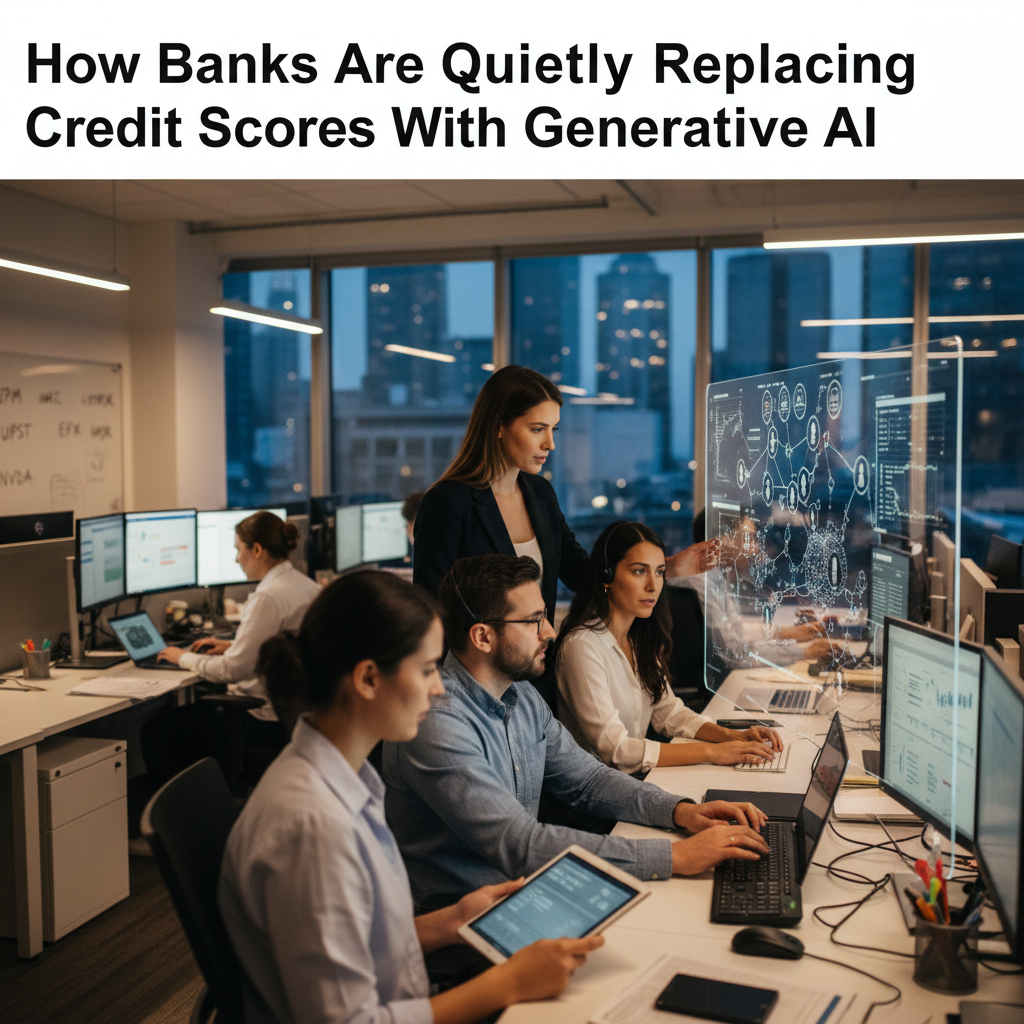
The quiet migration away from FICO and toward models that read documents, bank flows and even conversation logs is already underway. Over the last two years big banks, regional lenders and scrappy fintechs have started wiring large language models and machine-learning pipelines into credit decisions. To the public it looks incremental. Under the hood it’s structural.
Why this matters now
- Lenders are trying to capture nuance that a single FICO number misses: gig income that spikes and falls, subscription-heavy cashflows, money held in apps, and text-based signals that hint at stability.
- Generative models speed up document review and pull debt metrics from bank statements, pay stubs and invoices—what once took weeks of manual underwriting can now be done in minutes.
- For thin-file or nontraditional consumers this can open access. For others it may mean pricing that is harder to explain.
How it actually works (not the marketing version)
- Ingestion. Paper statements, screenshots and tax docs are converted into structured records using OCR plus transformer-based parsers. It’s messy at first; messy data is still the norm.
- Signal fusion. Proprietary models stitch bureau scores together with alternative signals—rent payments, inflows and outflows, even employment patterns inferred from transaction text.
- Decisioning and monitoring. Large models can draft explanations while downstream classifiers assign risk and price. Models are retrained continuously, which keeps them current but creates model drift to watch for.
A concrete example: instead of simply flagging a missed payment, a next‑gen model might note the missed payment coincided with a one‑time medical bill and was followed by steady payroll deposits. That pattern can tip someone from denied to approved at a competitive rate. It’s the kind of nuance that matters for people who have been penalized by blunt scores.
Trade-offs — and where regulators should pay attention
- Bias is not erased. Alternative signals are not neutral; they encode employment patterns, neighborhood differences and banking behavior that correlate with race and income. Machine learning can amplify those historical inequities.
- Explainability is shallow. A generated line that says risk is low because of stable cashflow is not the same as a rule-based reason a consumer or examiner can audit.
- Legal risk remains. Fair-lending laws still apply. Lenders that cannot justify disparate impacts invite scrutiny from the CFPB and state regulators.
A bit of history helps
Credit scoring has never been fixed. FICO rose when mainframe data dominated; scores were rules-heavy, auditable and consistent. Early ML in lending improved performance but still worked with modest feature sets. What’s new now is scale: models reading unstructured data and transformers trained on financial text. More powerful, yes—also less transparent.
Investor and consumer playbook
- For investors: favor banks that pair model adoption with rigorous governance. Infrastructure vendors—chip makers, cloud hosts, model providers—stand to benefit, but watch concentration risk.
- For consumers: ask for pre-approval disclosures and choose lenders who will explain how models affect pricing. Keep good records of irregular income and use services that aggregate statements cleanly.
A counterpoint worth holding
A lot of generative AI in finance is not underwriting at all but customer service and fraud detection, where explainability norms are different. Lenders can adopt cautiously: human-in-the-loop checks, shadow-mode testing and third-party audits all help. Still, history shows policy lags technology; without clear guardrails the fastest players often gain the most advantage—not necessarily the fairest.
Where this leads
Models that read the full financial life will change who gets credit and at what price. That can be a real social gain if governance, transparency and enforcement keep pace. Or it can repackage old exclusions in new statistical clothing. The outcome will turn on regulation, vendor practices and how seriously firms treat explainability and auditability.