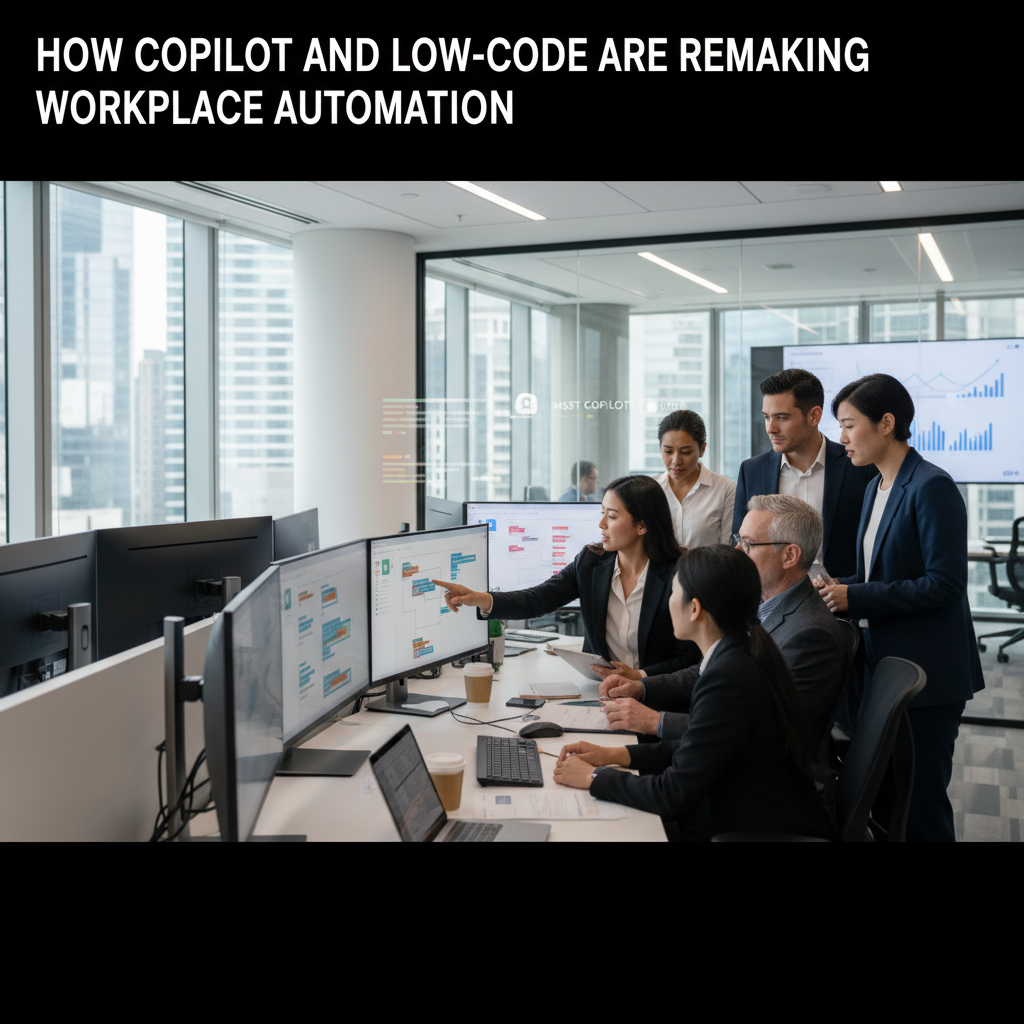
The moment automation stepped out of the back office and into the conference room was obvious. For years RPA promised something tidy: imitate a human clicking through screens and save hours. Now the engine has changed — large language models baked into low-code tools — and that shifts the math.
A short history, because context matters. RPA was basically rules and click sequences. Low-code put those sequences into the hands of non-developers. Add generative models and you get judgment plus natural language as the interface. Suddenly a business user can describe a process in plain English and get a workflow that reads invoices, reconciles accounts, flags exceptions and drafts emails.
Why this matters
- It lowers the activation energy. No more decade-old macros or three-week IT tickets. A product manager, controller or analyst can cobble together a prototype in hours.
- It expands what’s automatable. Things that needed fuzzy interpretation — free-text notes, vendor messages, judgment calls — now come into scope.
- It brings new failure modes. When an LLM hallucinates or a connector misroutes data, the result is wrong decisions, not just a broken invoice.
What's interesting here is how quickly dynamics change when judgment is automated. That matters more than it initially seems.
Who wins — and who has to adjust
- Big cloud providers are favored. Embedding an LLM inside Power Platform, Google Cloud, or ServiceNow makes it harder to move away: users build inside ecosystems they already pay for. That is why Microsoft is a particularly important player.
- Pure-play RPA vendors need to move beyond recorder-playback and become AI-native orchestration layers. UiPath is already pushing generative features; the real test is whether customers treat them as mission-critical or optional extras.
- Finance and ops teams stand to gain time and capacity. Expect faster month-end closes, fewer manual reconciliations and more automation ownership shifting to business units.
Some teams will adopt quickly. Others will underestimate the shift and pay for it.
Risks and governance
- Auditability. Automated judgment demands audit trails that regulators and CFOs will insist on. Prompts, model versions and decision logs need to be kept.
- Data leakage. Hooking sensitive ledgers to third-party models without strict controls invites breaches and compliance headaches.
- Skills shift. Jobs won’t disappear so much as change — from data-entry roles to automation architects, prompt engineers and controls specialists.
Market and investment implications
- Platform bets look safer. Companies that bundle identity, storage, connectors and models reduce integration friction and raise switching costs. That favors public clouds and well-funded workflow vendors.
- Niche RPA players that don’t embed models risk margin pressure. Conversely, firms that become orchestration layers for varied AI models can justify richer multiples.
Practical checklist for finance leaders
- Start small. Prototype one high-volume reconciliation or AP exception workflow with clear KPIs.
- Lock governance up front. Define logging, model versioning and human-in-the-loop thresholds before you scale.
- Measure accuracy, not just speed. False positives in finance carry different costs than in marketing.
- Pick partners wisely. Prefer vendors with enterprise-grade security and options for offline or isolated model deployments.
Automation has always been about moving human time toward higher-value work. This wave accelerates that, and it does so messily. Expect real gains once governance, controls and culture catch up. For leaders and investors the question is no longer if automation is coming — it already is — but who builds the architecture of trust around it.