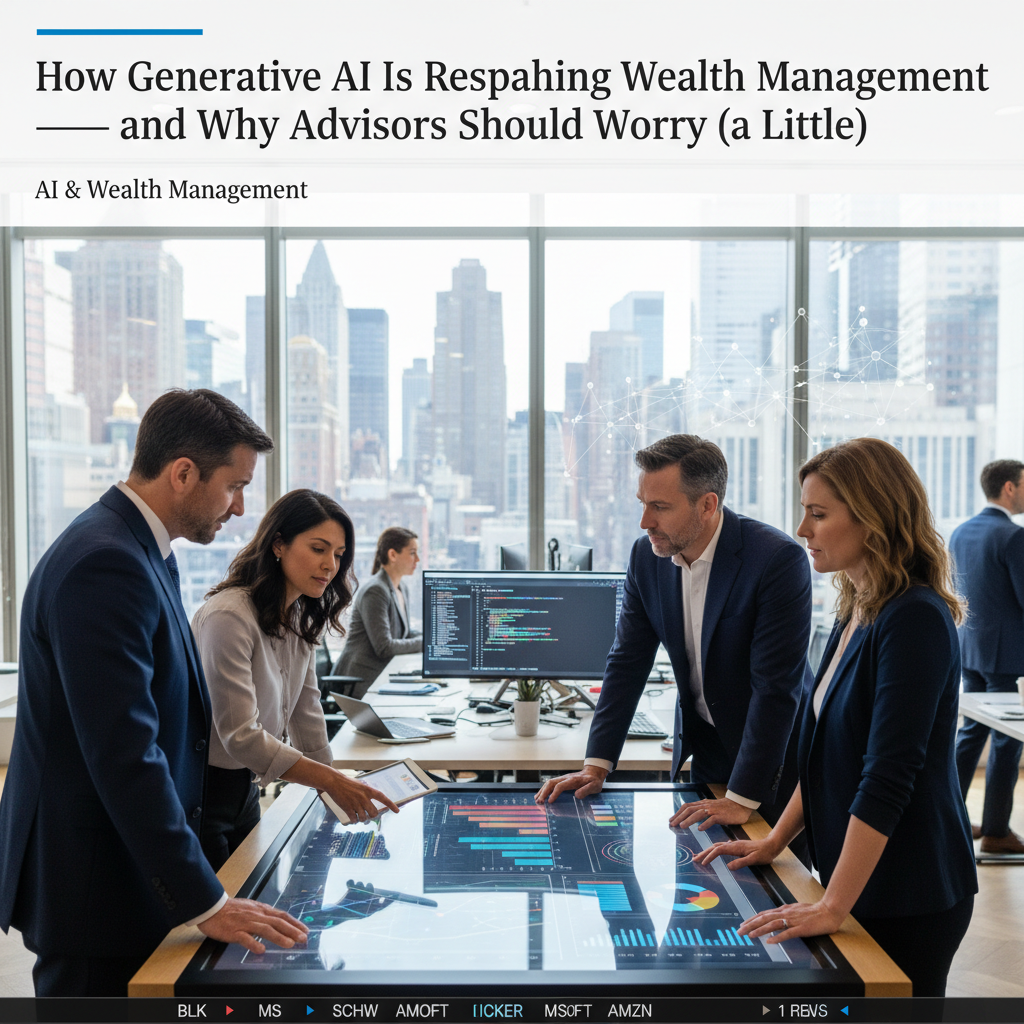
Generative AI is no longer a lab experiment for trading desks — it is pushing into the client-facing heart of wealth management.
This moment in wealthtech feels like the robo-advisor wave crossed with the smartphone era: fast rollouts, plenty of hype, and a messy distribution of winners and losers. Spend thirty minutes with a modern LLM-driven planner and you can produce a tailored retirement projection, a tax-loss harvesting sketch, and an estate overview that would have taken a junior planner days to assemble five years ago. It’s impressive. It’s also imperfect.
Why this matters now
- Scale, but smarter. Firms can generate individualized plans at volume — not a one-size template, but scenarios tuned to income swings, concentrated stock positions, and client priorities.
- Costs fall where it counts. Automation trims repetitive tasks — onboarding forms, base allocation, simple tax modeling — and frees advisors to focus on judgment calls that still need a human.
- Cloud and API economics change the game. Major cloud providers and model vendors have lowered the bar, so smaller RIAs can publish near-institutional advice much faster than before.
Gains are real. They are not frictionless.
Three big risks nobody should pretend aren’t there
-
Hallucinations and sloppy outputs. LLMs will invent numbers, misunderstand tax rules, or propose cash flows that don’t make sense. The results can look authoritative while being wrong, which creates legal and reputational exposure.
-
Fiduciary ambiguity. If an advisor relies on a model’s recommendation without clear oversight, regulators and litigants will ask who actually took responsibility — the human or the algorithm?
-
Data leakage and vendor concentration. Sending sensitive client data into third-party models raises privacy concerns and creates single points of failure when many firms depend on the same providers.
A quick historical comparison helps. Robo-advisors in the 2010s automated allocation but rarely tackled nuanced planning. Generative AI moves past that limit: natural-language plans, scenario analysis, richer outputs. That also raises the bar for governance; the questions get harder.
Signs this is already happening
- Boutiques and hybrid firms are piloting AI assistants to draft client letters, model retirement outcomes, and flag tax-loss harvest candidates.
- Larger firms are trialing LLMs internally: compliance summarization, client risk re-assessments, advisor playbooks.
None of this is a silver bullet. I’ve talked to planners who say drafts cut their work by 30–60 percent, but every output still needs a careful advisor rewrite. The AI accelerates, it doesn’t replace.
What wealth managers should be doing now
- Put guardrails in place. Run deterministic checks on any numeric output, require human sign-off for recommendations, and version-control prompts and models.
- Upgrade vendor due diligence. Treat model providers more like custodians: audit logs, data residency, SLAs, and breach response plans matter.
- Train for different skills. Advisors need to learn prompt design, recognize model limits, and interpret probabilistic outputs.
- Build explainability into client communications. People want to know why. Translate model reasoning into plain language and list the assumptions.
A couple of counterpoints
- Not every firm must rush. If your value is deep, relationship-driven planning, a measured approach with strong human oversight can preserve trust while improving efficiency.
- That said, laggards face real risk. Firms that don’t digitize advisory workflows will find themselves competing on price and responsiveness — and losing.
How this plays out
Generative AI will change how advice is produced, priced, and audited. Winners will treat models as power tools: they speed work and broaden personalization, but only under strict controls, clear accountability, and solid human judgment. That’s as much a cultural challenge as a technical one.
If you run an advisory practice, don’t tick AI off as a compliance item and move on. Think of it as a new operating system for advice — promising, disruptive, and demanding governance.
Actionable first steps
- Audit which advisor tasks could be sensibly automated this quarter.
- Pilot one well-scoped use case with mandatory human sign-off.
- Update client disclosures to reflect AI-assisted advice.
The future of wealth management will be built by firms that combine disciplined data practices with old-fashioned client care. AI speeds both — but only if you keep your hands on the wheel.