The pitch is tidy: reproduce customer behavior without exposing real people. For risk-averse finance teams that must balance model performance with legal and compliance guardrails, synthetic data looks like a cheat code.
In practice, though, trading desks, fraud teams, and consumer lenders are fumbling through something much messier. Over the past 18 months pilots have multiplied. Teams spin up artificial customers to augment scarce edge cases, build realistic transaction histories for testing, and share datasets inside privacy-preserving clean rooms so partners can collaborate without swapping raw PII.
Why finance pays attention
- Faster experimentation — Synthetic data removes a lot of the delay caused by approvals to use production records. Models iterate quicker.
- Privacy compliance — Non-identifiable records make it easier to obey regulations while still supplying scale for complex models.
- Cross-firm collaboration — Clean rooms and synthetic exports let banks work with vendors and regulators without handing over raw customer data.
But the tech is not magic. There are trade-offs that matter more in finance than they do in consumer apps.
Three practical limits you hear less about
- Fidelity versus edge cases
Synthetic generators reproduce average behavior well enough. Rare, high-risk patterns — the ones fraud and AML systems rely on — are harder. If the synthetic distribution smooths away tail events, models trained on that data will be blind where it matters most.
- Feedback loops and growing overconfidence
Use synthetic data to bootstrap a model, then let that model influence decisions that create new data, and you can build a reinforcing cycle. If the initial synthetic set misrepresents risk, the loop amplifies bias and produces blind spots that are expensive to correct.
- Adversarial and regulatory exposure
Too-close imitation of real customers can actually trigger privacy concerns. Regulators are watching for datasets that leak identifiable patterns, and attackers can probe models trained on synthetic data to find vulnerabilities. So the privacy promise can be fragile.
Where infrastructure vendors sit in this story
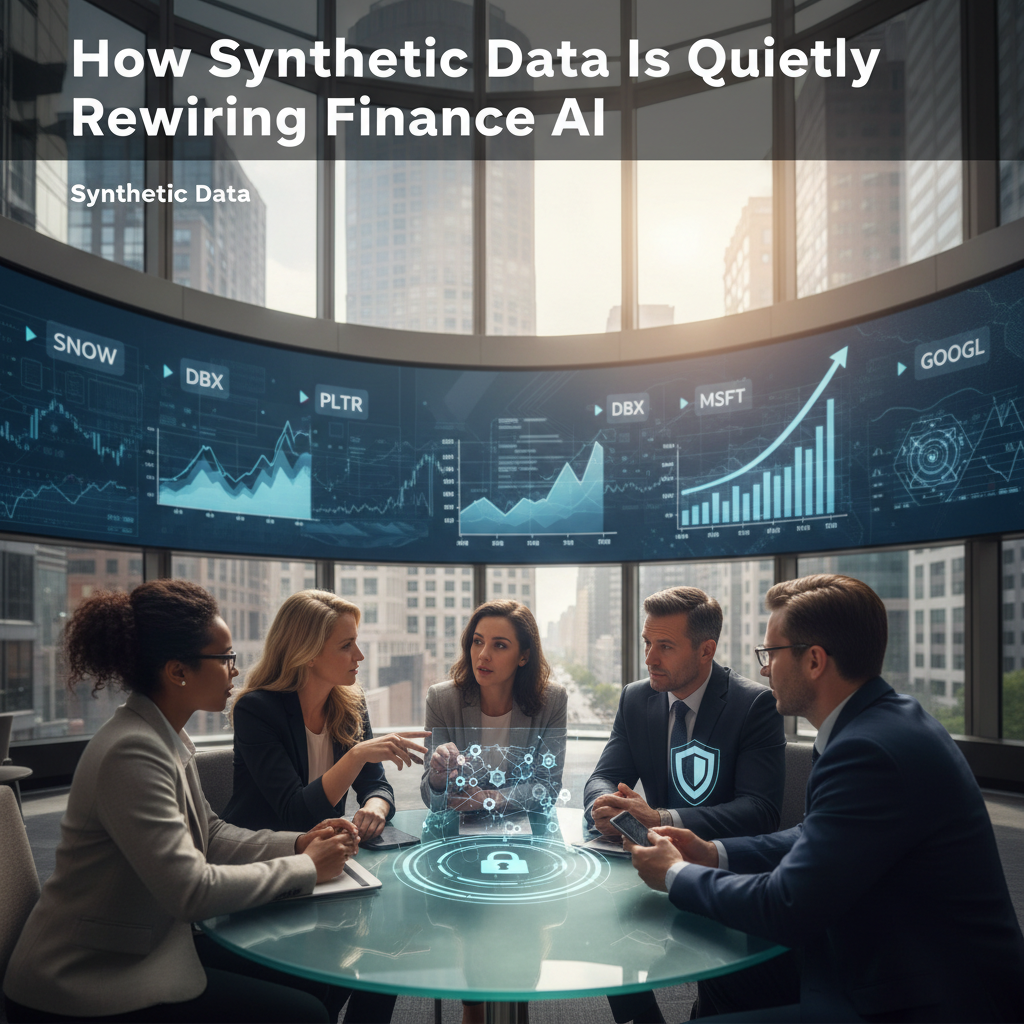
Snowflake and Databricks are natural hubs because they already live in banks’ stacks and offer governance controls. Palantir still matters for heavy integration and locked-down access. Big cloud and AI players are shipping toolkits and APIs for generating, validating, and cataloging synthetic assets.
For investors that follow the space, Snowflake, Databricks, Palantir, Microsoft, and Google are sensible bellwethers. Their platforms are the arteries through which synthetic experiments will scale — for better or worse.
Signals from the field
- Fraud teams commonly augment rare fraudulent trajectories with synthetic analogs to give detectors more signal. It helps reduce false negatives — but only when the generator is validated against held-out real cases.
- Credit modelers use synthetic consumers to stress-test lending algorithms across extreme macro scenarios without exposing borrower records.
- Fintechs partnering with clean-room vendors are enabling marketing and risk teams to collaborate while reducing leakage risk.
A pragmatic checklist for risk teams
- Validate synthetic generators against a protected holdout of real data you never used when building the synthetic set.
- Measure tail-event fidelity directly; track detection performance on rare classes, not just aggregate metrics.
- Use differential privacy or other provable protections when regulators demand formal guarantees.
- Keep humans in the loop — review newly generated edge cases before they affect production decisions.
Where this tends to land
Synthetic data is a useful tool, not a replacement for real-world validation. In regulated finance it speeds experiments and eases privacy friction — if firms treat it as a supplement and maintain strict controls. Watch how vendors and regulators converge on standards; that convergence will decide whether synthetic data becomes a genuine productivity booster or an industry blind spot.
Near-term signals to track
- Regulatory and industry standardization that defines acceptable fidelity and privacy tests.
- Better metrics for tail fidelity and adversarial robustness from vendors.
- Deeper partnerships between cloud/data platforms and synthetic specialists that bake governance into pipelines.
If you work on finance AI, pilot cautiously, measure extensively, and keep judgment close to the loop. Synthetic data can speed you up — but without those guards it can also speed you straight into trouble.