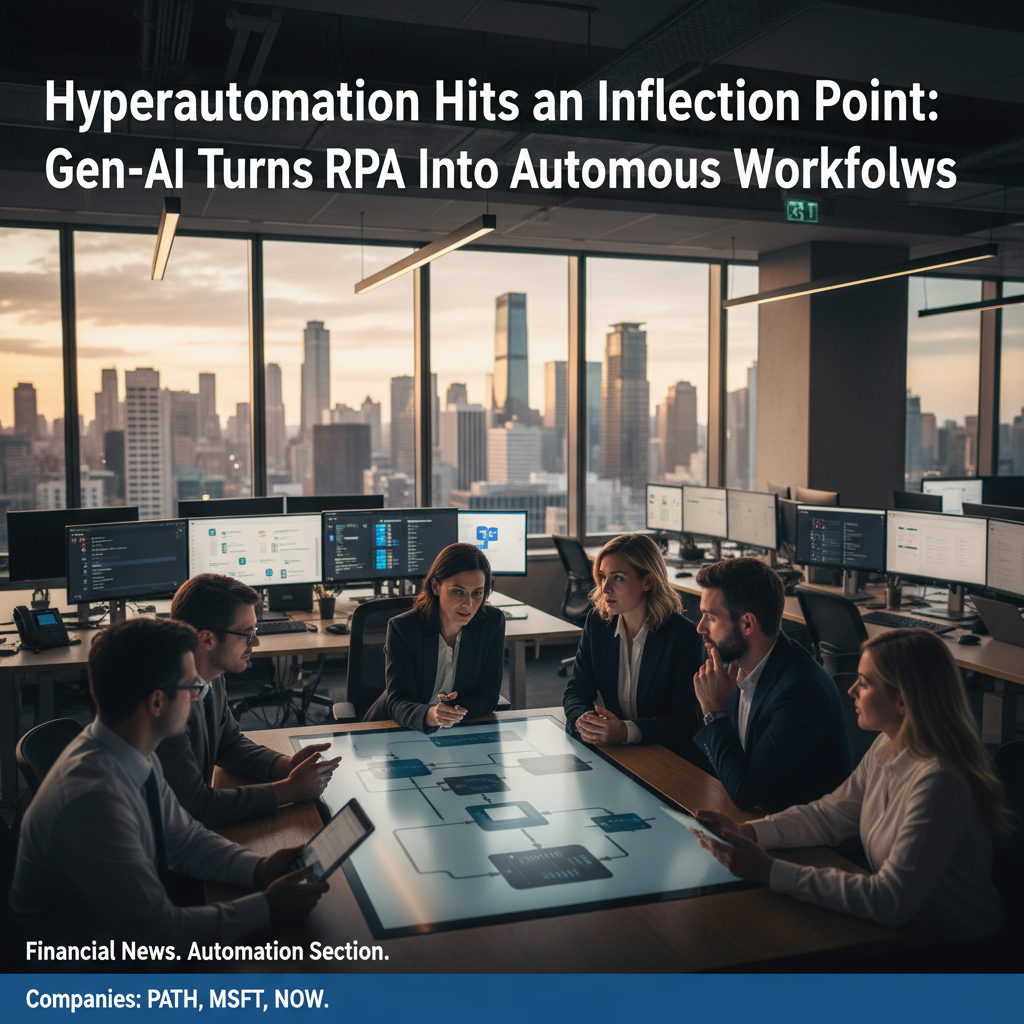
The mood in IT departments has shifted. For a long time Robotic Process Automation felt like glorified macros: handy for repetitive chores but brittle and expensive to babysit. Now large language models are creeping into orchestration layers, turning those macros into context-aware agents that can read an email, infer intent, and pick the next action without an engineer writing a rule for every contingency.
Why this matters now
- LLMs are better at messy inputs. Invoices, chats, contracts — the kind of noisy data that once needed bespoke parsers — are now tractable.
- Vendors are converging. UiPath, Microsoft Power Automate, ServiceNow and the like are bundling models with orchestration, which lowers the integration overhead.
- The ROI story is tangible. Early adopters report shorter cycle times and lower back-office cost when AI reduces exception volumes rather than merely speeding up the average case.
A short history, with a twist
RPA began as a tactical cost play: screen-scraping bots imitating clerks. Then came workflow engines and low-code tools that formalized processes. The twist now is that generative models let teams avoid rule-by-rule coding. Instead of enumerating every exception, you can train or prompt a model to handle edge cases — which turns fragile automations into much more resilient workflows. Of course, that resilience is probabilistic; it helps, but it isn’t a magic bullet.
Real implications — winners and warning signs
- For CIOs: this is as much governance as productivity. Smart automations need guardrails — model versioning, human-in-the-loop checkpoints, and clear audit trails.
- For workers: routine roles will contract. Hybrid jobs — operator plus automation curator — will grow. Reskilling budgets, not software licenses, become the real line item to watch.
- For vendors: consolidation seems likely. Platforms that combine model management, connectors, and observability will have the advantage. Niche point solutions could be absorbed or relegated to edges.
Concrete examples
- Accounts payable: rather than building rule trees for every invoice layout, an LLM pulls fields and flags ambiguous records, cutting reconciliation by days or weeks.
- Customer support triage: AI reads chat context, fills ticket fields, and suggests responses; human agents step in for the knotty escalations.
Counterpoints and risks
- Not every task should be handed to an autonomous model. High-stakes activities — regulatory reporting, legal judgments — still demand strict human oversight.
- There’s a real danger of technical debt. Adaptive models amplify garbage-in/garbage-out faster than rule-based bots ever did. Overpromising automation leads to brittle systems.
What to do this quarter
- Start small and safe: high-volume, low-risk processes such as invoice classification, basic HR onboarding, and support triage are good testbeds.
- Track exception rates, not just throughput. A falling exception rate is a better sign of genuine automation maturity than raw speed.
- Invest in people. Build hybrid roles that mix domain expertise with prompt design and process thinking; that’s where the day-to-day value lives.
The upshot: the push toward hyperautomation with generative AI is not a drop-in upgrade. It’s an architectural and organizational pivot. Companies that treat it as a governance and skills challenge, not merely a product purchase, will capture lasting value. Others will buy the promise and end up with a new class of brittle automation debt.
Pedro Marini