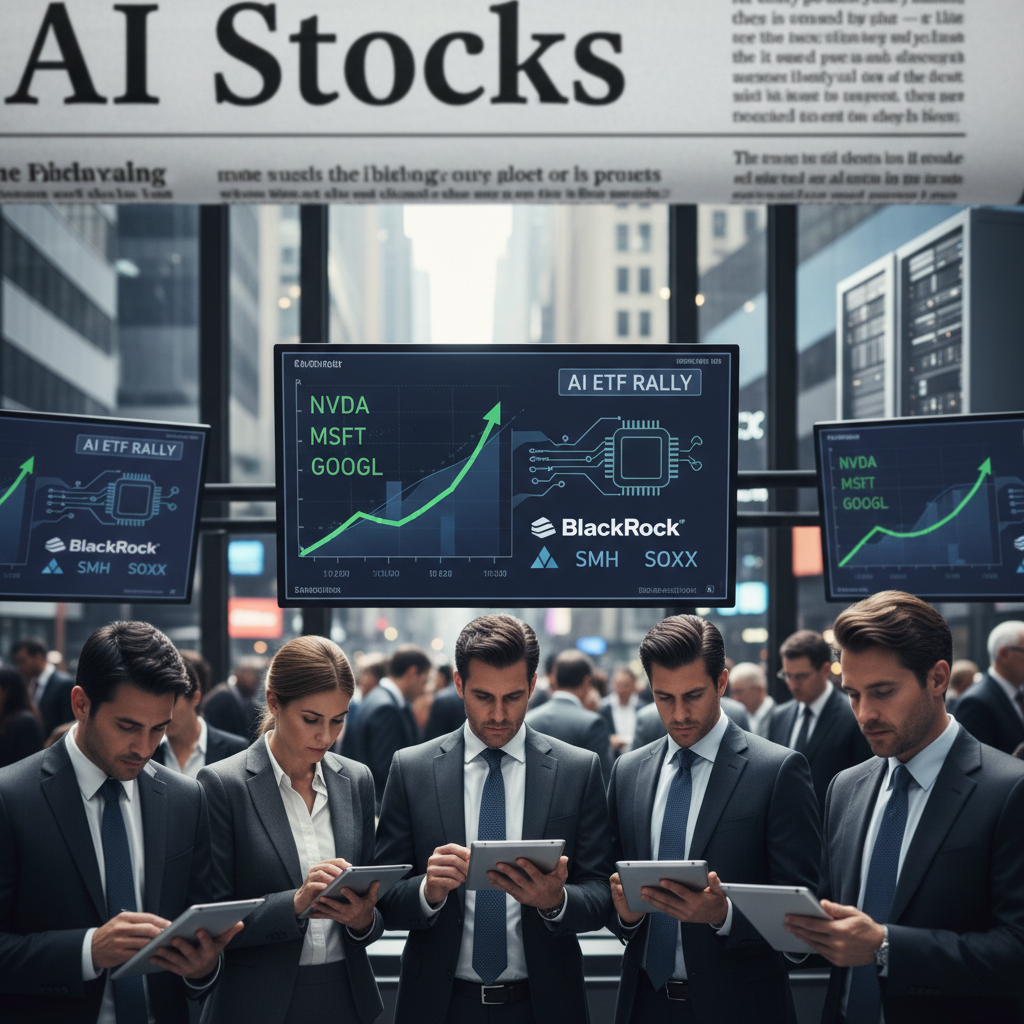
The story is familiar. A few names — Nvidia chief among them — lift an index, big ETFs gush cash, and headlines shorten the whole AI opportunity to a single chipmaker. That shorthand makes for tidy headlines. It’s also risky.
Right now
Retail and institutional money are pouring into AI-themed funds with a fervor that recalls late-1990s tech mania. Only this time the talk is about models, cloud GPUs and enterprise transformation, not browser plays. ETFs that focus on AI or semiconductors have seen large inflows, and new AI-labeled funds keep appearing. Momentum feeds itself: flows inflate a handful of big holdings, those holdings boost ETF performance, and that performance attracts still more flows.
Why concentration matters
- Many AI ETFs are top-heavy. Nvidia can be double-digit percent of a fund. When one stock drives most of the returns, buying the ETF looks a lot like making a single-stock bet.
- History is instructive. Around late 1999 the sector story masked huge fundamental dispersion; when sentiment reversed, even broadly held funds felt the pain because a few winners had carried the pack.
Beyond chips — the rest of the chain
AI growth is not only about GPUs. A more granular way to think about the theme:
- chips and hardware: GPUs, accelerators and foundry exposure;
- cloud and infrastructure: hyperscalers renting compute by the hour;
- AI software and enterprise tooling: model providers, MLOps platforms, vertical applications;
- data services and edge: firms supplying labeled data, sensors and real-time inference devices.
Each area has different cycles, regulatory exposures and margin dynamics. Tilt only to chips and you miss recurring-revenue models and the software-style rent extraction that often underpins durable winners.
What's interesting here is how differently these segments behave in downturns. Hardware is cyclical; software sticks around. That shift matters more than it first appears.
Regulatory and geopolitical tail risks
Export controls on advanced semiconductors, tougher AI safety rules, and procurement requirements for government work can quickly re-order winners and losers. This is not hypothetical — restrictions on chip exports to China and proposals for AI audits are already being discussed.
Practical implications for investors
- Check overlap. Many AI ETFs hold the same handful of giants; owning several funds can simply amplify single-stock risk.
- Mind fees and tax efficiency. Thematic funds often carry higher expense ratios and greater turnover than broad-market alternatives.
- Consider active managers. Skilled managers can sidestep bubbles within the theme and rotate across the value chain.
- Position sizing matters. Some allocators cap exposure to any single name or limit total AI-theme weight to a disciplined slice of the portfolio.
A quick allocation checklist
If you want exposure but not a one-supplier story, a simple split to think about (not a recommendation) is:
- 25% chips and infrastructure,
- 25% cloud platforms,
- 25% software and applications,
- 15% data and services,
- 10% thematic ETFs or active strategies.
It’s a rough starting point, nothing heroic — just a way to ensure you own different economic models.
An editorial note
AI is a generational shift; the excitement is warranted. But enthusiasm without examination turns structural opportunity into a momentum trap. Institutional-level due diligence is now relevant to retail investors too: look through ETF holdings, assess concentration, and ask which layer of the stack you actually own.
If past tech inflection points are any guide, long-term winners will pair durable business models and pricing power with direct customer access — not merely supply scarce components.
ETFs are an easy ticket into the story, but that fare can be overpriced when a single star carries the show. Diversify across the AI ecosystem, respect concentration risk, and treat this as a multi-act play rather than a single-hero narrative.