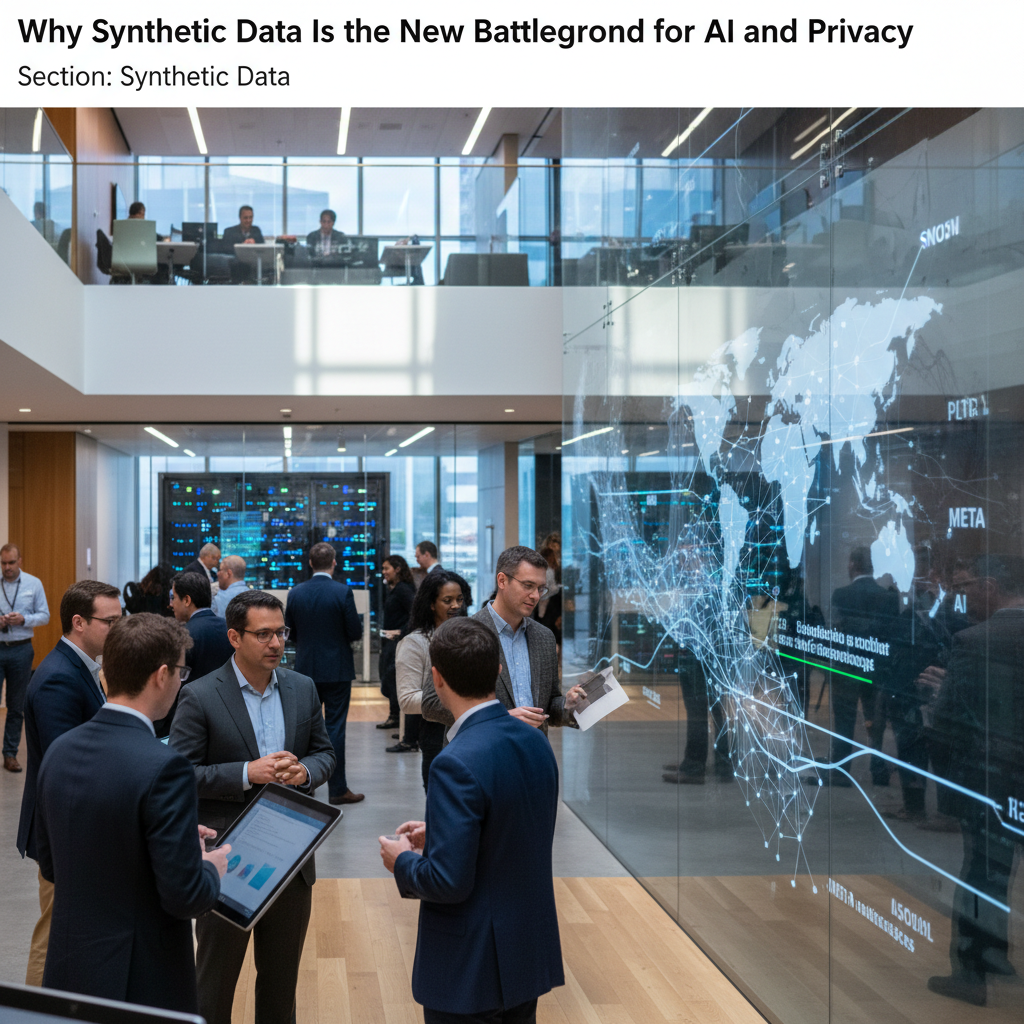
Synthetic data has stopped being an experiment — it’s become the quick route companies take when they need lots of privacy-safe training examples fast.
For U.S. firms building credit scorers, chatbots or fraud detectors, real customer records are irresistible and risky in equal measure. Synthetic datasets promise a fix: generated records that look and act like real users but contain no actual personal identifiers. The pitch is neat. The practice is messier.
Why firms are sprinting toward synthetic data now
- Speed and scale — you can spin up millions of realistic records without waiting through procurement cycles or pricey data-sharing contracts.
- Regulatory cover — when done right, synthetic data can ease HIPAA, GLBA and CCPA headaches.
- Easier collaboration — marketplaces and clean rooms from companies such as Snowflake and Palantir let teams exchange transformed or synthetic assets without exposing raw tables.
Convenience, however, is not a cure. There are real trade-offs.
Real risks hiding under the polish
- Fidelity gaps. Synthetic data can reproduce surface-level statistics but miss rare correlations that actually keep models working in production. A model trained on pretty averages can still blow up on edge cases.
- Regulatory ambiguity. Laws do not consistently treat synthetic data as a safe harbor; compliance teams will still want provenance, documentation and evidence that records are non-identifiable.
- Poisoning and drift. Generators inherit bias from their training inputs and can be manipulated by attackers. If your generator learns from biased or tampered data, you scale that problem fast.
A short historical note: the data-broker boom of the early 2010s taught companies that easier access to customer profiles speeds product development — and that regulatory and reputational costs often follow. Synthetic data feels like the next chapter: more control, but also fresh technical and governance complexity.
Who’s shaping the market — and why it matters
Startups such as MostlyAI, Gretel and Hazy focus on synthetic personal data. Enterprise vendors like Snowflake and Palantir push marketplaces, clean rooms and governed pipelines. Cloud providers increasingly tie synthetic generation into model training workflows. The upshot: it’s easier for teams to try synthetic data, but you also get more vendor lock-in and opinionated stacks that define what counts as good enough.
A practical checklist for executives and builders
- Validate provenance: require documented training sources and a clear transformation pipeline.
- Measure fidelity beyond averages: probe tail behavior, joint distributions and rare-event recall.
- Demand privacy metrics: k-anonymity, differential privacy guarantees or mutual-information bounds where they apply.
- Threat-model the generator: who can tamper with training data, and how would poisoned synthetic samples show up in predictions?
- Get legal sign-off: map specific synthetic use-cases to relevant regulations and have compliance approve the playbook.
A counterpoint worth keeping in mind
Some teams do best with hybrid approaches — small amounts of consented real data mixed with synthetic augmentation often outperforms going pure one way or the other. The right answer depends on product risk and how costly errors are downstream.
What matters in practice
Synthetic data is not a silver bullet. It is, though, a potent tool changing how American companies feed AI. Treat it like a programmable asset: instrument it, test it and govern it. Do that and you can get scale without ceding control. Ignore the new failure modes and the short-term wins will look expensive later.
Short tactical list for teams
- Run synthetic versus real A/Bs on the live prediction task.
- Include privacy metrics in your data SLAs.
- Rotate and re-evaluate generators periodically to avoid drift.
This is a moment for pragmatism: synthetic data can expand capability, but it does not buy absolution. Approach it with engineering rigor, not wishful thinking.